

Are you tired of studying the same material over and over again, only to forget it later? There’s a better way to learn! We want to introduce you to a powerful technique that can change your study habits.
This technique is called interleaving. It involves switching between different types of material or problems. This way, you can understand and remember better. We’re excited to share how interleaving can help you reach your learning goals.
Key Takeaways
- Discover the benefits of interleaving for effective learning.
- Learn how to apply interleaving to your study routine.
- Understand how interleaving can improve retention and deepen understanding.
- Explore practical tips for implementing interleaving in your daily study habits.
- Find out how interleaving can help you achieve your learning goals.
What Is Interleaving and Why Does It Matter?
Interleaving is a new way to learn and remember things. It means switching between different learning activities or topics after a short time. This usually happens after solving a few examples or problems.
Defining the Interleaving Technique
Interleaving mixes different types of material or problems to help you understand and remember better. Unlike traditional methods, where you focus on one topic at a time, interleaving makes you switch between many topics or skills.
For instance, when learning math, you might switch between solving algebra and geometry problems. This way, your brain gets to make connections between different concepts.
The Difference Between Blocked and Interleaved Practice
To see why interleaving works, let’s compare it with blocked practice. Blocked practice means practicing one skill or topic until you get it right before moving on. It might feel easier but can lead to poor long-term memory and trouble applying what you’ve learned.
Interleaved practice, on the other hand, mixes different skills or topics. Here are some main differences:
- Variety in Practice: Interleaving makes your study sessions more interesting and challenging.
- Improved Problem-Solving: Switching between different problems helps you figure out the right solution each time.
- Better Retention: Interleaving requires more effort, which can help you remember things better over time.
Why Traditional Study Methods Fall Short
Traditional study methods often use blocked practice. This means focusing on one topic until you feel you’ve mastered it. While it might help you pass a test, it has its limits:
- Lack of Depth: Blocked practice can lead to shallow learning, where you just memorize without understanding.
- Inability to Discriminate: Studying one topic at a time can make it hard to tell it apart from similar topics.
- Poor Transfer of Learning: Blocked practice can make it hard to use what you’ve learned in new situations.
By recognizing the flaws in traditional methods and using interleaving, you can improve your learning. Interleaving is more than just mixing up your study material. It helps you gain a deeper understanding of what you’re learning.
The Science Behind Interleaved Learning
Let’s explore the science behind interleaved learning. You’re about to learn how it boosts your learning by working with your brain.
Cognitive Psychology Research on Interleaving
Research in cognitive psychology shows interleaving is more than a study trick. It’s a way to work with our brains, not against them. Studies prove that interleaving leads to better retention and understanding than traditional methods.
A study in the Journal of Experimental Psychology: Learning, Memory, and Cognition found a big difference. Students who interleaved different math problems did much better on tests than those who practiced in blocks.
How Your Brain Processes Interleaved Information
So, how does our brain handle interleaved info? Interleaving makes us constantly switch contexts and recall info. This strengthens connections and boosts our ability to apply what we’ve learned.
Interleaving trains our brain to be more flexible and adaptable. It’s like training different muscle groups to improve overall performance.
The Role of Desirable Difficulties in Learning
The idea of “desirable difficulties” is key to understanding interleaving’s power. Cognitive psychologist Robert Bjork coined this term. It refers to challenges during learning that enhance long-term retention and understanding.
Interleaving makes learning harder in the short term. But this difficulty improves long-term memory encoding. This makes recalling and applying what we’ve learned easier when it counts.
Key Benefits of Using Interleaving for Study Sessions
Interleaving mixes different topics or skills in study sessions. It boosts learning outcomes in a big way. This method is more than just mixing things up. It’s a structured way to learn that offers several benefits.
Enhanced Long-Term Retention and Memory
One key benefit of interleaving is better long-term memory. It uses small doses of review for different topics. This way, you remember information for a long time, not just briefly.
Improved Problem-Solving and Critical Thinking Skills
Interleaving also sharpens problem-solving and critical thinking. By switching between different problems, you learn to apply your knowledge in new ways. This boosts your ability to think critically and solve problems.
Better Discrimination Between Similar Concepts
Another advantage is better learning between similar concepts. Interleaving helps you tell similar concepts apart. This reduces confusion and deepens your understanding of their differences.
Increased Transfer of Knowledge to New Situations
Interleaving also makes learning more transferable. By learning in different contexts, you’re ready for new challenges. This makes your learning more useful in real-life situations.
| Benefit | Description | Example |
|---|---|---|
| Enhanced Long-Term Retention | Interleaving helps retain information over the long term by reviewing material in a spaced-out manner. | Studying different historical periods in an interleaved manner helps remember key dates and events more effectively. |
| Improved Problem-Solving Skills | By switching between different problem types, interleaving enhances critical thinking and problem-solving abilities. | Interleaving different types of math problems (e.g., algebra, geometry) improves the ability to solve them accurately. |
| Better Discrimination Between Concepts | Interleaving helps distinguish between similar concepts by presenting them in a mixed order. | Learning different languages or programming languages through interleaving reduces confusion between similar syntax or vocabulary. |
In conclusion, interleaving brings many benefits to your study sessions. It improves retention, problem-solving, and the ability to apply what you’ve learned. By using this technique, you can enhance your learning experience.
How Interleaving Compares to Traditional Study Methods
Studying one topic at a time might not be the best way. Interleaving mixes different topics or skills in study sessions. This method is different from traditional study techniques. Knowing these differences can help you choose the best way to learn.
Interleaving vs. Blocked Practice
Blocked practice focuses on one topic until you think you’ve got it. But, research shows it doesn’t help keep information in your memory for long. Interleaving, by contrast, switches between topics or skills. It might be harder at first, but it helps you understand and apply different concepts better.
Interleaving is better because it helps you understand deeply. Switching topics makes you remember information better. This strengthens your understanding of the material.
Interleaving vs. Massed Practice
Massed practice means studying one subject a lot in a short time. It might help you learn quickly, but it can lead to burnout. Interleaving spreads out your study effort across different topics. This can make studying less tiring and more fun.
Interleaving is great because it’s flexible. You can mix topics in a way that keeps your study sessions interesting and challenging.
Combining Interleaving with Spaced Repetition
Using interleaving with spaced repetition makes a strong learning plan. Spaced repetition reviews material at longer intervals to help you remember it. By mixing topics and then reviewing them, you deepen your understanding and keep the information in your memory.
This mix is powerful because it uses the best of both methods. Interleaving helps you understand and apply different concepts. Spaced repetition prevents you from forgetting what you’ve learned.
Step 1: Identify the Subjects or Skills to Interleave
The first step in making an interleaving study plan is to pick the topics you want to mix. This step is key to a good study session. Think about how these topics relate and how mixing them can help you learn more.
Choosing Related but Distinct Topics
To make the most of cognitive interleaving, pick topics that are connected but different. This mix is important for learning. For example, mixing different math problems can boost your problem-solving skills.
- Find subjects that share a common theme or category.
- Choose topics with different ways to solve problems.
- Try mixing theory and practice in a subject.
Determining the Right Number of Subjects to Mix
The number of subjects to mix can vary, but usually ranges from 2 to 5. Too few subjects might not challenge you enough. Too many can confuse you. Try different mixes to see what works best for you.
“The art of interleaving is not just about mixing topics, but about creating a harmonious blend that enhances learning.”
Assessing Topic Compatibility for Interleaving
Not all topics are good for interleaving. You need to check if they work well together for effective study interleaving.
Selecting Topics with Similar Cognitive Demands
Topics that need similar thinking skills can be mixed well. For example, studying different historical periods can be interleaved because they need similar critical thinking.
Avoiding Topics That Are Too Similar or Too Different
Watch out for topics that are too alike or too different. They might not offer enough challenge or connection. Finding the right mix is key for good interleaving.
By choosing and mixing your study topics carefully, you can make a great interleaving study plan. This plan will improve your learning experience.
Step 2: Create Your Interleaved Study Schedule
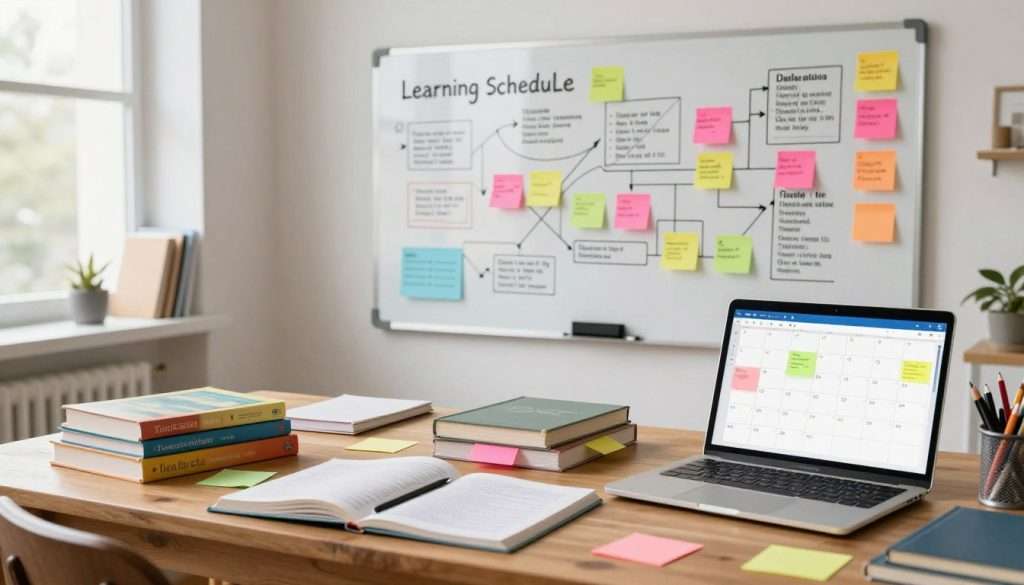
Creating a good study schedule is key to learning well. We’ll show you how to plan your study time, decide on session length and frequency, and assign time for each subject.
Planning Your Study Session Structure
First, figure out your study session structure. Decide how long each session will last and how often you’ll study.
Deciding on Session Length and Frequency
The length and frequency of your study sessions depend on your schedule and goals. For example, if you’re studying for a big exam, you might need to study more often.
Tip: Start with shorter sessions (45-60 minutes) and adjust as needed based on your focus and retention.
Allocating Time for Each Subject
When deciding how much time to give each subject, think about how hard it is and how well you understand it. Harder subjects might need more time.
For example: If you’re studying math and science together, give more time to the subject that’s harder for you.
Determining Time Blocks for Each Subject
Time blocking is a great way to manage your study schedule. By setting specific times for each subject, you can make progress in all areas.
Here’s a simple way to do time blocking:
- Find your most productive times of the day.
- Set specific times for each subject.
- Try to stick to your schedule as much as you can.
Building a Weekly Interleaved Schedule
Now, let’s create a sample weekly schedule. We’ll show examples for students and professionals to see how interleaving works in different situations.
Sample Weekly Schedule for Students
| Day | Time | Subject |
|---|---|---|
| Monday | 9:00 AM – 10:00 AM | Math |
| Monday | 10:00 AM – 11:00 AM | Science |
| Tuesday | 9:00 AM – 10:00 AM | History |
| Tuesday | 10:00 AM – 11:00 AM | Math |
Sample Weekly Schedule for Professionals
| Day | Time | Skill |
|---|---|---|
| Monday | 7:00 PM – 8:00 PM | Language |
| Tuesday | 7:00 PM – 8:00 PM | Programming |
| Wednesday | 7:00 PM – 8:00 PM | Data Analysis |
| Thursday | 7:00 PM – 8:00 PM | Language |
Step 3: Implement Interleaved Practice in Your Study Sessions
Let’s explore how to use interleaving in your studies. It’s a key step to make your study time better. With the right steps, you can get the most out of it.
Starting Your First Interleaved Session
To start interleaving, set up your study area well. Having the right study space is key. Make sure it’s tidy, free from distractions, and has everything you need.
Setting Up Your Study Environment
Make your study area great by cleaning it up and turning off distractions. Use tools like website blockers if you need to. A neat space helps you focus better.
Preparing Materials for Multiple Subjects
Get your materials ready before you start. Collect everything you need for your subjects, like books and notes. Organize them so you can easily switch between them.
Switching Between Topics Effectively
Switching between topics can be hard. It’s important to know when to switch and how to do it smoothly.
Recognizing When to Switch Subjects
Decide when to switch based on your goals and the material’s difficulty. You might switch after finishing a task or after a certain time.
Managing Mental Transitions
Use short breaks or quick reviews to help switch topics. This keeps your mind flowing and avoids getting too tired.
Maintaining Focus During Transitions
Staying focused during transitions is key. Try mindfulness or deep breathing to help you stay on track.
Tracking Your Progress and Adjusting as Needed
Keep track of how you’re doing and adjust your plan if needed. Use a journal or app to monitor your progress and see where you can improve.
By following these steps and staying consistent, you can make interleaved practice a big part of your studying. This will help you learn more effectively.
Applying Interleaving to Different Learning Contexts
Interleaving is great for many learning areas, like math, language, and professional skills. It helps learners from all walks of life and with various goals.
Interleaving for Mathematics and Problem-Solving
Interleaving is super useful for math and solving problems. It mixes different math problems to help learners find the right strategies.
Mixing Different Types of Math Problems
Instead of focusing on one math area, like algebra, learners mix different types. This way, they get a deeper grasp of math and improve their problem-solving.
Real-World Examples and Success Stories
Research shows interleaving helps in math studies. Students who mixed problem types did better on tests than those who didn’t. For example, a study found interleaving improved math test scores significantly.
Using Interleaving for Language Learning
Interleaving is also key for learning languages. It alternates between grammar, vocabulary, and conversation to balance learning.
Alternating Between Grammar, Vocabulary, and Conversation
For instance, a learner might switch between grammar, new words, and conversations. This method strengthens language skills and boosts proficiency.
| Language Learning Aspect | Interleaving Benefit |
|---|---|
| Grammar | Improved understanding of grammar rules through varied practice |
| Vocabulary | Enhanced retention of new words through contextual learning |
| Conversation | Better application of language skills in real-life scenarios |
Interleaving in Professional Skill Development
Interleaving isn’t just for school; it’s also for work. It boosts learning in technical and soft skills.
Applying Interleaving to Technical Skills
For tech skills, like coding, mixing topics improves skills. A coder might switch between languages or projects.
Using Interleaving for Soft Skills Training
Soft skills, like leadership, also benefit from interleaving. Mixing training activities enhances understanding and use of these skills.
Common Mistakes to Avoid When Using Interleaving
Interleaving can be tricky if you don’t do it right. It’s a powerful learning tool, but it needs to be used correctly. Let’s look at some common mistakes to steer clear of.

Switching Topics Too Frequently
Switching topics too fast is a common mistake. It can confuse you and make learning hard. It’s key to find a balance between variety and depth. For example, when studying different math problems, don’t jump between them without understanding each one well.
Interleaving Completely Unrelated Subjects
Interleaving means mixing topics, but they should be related. Interleaving unrelated subjects can spread your focus too thin. For instance, mixing advanced calculus with basic grammar might not be the best approach.
Giving Up Too Early Due to Initial Difficulty
Interleaving can be tough at first, if you’re used to studying in blocks. Feeling frustrated or unsure is normal when starting. But, it’s important to keep going and adjust to this new way of learning. The hard start is a sign you’re pushing yourself, which is good for learning.
Failing to Review and Reinforce Learning
Interleaving is not just about mixing topics; it’s also about reviewing what you’ve learned. Regular review sessions are crucial to keep your knowledge strong and prevent forgetting. Make sure to include review in your study plan to get the most from interleaving.
Knowing these common mistakes and avoiding them can help you get the most out of interleaving. The secret to successful interleaving is finding the right balance, staying consistent, and regularly reviewing what you’ve learned.
Advanced Strategies to Maximize the Interleaving Effect
Ready to take your learning to the next level? It’s time to explore advanced strategies that boost the interleaving effect. You’ve learned the basics of interleaving. Now, let’s refine your approach and make the most of this powerful technique.
Enhancing interleaving means combining it with other effective learning methods. Let’s explore some advanced strategies to optimize your study sessions.
Combining Cognitive Interleaving with Retrieval Practice
Combining interleaving with retrieval practice creates a powerful learning mix. Retrieval practice strengthens your memory by actively recalling information. Interleaving different problems or topics and then testing yourself reinforces your memory.
For example, studying for a math test? Interleave different problem types and use flashcards to quiz yourself. This mix of interleaving and retrieval practice can greatly improve your learning.
Using Spaced Interleaving for Long-Term Mastery
Spaced interleaving combines interleaving with spaced repetition for long-term mastery. It involves reviewing material over longer intervals.
To use spaced interleaving, create a study schedule that mixes topics and spaces out review sessions. For instance, mix historical periods one day and review them a week later, mixing them with other topics.
| Study Session | Topics Covered | Spacing Interval |
|---|---|---|
| Session 1 | History: Ancient Civilizations, Medieval Period | – |
| Session 2 | History: Renaissance, Modern Era (Review Ancient & Medieval) | 1 week |
| Session 3 | History: All periods (mixed review) | 2 weeks |
Adjusting Interleaving Intensity Based on Skill Level
The effectiveness of interleaving varies with your skill level. Beginners should start with gentle interleaving, increasing intensity as they get more comfortable.
For example, starting a new language? Begin with similar grammar rules or vocabulary themes. As you progress, increase the variety of topics, making your study sessions more challenging and effective.
Integrating Interleaving with Active Recall Techniques
Active recall engages with the material you’re learning, unlike passive reading. Integrating interleaving with active recall techniques, like summarizing or creating concept maps, enhances your learning.
For instance, after interleaving topics, create a concept map. This active engagement solidifies your understanding and promotes deeper learning.
Tools and Resources for Implementing Interleaved Learning
Let’s look at the tools and resources for better interleaved learning. You’ll need the right study materials and tools to get the most out of it.
Digital Apps That Support Interleaved Practice
Digital apps can really help with interleaved learning. Here are some top tools:
Anki and Flashcard Systems
Anki is a well-known flashcard app that uses spaced repetition for effective memorization. It lets you create different decks for subjects and mix them up. This helps you learn across various topics.
Key Features of Anki:
- Customizable flashcards
- Spaced repetition algorithm
- Support for images, audio, and more
Notion and Study Planning Tools
Notion is a workspace for planning your study sessions, making task lists, and tracking progress. It helps you set up a study plan that mixes different subjects. This ensures a balanced study routine.
“Notion’s flexibility makes it an ideal tool for creating a customized interleaving study plan.” – Productivity expert
Creating Physical Study Materials for Interleaving
Physical study materials are also key for interleaved learning. Here are some ideas:
- Create a binder with separate sections for different subjects
- Use flashcards to review key terms and concepts
- Develop a rotation schedule to interleave your study materials
Tracking and Analytics Tools to Measure Progress
To make interleaving work best, tracking your progress is crucial. Here are some tools for that:
| Tool | Features | Benefits |
|---|---|---|
| Toggl | Time tracking, reporting | Helps you understand how much time you spend on each subject |
| Forest | Productivity timer, focus-enhancing | Encourages focused study sessions |
| Notion | Task management, progress tracking | Allows you to monitor your study plan and adjust as needed |
By using these tools and resources, you can improve your interleaved learning and get better results.
Conclusion
We’ve looked into the powerful method of interleaving and how it can change your learning. Using interleaved practice in your studies can make you remember things better. It also helps you understand complex ideas more deeply.
Interleaving is not just a study trick. It’s a way to make your brain work harder and get a better grasp of tough topics. By using the tips from this article, you can make your study time more effective. This will help you learn more.
We suggest you try interleaving and see how it works for you. With regular practice and a flexible mindset, you can fully benefit from it. This will help you improve your learning skills.