

Do you ever feel like your brain is a sieve? You study for hours, only to forget everything by the time the test starts. Here is the good news: you do not need a perfect brain to succeed. You just need a better system.
Learning how to build a memory that lasts a lifetime is not about magic tricks. It is about using reliable habits for school, work, and even learning new languages. We will show you how to turn studying from a chore into a manageable, confident process.
We suggest using simple cues like highlighting key points and reviewing them often. While a memory palace is a fun tool, it should never replace actually reading your material. If you want to go deeper, my free book How to Become the Smartest Student in the Classroom gives you a full system. It covers study routines and strategies that actually stick. Grab your free copy here.
Key Takeaways
- Memory is a skill you can develop with a reliable system.
- Consistent review creates stronger mental cues for long-term recall.
- Highlighting is helpful, but active engagement with text is better.
- A memory palace is a supplement, not a replacement for deep reading.
- Transforming your study habits makes learning an enjoyable experience.
Why Some Memories Last and Others Fade
Our brains don’t store everything we see. They act as filters, deciding what’s worth keeping. To make long-lasting memories, you need to know how your mind picks what to remember. It’s not about being smart; it’s about using the right memory formation strategies to mark important data.
How attention determines what the brain stores
Attention is key. If you’re not focused, your brain ignores what you’re seeing or hearing. Think of your attention as a spotlight in a dark room. Only what the light touches gets processed.
If the light misses the information, it’s not stored in your memory. You must focus on what you want to remember to ensure it’s processed.
The role of meaning, emotion, and personal relevance
Once you’re focused, you need to make the information meaningful. Facts that connect to your life or evoke strong emotions stick. They’re like Velcro, attaching to what you already know or feel.
When you link a dull topic to your life, you create strong hooks. These hooks help you recall information later.
Short-term memory, working memory, and long-term memory
Think of your memory in three stages. First, there’s short-term memory, like a quick glance at a phone number. Then, there’s working memory, your mental workspace for solving problems.
Lastly, there’s long-term memory, your permanent library. The goal is to move information from your temporary workspace to your permanent library.
| Memory Type | Function | Duration |
|---|---|---|
| Short-term | Initial sensory input | Seconds |
| Working | Active processing | Minutes |
| Long-term | Permanent storage | Indefinite |
Why forgetting is part of effective learning
Many think forgetting is a failure, but it’s normal. When you forget something, your brain is working hard to rebuild that memory path. This effort makes your knowledge stronger over time.
Instead of getting frustrated, see forgetting as a sign to review again. By revisiting information as it fades, you strengthen those long-lasting memories for the future.
How to Build a Memory That Lasts a Lifetime
To create a lasting memory, first decide what you want to remember. Many of us try to learn everything from textbooks. That’s a sure way to burn out. Instead, choose carefully what to learn.
Set a specific memory-building goal
Setting clear goals is key. Instead of saying “I want to learn biology,” aim for something specific like “I want to recall the five stages of mitosis by Friday.” Clear goals guide your brain and help you focus.
Choose information worth remembering
Not every sentence is important. Use quizzes or summaries to find the key concepts. This way, you focus on what really matters, saving time and energy.
Use an active system instead of relying on repetition alone
Simple repetition won’t work. You need effective memory-building techniques that challenge your brain. An active system makes learning a structured process, not a guessing game.
Record what you want to remember
Keep a daily planner or digital log of important facts. Writing things down frees up your mind for deeper thinking. Seeing your goals in writing helps you stay on track.
Decide when and how you will retrieve it
Don’t just study; plan when you’ll review what you’ve learned. Whether it’s during your morning coffee or a dedicated hour on Sunday, regular review is key. Consistency beats intensity every single time.
Track progress without judging normal forgetting
Forgetting is normal, not a failure. Use a simple tracking method to see what sticks and what needs more practice. If you forget something, just adjust your plan and try again.
“Memory is the treasury and guardian of all things.”
| Habit Type | Method | Result |
|---|---|---|
| Passive | Rereading notes | Low retention |
| Active | Self-testing | High retention |
| Strategic | Spaced review | Long-term mastery |
Step One: Prepare Your Brain for Stronger Memory Formation
Your brain is like a high-performance engine. It needs the right fuel and a clear path to work well. To master new skills, you must clear your mental space first. Using memory formation strategies early helps your brain capture and store information better.
Remove distractions before learning
Your attention is limited, and distractions take away from it. Turn off your phone and clear your space before learning. In lectures, sit up front to avoid distractions and keep your focus on the board.
Break large subjects into manageable chunks
Trying to learn too much at once can burn you out. Break down big topics into smaller, easier pieces. This helps avoid feeling overwhelmed and gives you clear goals for your study sessions.
Connect new information to what you already know
Your brain likes patterns and what it already knows. When learning something new, try to link it to something familiar. This makes it easier to remember later.
Use focused study sessions with clear stopping points
Study in short, focused sessions, like mini-missions. Set a timer to keep your mind sharp. When it goes off, take a break to let your brain rest.
| Feature | Distracted Learning | Prepared Learning |
|---|---|---|
| Focus Level | Fragmented and shallow | Deep and sustained |
| Retention Rate | Low due to interference | High due to clarity |
| Mental Energy | Rapidly depleted | Conserved for complex tasks |
| Outcome | Frustration and fatigue | Confidence and mastery |
By using these memory formation strategies, you turn studying into a reliable system. Preparation is key to success, starting with how you treat your brain before learning.
Step Two: Encode Information So It Becomes Memorable
Now that you’ve prepared your brain, it’s time to make information stick. Encoding turns facts into mental structures your brain loves. Instead of just repeating, use mnemonic devices for memory to make it fun and effective.
Turn abstract ideas into vivid images
Our brains remember pictures better than text. When you meet an abstract concept, see it as a real object or scene. For example, think of supply and demand as a seesaw in a park.
The more vivid and colorful your mental image, the easier it is to recall.
Build stories that connect unrelated details
Stories link information together. You can turn random facts into a short story. One person remembered twenty words by imagining them in a silly adventure.
This method uses mnemonic devices for memory without feeling like studying.
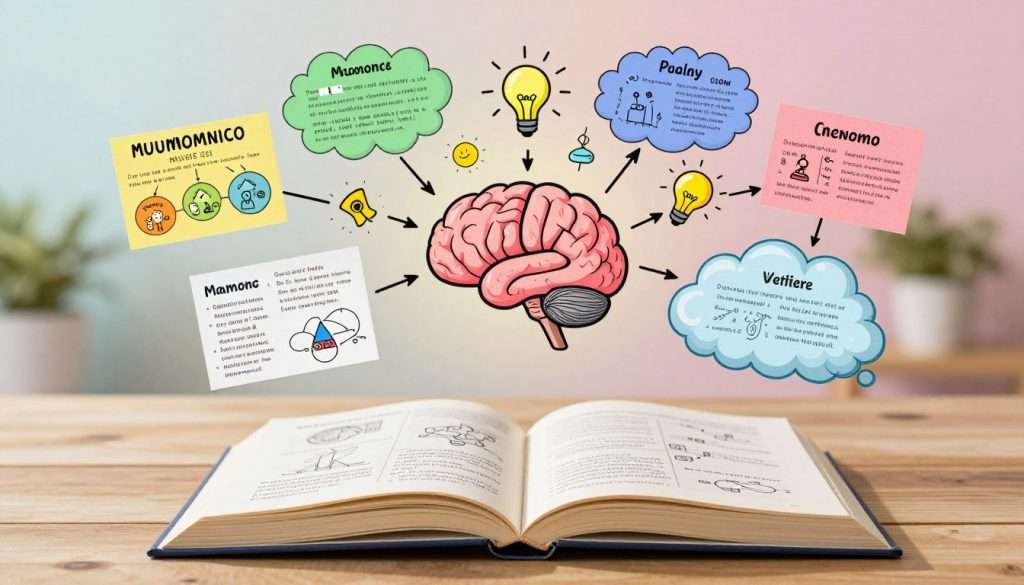
Use elaboration to explain why each fact matters
Elaboration asks “why” or “how” a fact works. Explain it in your own words, like teaching a friend. This deep processing creates stronger neural connections, making it hard to forget.
Apply the dual-coding method with words and visuals
Dual-coding combines verbal and visual cues. It engages two brain parts, doubling your success chances.
Create simple diagrams for processes and relationships
You don’t need to be an artist to sketch. Simple diagrams clarify how ideas relate. They act as a visual map for your thoughts.
Use concrete examples instead of copying definitions
Definitions are often cold. Use real-world examples instead. For biology, think about how a process works in your body or pet.
| Technique | Best Used For | Primary Benefit |
|---|---|---|
| Visualization | Abstract concepts | Creates mental hooks |
| Storytelling | Lists and sequences | Adds emotional context |
| Elaboration | Complex theories | Deepens understanding |
| Dual-Coding | Processes | Engages multiple senses |
Test whether you understood the material before moving on
Before closing your book, do a quick check. Try to explain the main idea out loud. If you struggle, you’re not ready to move on yet. Mastering mnemonic devices for memory is about quality, not speed.
Step Three: Use Mnemonic Devices for Memory
Playing a game with your mind can help you remember things better. Mnemonic devices for memory turn boring facts into memorable images. These images are hard to forget.
These memory-building techniques act like mental hooks. They catch information before it slips away. The trick is to choose a tool that fits the type of data you’re trying to learn.
Choose the mnemonic that matches the information
Not every trick works for every task. A simple word trick might be perfect for a list. But for a long sequence, you might need a spatial map.
Build acronyms and acrostics for ordered lists
For lists, try turning the first letters into a word or sentence. For example, “ROYGBIV” helps you remember the seven colors of the rainbow.
You can also link these cues to locations in your mind. It’s a fun way to organize chaos into a neat structure.
Use the method of loci to remember sequences
The method of loci, or the “memory palace,” is powerful. You can use a real route, a fictional building, or a video-game map as your palace.
Keep your locations consistent. Start with a familiar structure. Avoid changing the objects in each room too often.
Apply the peg-word system to numbered information
The peg-word system is great for remembering items in order. You associate each number with a rhyming word, like “one is a bun” or “two is a shoe.”
Then, create a mental image of the item you need to remember with that peg. It makes numbers feel concrete and easy to visualize.
Use names, faces, and associations in everyday conversations
Meeting new people can be stressful, but you can master names with simple habits. These memory-building techniques help you remember people easily.
Repeat a person’s name naturally
When you first hear a name, say it back during the conversation. Using the name in a sentence helps lock it into your memory.
Attach the name to a distinctive visual feature
Look for a unique trait, like a bright scarf or a specific smile, and link it to the name. Visual associations are incredibly sticky for the human brain.
Avoid mnemonics that are more complicated than the material
Remember, the goal is to simplify your learning process. If you spend more time building a complex memory palace than actually learning the subject, you have gone too far.
Your mnemonic devices for memory should be a shortcut, not a second subject to study. Keep it simple, keep it playful, and watch your recall improve.
Step Four: Strengthen Long-Term Memory With Retrieval and Spacing
Make your brain a vault by mastering retrieval and spacing. Study time should be like a workout, not just a library visit. To strengthen long-term memory, your brain needs to work hard to remember information, not just glance at it.
Replace passive rereading with active recall
Rereading notes might seem helpful, but it’s often a trap. Your brain gets used to the words and tricks you into thinking you know the topic. Instead, close your book and try to explain the concept out loud.
Ask questions before checking the answer
Stop before looking at your notes or flashcards. Ask yourself a specific question about the material and try to answer it first. This simple change is the best way to enhance memory recall because it creates a mental hook for the information.

Use spaced repetition to improve memory retention
Spaced repetition is key to keeping facts fresh. By spreading out your reviews, you fight the brain’s tendency to forget unused data.
Review new material on the same day
The best time to review is shortly after learning the material. A quick recap at the end of the day helps solidify the connections you’ve made.
Schedule follow-up reviews over increasing intervals
Don’t review everything daily. Instead, wait a day, then three days, then a week. This makes your brain work harder to recall the information.
Extend the interval when recall becomes easy
If you can recall a fact easily, push the next review date further out. If you know it well, you don’t need to review it tomorrow.
Mix related topics to improve flexible memory recall
Don’t study one subject for hours. Mixing related topics trains your brain to distinguish between similar concepts. This makes your knowledge more flexible and easier to apply in real-world situations.
Use flashcards correctly without memorizing familiar cues
Flashcards are powerful, but they can become crutches. If you always see the same image or color on the back of a card, you might be memorizing the card rather than the fact. Change your prompts often to ensure you are actually learning the content.
“Memory is the residue of thought.”
Keep an error log for facts you repeatedly forget
We all have those stubborn facts that just won’t stick. Keep a small list of these items and review them more frequently. For a fun challenge, try to visit ten memory-palace locations in just eighteen seconds; treat this speed as a way to sharpen your focus rather than a test of perfection.
Step Five: Support Memory With Sleep, Movement, and Stress Control
Your brain is like a high-performance engine. It needs the right fuel and care to work well. Study techniques are important, but your body’s health is the base for learning. To improve memory retention, treat your body as well as your study materials.
Protect sleep before and after demanding learning
Sleep is crucial, not just for rest. It’s when your brain saves new info. A good night’s sleep before studying sharpens your focus. Never underestimate the power of a good night’s sleep after learning, as it solidifies memories and clears mental clutter.
Use regular physical activity to support brain health
Exercise boosts blood flow to the brain, delivering oxygen and nutrients. You don’t need to run marathons. Even a short walk or bike ride can improve mood and focus.
Manage stress that interferes with attention and recall
High stress blocks your ability to store and recall info. Keeping stress low lets your brain thrive. It’s like having a backup plan, reducing anxiety.
Use slow breathing before a study session
Before studying, take a few deep breaths. This signals your nervous system to focus. It’s a simple yet effective memory enhancement tip that clears mental fog.
Take brief movement breaks during focused work
Sitting for hours can make you tired and unfocused. Stand up, stretch, or walk around every hour. These breaks refresh your brain, keeping you focused all day.
Eat and hydrate consistently without chasing miracle supplements
Your brain works best on healthy, steady food, not expensive supplements. Eat balanced meals and drink water all day. Hydration is a simple way to keep your mind sharp.
Recognize when persistent memory problems require medical advice
Forgetfulness is normal, but persistent issues are not. If your memory keeps failing, see a doctor. These memory enhancement tips support a healthy brain, but medical care is needed for serious issues.
Step Six: Turn Knowledge Into Long-Lasting Memories Through Use
To create long-lasting memories, treat your brain like a workshop, not a storage locker. Information stays with you only when you use it in real life. This makes it permanent.
Explain the material without looking at your notes
Testing your knowledge is easy: just explain it out loud without notes. Relying on notes means you’re just recognizing, not recalling. Speaking aloud shows where you need to study more.
Teach a concept to another person
Teaching is the best way to know you understand something. When you explain a complex idea, you simplify it. If you struggle, you know what to study more.
Practice skills in realistic situations
Theory is good, but practical application makes a skill stick. Use new skills in real projects that matter to you. This makes your brain keep the information better.
Connect learning to work, hobbies, and daily decisions
Your brain likes patterns and relevance. Link new facts to your hobbies or work. This makes the information harder to forget. Using a concept in daily life strengthens long-lasting memories.
Write brief reflections that reinforce personal meaning
Write a short reflection on what you learned each day. Connect it to your goals or experiences. This helps your brain see it as important, not disposable.
Revisit important memories without allowing nostalgia to replace accuracy
When recalling past knowledge, keep facts straight. Use a “mental palace” to store information. But make sure each spot is tied to a clear, objective action. This keeps your recall sharp and prevents mixing up stories with facts.
| Learning Method | Memory Impact | Effort Level |
|---|---|---|
| Passive Rereading | Low | Low |
| Active Teaching | High | High |
| Real-World Application | Very High | High |
| Reflective Writing | Medium-High | Medium |
By becoming an active learner, your knowledge turns into long-lasting memories. Keep testing, teaching, and applying what you know. This way, your knowledge will stay with you forever.
Step Seven: Build a Memory Routine You Can Maintain
You have all the tools now, so let’s weave them into a rhythm that actually fits your busy life. Building a sustainable habit is the final piece of the puzzle for anyone serious about mastering new information.
Create a weekly memory practice schedule
Start by blocking out specific times in your calendar for learning. Treat these sessions like important appointments you cannot miss. By setting a consistent weekly schedule, you remove the guesswork and make progress a natural part of your routine.
Combine encoding, mnemonic devices, retrieval, and spaced reviews
A great routine isn’t just about reading; it is about active engagement. You should mix your vivid encoding techniques with quick mnemonic devices to make facts stick. When you use these methods together, you significantly enhance memory recall and keep your brain sharp.
Measure recall rather than time spent studying
Stop watching the clock and start watching your results. It is far better to recall five facts in ten minutes than to stare at a book for two hours without retaining anything. Focus on what you can actually explain or retrieve from your own mind.
Adjust the system for school, work, languages, and personal experiences
Your system should be flexible enough to handle different types of information. Whether you are learning a new language or prepping for a big work presentation, adapt your approach to fit the task. Personalizing your strategy ensures that you stay motivated regardless of the subject matter.
Troubleshoot common obstacles to memory improvement
Even the best plans hit a few bumps in the road. When you run into trouble, don’t get discouraged; just adjust your tactics.
When you keep forgetting names
Try linking the person’s name to a vivid image or a funny rhyme immediately upon meeting them. This simple trick creates a stronger mental hook.
When you remember recognition but not recall
If you recognize information but can’t explain it, you are likely relying on passive review. Switch to active recall by closing your notes and forcing your brain to produce the answer from scratch.
When your review schedule becomes overwhelming
If your list of things to review feels too long, prioritize the most difficult items. It is okay to slow down and focus on quality over quantity.
Use a simple monthly review to strengthen long-term memory
Once a month, take a step back to look at the big picture. This helps you strengthen long-term memory by connecting older concepts to what you are learning today. Use the table below to track your progress and keep your goals clear.
| Memory Strategy | Primary Benefit | Frequency |
|---|---|---|
| Active Recall | Boosts retention | Daily |
| Spaced Review | Prevents forgetting | Weekly |
| Monthly Audit | Ensures mastery | Monthly |
Conclusion
Creating lasting memories isn’t about magic tricks or having a perfect memory. It’s about paying attention, making information meaningful, and using retrieval and spacing wisely. Adding sleep and exercise to your routine makes learning a natural part of your day.
A memory palace can help organize complex facts, but it’s not a replacement for effort. Tools should aid your understanding, not do the work for you. Begin with a simple routine. A short practice session followed by a review can make a big difference in how you remember things.
If you’re interested in learning more, check out my free book, “How to Become the Smartest Student in the Classroom.” It offers memory techniques, study routines, and strategies that really work. There’s no cost and no catch. Get your free copy here at https://www.studyingmachine.com/free-books/ and start building your knowledge today.