

We’ve all been there, staring at a pile of notes at 2:00 AM, trying to cram information into our brains. It feels like a race against time, but real knowledge doesn’t stick when you rush. True mastery comes from using effective study methods that make every minute count.
Instead of just reading, we focus on active learning. By questioning, teaching, and reflecting, you build a stronger memory. These cognitive enhancement tips make studying smooth and rewarding. We’ll explore five simple shifts to improve how your brain absorbs information.
If you want to dive deeper, my free book How to Become the Smartest Student in the Classroom offers a full system. It includes memory techniques and routines that stick. Get your free copy here.
Key Takeaways
- Stop cramming and start using active recall to boost long-term retention.
- Teaching concepts to others is one of the best ways to solidify your own understanding.
- Focus on quality study sessions rather than just the number of hours spent at your desk.
- Reflection helps you identify gaps in your knowledge before they become problems.
- Small, consistent changes in your routine lead to massive improvements in academic performance.
What It Really Means to Learn Faster
True speed learning isn’t about rushing. It’s about understanding deeply. Many think finishing a book fast means they’ve learned it. But, real accelerated learning is when you grasp things much quicker than expected.
Define Speed Learning Without Sacrificing Understanding
We aim to help you learn knowledge that lasts. It’s not about skimming or memorizing facts that fade away. Instead, it’s about creating a mental structure to grasp complex ideas fast and keep them long-term.
Separate Short-Term Memorization From Durable Learning
There’s a big difference between cramming and learning a skill. Short-term memorization is like writing on a whiteboard; it’s easy but erases quickly. Durable learning, on the other hand, is like carving into stone. It lets you recall, explain, and apply what you know in new situations.
Use the Four-Part Learning Cycle: Focus, Encode, Retrieve, and Apply
To improve your study sessions, follow a simple four-part cycle. First, Focus on the task. Then, Encode the information by linking it to what you already know. Next, Retrieve that information from memory. Lastly, Apply it to solve real problems.
“Learning is not attained by chance, it must be sought for with ardor and attended to with diligence.”
Why Effortful Practice Produces Better Results Than Passive Review
Passive review, like re-reading notes, might seem productive but is often a waste. Effortful practice makes your brain work harder, building stronger connections. Struggling to recall answers actually strengthens your memory.
How to Measure Progress Beyond Hours Spent Studying
Stop counting study hours. Instead, measure progress by how well you can explain concepts or solve problems without notes. The table below shows how to focus on mastery over time.
| Metric | Passive Approach | Active Approach |
|---|---|---|
| Primary Goal | Time spent | Skill mastery |
| Memory Style | Short-term | Durable recall |
| Evaluation | Hours logged | Problem accuracy |
| Outcome | Familiarity | Independence |
If this article resonated with you, my free book How to Become the Smartest Student in the Classroom offers a full system. It includes memory techniques, study routines, and strategies that stick. No cost, no catch. Get your free copy here.
How to Learn Faster: 5 Proven Strategies That Actually Work
Learning doesn’t have to be slow. To learn faster, treat your brain like a muscle that needs exercise.
Use Active Recall to Strengthen Memory
Turn Notes Into Questions Before Reviewing Them
Change your notes into questions. This makes your brain work harder to find answers.
Practice Recalling Information Without Looking at the Answer
Try explaining what you’ve learned out loud. If you can’t, you need more practice.
Use Blank-Page Recall, Flashcards, and Practice Tests
Write down everything you remember about a topic. Tools like the Leitner flashcard system are great for memory.
Correct Mistakes Immediately and Explain the Right Answer
When you’re wrong, explain why the right answer is correct. This helps you remember better.
Space Out Review Sessions for Long-Term Retention
Replace Cramming With a Calendar-Based Review Schedule
Don’t cram. Use a schedule to review material at the right times.
Review Material Just Before You Are Likely to Forget It
Test yourself when you’re about to forget. This is key for learning well.
Adjust Review Intervals Based on Difficulty and Accuracy
Make review sessions harder for easy topics and easier for tough ones.
Combine Spaced Repetition With Active Recall
Using both spaced repetition and active recall makes learning more effective.
Break Complex Ideas Into Chunks and Connect Them
Identify the Core Concepts Before Memorizing Details
Focus on the main idea first. Then, add details to it.
Group Related Facts Into Meaningful Patterns
Our brains love patterns. Grouping facts helps you remember them faster.
Use Analogies, Examples, and Visual Representations
Explain complex ideas simply. If you can’t, you need to understand it better.
Build From Simple Components to Complete Skills
Learn the basics first. You can’t build a house without a solid foundation.
Interleave Practice to Improve Flexible Thinking
Mix Related Problems Instead of Repeating One Type
Don’t do the same problem over and over. Mix it up to challenge yourself.
Switch Between Concepts While Preserving a Clear Learning Goal
Keep your goal in mind but switch topics often. This keeps your brain sharp.
Use Interleaving for Mathematics, Languages, Music, and Sports
Interleaving works for many subjects. It keeps your skills sharp and adaptable.
Recognize When Struggle Signals Productive Practice
Struggling is a sign you’re learning. It means you’re growing.
Protect Deep Focus and Use Fast Feedback
Remove Notifications and Other Sources of Distraction
Your phone can distract you. Put it away to focus better.
Work in Focused Blocks With Specific Outcomes
Work in focused blocks. Know what you want to achieve before starting.
Seek Feedback From Practice Tests, Instructors, or Skilled Peers
Get feedback to know if you’re on the right track. Use practice tests for immediate feedback.
Use Errors to Choose the Next Practice Task
Use mistakes to guide your next study session. They show where you need to improve.
If you liked this article, check out my free book How to Become the Smartest Student in the Classroom. It has memory techniques, study routines, and strategies that really work. No cost, no catch. Get your free copy here.
Build a Study Session Around Retrieval and Application
Make your study time more effective with a simple, repeatable structure. Many students struggle because they lack a clear rhythm. But, you can master speed learning by following a consistent path every time you study.
Set One Precise Learning Objective
Before you start, decide exactly what you want to achieve. Instead of saying “I will study biology,” aim for “I will understand how photosynthesis converts light into energy.” This focus keeps your brain sharp and prevents you from wandering off-track.
Preview the Material to Create a Mental Framework
Think of this as building a skeleton before adding the muscle. Spend a few minutes scanning headings, bold terms, and images to see the big picture. This simple habit creates a mental map that makes the details much easier to absorb later.
Study Briefly Before Closing the Book and Recalling
Don’t fall into the trap of reading for hours without stopping. Read a small section, then close the book and force your brain to retrieve the information from scratch. This is one of the most effective quick learning methods because it forces your neurons to fire and strengthen those memory pathways.
Apply the Concept Through Problems, Projects, or Explanations
Knowledge is only useful when you can put it to work. Whether you solve a practice problem or build a small project, applying what you learned cements the information in your mind. If you want to go deeper into these techniques, my free book How to Become the Smartest Student in the Classroom gives you a full system for mastering any subject. You can grab your free copy here.
Use the “Explain It Simply” Test to Find Knowledge Gaps
If you want to know if you truly understand a topic, try to explain it to a friend or even an imaginary audience. If you stumble or use jargon to hide your confusion, you have found a knowledge gap. This test is a brilliant way to see exactly where your understanding breaks down, allowing you to fix it immediately.
Choose the Right Learning Method for the Material
Are you using the best effective study methods for your goals? Many students pick a method because it feels right or looks good. But, true mastery comes from matching your strategy to your goals.

Use Practice Problems for Quantitative and Technical Subjects
For math, physics, or coding, just reading the book isn’t enough. You need to solve active problem-solving exercises. This way, you apply formulas, not just recognize them.
Use Speaking and Writing Practice for Languages
Learning a new language is all about performance. To speak well, practice speaking out loud, even if it feels awkward. Writing in your target language also helps you use vocabulary in real conversations.
Use Demonstration and Deliberate Repetition for Physical Skills
For skills like playing an instrument or sports, muscle memory is key. Watch a demonstration, then practice with deliberate focus. Break the skill into small parts to improve your technique.
Use Comparison and Argument Mapping for Complex Ideas
Abstract concepts can be overwhelming. Use argument maps or comparison charts to see how ideas connect. This helps you understand the big picture and find gaps in your knowledge.
Match the Method to the Type of Performance You Need
Your study routine should match the final test or real-world use. Practice explaining concepts to others if you need to. Simulate the task environment if you need to perform it.
“The secret to mastery is not just effort, but the alignment of your practice with the reality of the task.”
If this article struck a chord, check out my free book How to Become the Smartest Student in the Classroom. It offers memory techniques, study routines, and strategies that work. No cost, no catch. Get your free copy here → https://www.studyingmachine.com/free-books/.
Accelerate Skill Acquisition With Deliberate Practice
True mastery isn’t about how many hours you log, but how you spend those minutes. To achieve accelerated skill acquisition, treat practice as a focused effort. Target one specific weakness at a time.
Identify the Smallest Skill That Needs Improvement
Don’t try to learn an entire subject at once. Break your goal down into the smallest possible components. This makes it easier to measure progress and stay motivated.
Practice at the Edge of Your Current Ability
Growth happens when you push just beyond what you find comfortable. If a task feels easy, you are likely just maintaining your current level rather than improving. Use cognitive enhancement tips, like taking a brisk walk, to stay focused.
Repeat Weak Areas Instead of Repeating What Feels Easy
It’s tempting to stick with what you’re good at. But real progress hides in the areas where you struggle. Spend your study time on the parts that make you stumble.
Track Accuracy, Speed, and Independence Over Time
You cannot improve what you do not measure. Keep a simple log of your performance. This data-driven approach turns learning into a game you can win.
Increase Difficulty Only After the Current Level Becomes Reliable
Patience is your best friend here. Do not rush to the next level until you can perform your current task with total consistency. Once you reach that point, you’re ready to add a new layer of complexity.
If this approach to learning resonates with you, my free book How to Become the Smartest Student in the Classroom offers a full system. It includes memory techniques, study routines, and strategies that actually stick. No cost, no catch. Grab your free copy here → https://www.studyingmachine.com/free-books/.
Avoid Common Habits That Make Learning Slower
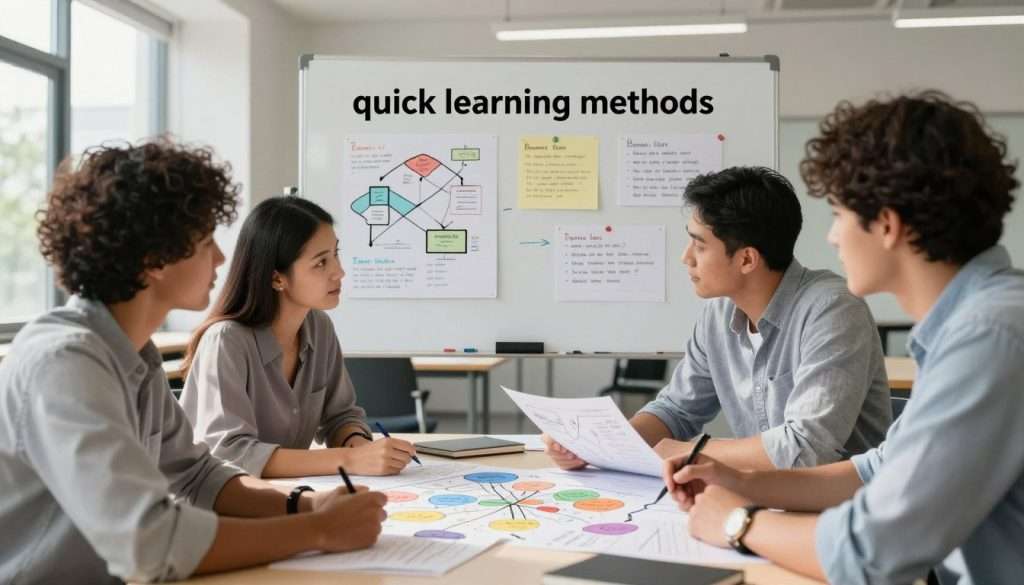
Many students slow down by using habits that don’t work well. We often think busy work is progress, but it’s not. By spotting these habits, you can use quick learning methods that really help.
Stop Rereading When You Should Be Testing Yourself
Rereading feels safe because it’s familiar. But it doesn’t help you remember things well. Instead, try to recall information without looking at your notes.
Do Not Confuse Familiarity With Mastery
Knowing a concept on paper doesn’t mean you’ve mastered it. True mastery means you can explain it without help. This shows you really understand it.
Avoid Multitasking During Challenging Study
Your brain can’t handle many tasks at once. Switching between your book and phone breaks your focus. Keep things simple to study better.
Do Not Change Methods Before Giving Them Enough Practice
It’s tempting to try new things when you’re stuck. But most quick learning methods need time to get used to. Give them a few tries before changing.
Replace Motivation-Dependent Plans With Small, Scheduled Actions
Waiting for the right mood to study can lead to procrastination. Instead, make a plan with small, scheduled actions that you do every day. If this article helped, check out my free book How to Become the Smartest Student in the Classroom. It has memory tips, study routines, and strategies that work. No cost, no catch. Get your free copy here.
Turn These Optimal Learning Techniques Into a Weekly System
You have the tools, but now it’s time to make them a part of your busy life. Random bursts of effort don’t lead to lasting success. Instead, we aim to create a routine that makes accelerated learning a natural part of your week.
Plan New Learning, Retrieval, Review, and Application
A good system balances different mental tasks. Set aside specific times for each learning phase. This ensures you’re not just reading, but actually retaining information.
- New Learning: Spend time on fresh material.
- Retrieval: Make your brain recall facts without notes.
- Review: Space out sessions to fight forgetting.
- Application: Use what you learned to solve real problems.
Schedule the Most Demanding Work During Your Best Focus Hours
We all have peak hours when our brains are sharpest. Whether you’re a morning person or a night owl, protect those hours for tough tasks. Aligning hard study goals with your natural energy makes accelerated skill acquisition less of a chore.
Use a Weekly Review to Find Knowledge Gaps
Every week, take fifteen minutes to review your progress. Identify fuzzy concepts and areas where you struggled. This habit helps pinpoint what needs more focus in the future.
Keep a Simple Record of Sessions, Errors, and Improvements
You don’t need a complex tracker to see your growth. A simple notebook or digital list works well. Logging study dates, errors, and improvements provides clear evidence of your progress, boosting motivation.
Adjust the System Without Abandoning the Core Strategies
Life is unpredictable, and your schedule will change. It’s okay to adjust your study blocks for work, sleep, or family needs. Just keep the core optimal learning techniques intact, even when timing changes.
If you want to dive deeper, my free book How to Become the Smartest Student in the Classroom offers a full system. It includes memory techniques, study routines, and strategies that stick. No cost, no catch. Get your free copy here.
Keep Improving With a Complete Learning System
Building a high-performance brain takes time, but you can start today. You don’t need to change your whole life to see results. Just make small, consistent changes that add up over time.
Start With One Strategy in Your Next Study Session
Choose just one technique for your next study session. Whether it’s active recall or spacing, mastering one tool at a time helps you avoid feeling overwhelmed. Once you get the hang of it, you can add another one.
Combine Memory Improvement Strategies as They Become Automatic
As you get more confident, you’ll see that memory improvement strategies work best together. Mixing active recall with spaced review and deliberate application creates a strong cycle. These habits will become second nature, making it easier to learn complex topics.
Get the Free Book How to Become the Smartest Student in the Classroom
Ready to dive deeper? We have a special offer for you. Our free book, How to Become the Smartest Student in the Classroom, offers a complete system for success.
Highlight the Free Book’s Memory Techniques, Study Routines, and Strategies That Stick
This resource is full of proven memory improvement strategies, study routines, and tips that work. It’s designed to make your study time enjoyable and effective. There’s no cost and no catch—just pure value to help you achieve your goals.
Include the Call to Action: “Grab your free copy here → https://www.studyingmachine.com/free-books/”
Ready to change your learning journey? Grab your free copy here → https://www.studyingmachine.com/free-books/
Conclusion
You now have a smarter way to work. True speed in learning comes from better retrieval and spacing. It’s more about focus than just cramming.
Active learning takes more effort at first. But, it makes exam days less stressful. Your brain can recall information easily.
Try one small action today. You might turn your notes into questions or do a blank-page recall session. These small changes can make you a master learner.
Want to dive deeper? If these ideas excite you, check out my free book. It’s called “How to Become the Smartest Student in the Classroom.” It has memory techniques, study routines, and strategies that work.
There’s no cost and no catch. Get your free copy here at https://www.studyingmachine.com/free-books/ to start your journey.