

You sit down to study one thing, and somehow your phone, your tabs and your to-do list all want a turn at your attention. Your laptop is open, but your mind is already sorting tomorrow’s errands. You meant to start ten minutes ago.
This happens to students and adults alike. Focus can slip when a notification lights up or a worry wanders in, even when the work matters to you. That does not mean you lack discipline.
We can make focus easier through small choices, not by demanding perfect concentration. The goal is to spend more of your time and energy on work that matters, with less stress about every stray thought. A useful approach should fit real life, including busy days and imperfect plans.
We will help you notice what pulls at your focus, make useful changes and return to your next task. You can try one idea at a time and keep the ones that help. We do not need a perfect day to make progress; we need one clear next task and a way to return to it.
Key Takeaways
- Notice where your attention goes before you try to change it.
- Choose one specific next action for each focus session.
- Make your phone and workspace less likely to interrupt.
- Practice returning to a task without scolding yourself.
- Try timed work intervals that suit the task and your energy.
- Seek professional support when focus problems disrupt daily life.
What Is Attention Management, Really?
Attention management is choosing where your attention goes instead of letting every ping or passing thought choose for you. Attention geography is a simple way to notice whether your attention is on your body, the outside world or your thoughts. That map can help you see what is happening in the moment.
The three attention locations are body, world and mind. They describe where attention lands, not whether your work is going well. A tight shoulder, a sound in the hall or a replayed conversation can each claim your focus.
| Attention location | Example | Quick way to notice it |
|---|---|---|
| Body | Tight shoulder | Check for tension |
| World | Background noise | Name the sound |
| Mind | Replaying a conversation | Notice the thought |
Attention can shift from one location to another in seconds. You might read a sentence, hear a door close, then remember an awkward chat. That shift is normal; it is not proof that your mind has failed.
Mind-wandering is not automatically a failure. Notice it, then gently return your attention to what matters in this moment.
A separate work-state model describes four states: reactive and distracted, daydreaming, flow, and focused and mindful. Those states describe how work feels, while body, world and mind show where attention lands. Keeping the two models separate gives us more clarity than treating them as the same map.
For example, you may be in a focused and mindful work state while noticing your body’s breathing. Or you may be daydreaming, with attention caught in your mind. One model does not cancel out the other.
When you notice where your attention has landed, you can decide whether it belongs there right now.
Why Does Your Attention Keep Slipping?
A wandering mind is not proof that you are lazy; attention can get pulled by what is happening around you, inside you or in your body. Focus has limits, and those limits can change with your energy, stress and surroundings. Distractions are signals to notice, not personal failings.
Frequent or disruptive attention problems deserve a closer look. A hard day happens to everyone, but lasting problems can affect school, work and daily life. The cause may be simple, complex or a mix of factors.
Everyday drains on attention
Notifications ask for a quick glance, then another. Noise can make reading harder, especially when it changes without warning. Stress may keep the brain busy with concerns that feel more urgent than the task in front of you.
Tiredness can lower the attention you have available, even when your plan looks reasonable. Task-switching also takes effort: every move from a paper to email can make it harder to settle back in. Internal worries can pull focus without any sound or screen at all.
These pulls do not mean you have poor character. They show that attention has a limited capacity, and different demands compete for it. Naming the pull can make the next choice clearer.
When a child or adult may need an evaluation
To improve a child’s attention span, start with a predictable, age-appropriate study setting and short, clear tasks. A routine can make the next step easier to understand. Persistent academic or behavioral concerns call for a clinician’s assessment.
A short attention span alone cannot identify ADHD. As of late 2023, an estimated 15.5 million U.S. adults, or 6.0% of adults, had a current ADHD diagnosis. About half received their diagnosis in adulthood, rather than childhood.
ADHD diagnostic criteria require symptoms to have been present before age 12. For children ages 4 through 18 with academic or behavioral problems and signs of inattention, hyperactivity or impulsivity, the American Academy of Pediatrics recommends that clinicians start an evaluation.
Clinicians should confirm DSM-5 criteria and consider other causes, including trauma. If attention problems are persistent or disruptive, write down what you notice and discuss it with a qualified clinician.
How to Manage Your Attention at Work and While Studying
Before you try to fix your focus, spend one ordinary day noticing what keeps borrowing it. A one-day attention audit can reveal patterns that are easy to miss while you rush through tasks. It is observation, not a test you can pass or fail.
Start by tracking attention shifts for one day, then target your two or three most frequent, lowest-value distractions. How to manage your attention at work starts with noticing interruptions and priorities, not building a perfect schedule. Your notes can show where one small change may help.
- Tally each attention shift for one day, including when you leave a task for another.
- Note the situation and your energy level when each shift happens.
- Identify the two or three most frequent low-value distractions in your notes.
- Choose one small change to test for a week, then check what changed.
Your notes might show that email pulls you away most often before lunch. They might also show that worries rise when a task feels unclear. Use the pattern that appears, rather than guessing what should be the problem.
To stay focused on your goals, connect each focus session to one specific next action. “Work on biology” is broad; “answer questions one through three” gives your attention a clear job. That small detail can make it easier to begin.
Choose a change you can test in the week ahead, such as writing the next action before each work session. Leave the rest of your routine alone for now. Pick one attention leak to address this week, rather than trying to redesign your whole day at once.
Set Up Your Space and Devices to Make Focus Easier
If your phone is beside your notebook, it is an open invitation for your attention to take a little detour. Easy access can turn one quick check into a string of distractions. You can make that detour less tempting with a few clear boundaries.
Put your phone in another room when you need fewer easy interruptions. A quieter digital and physical space can help focus take less effort. Choose changes that fit your home, class or work setting.
Make the digital environment quieter
Silence nonessential notifications and close tabs that do not belong to your task. If you need help limiting certain sites, Forest, Flora and Cold Turkey are examples of content-blocking apps, not endorsements. Pick a tool only if it suits your needs.
To improve attention span after TikTok, mute or move social apps, set a clear stop point and begin one defined offline task. For instance, decide to stop scrolling after one saved video, then read two pages from your notes. The switch may feel bumpy at first, so keep the first task small.

Give your study space one clear job
Clear visible clutter that does not serve the task you chose. Move extra papers out of your line of sight, but keep the materials you need within reach. A simple space can make it easier to see what to do next.
Choose a quieter place when possible. If home is busy, try a library corner or another spot where people are less likely to stop by. You do not need a perfect room; you need a place that supports the task.
To improve concentration and focus while working, set specific boundaries, such as closing email during a work block. Headphones or a small sign can also show others that you are busy. When the room is noisy or shared, choose one visible boundary, such as headphones or a “please come back later” sign.
Train Your Focus With Small, Repeatable Practices
Focus gets stronger through small returns, not by never wandering in the first place. Practice makes the return more familiar, even when the task still takes effort. You can build that skill with short activities that fit into a regular day.
Begin with a 10-minute monotasking session, then build from there. Monotasking means doing short tasks one at a time instead of splitting attention among several. Keep a scrap of paper nearby for thoughts that can wait.
Start with one task at a time
Pick one small task, such as reading a page or solving a single problem. Set a 10-minute limit and give that task your attention. If another thought pops up, write it down instead of following it.
This does not require a perfectly quiet mind. You may notice a worry, remember a message or feel the urge to switch tasks. Each time you return to the work, you practice choosing where your attention goes.
Bring attention back to the present
Notice one body sensation or sound, such as your feet on the floor or a fan humming nearby. Then bring your attention back without scolding yourself. The goal is a gentle return, not a battle with your thoughts.
Try a 10-30 second check-in when a longer practice feels like too much. Notice the sound, the feeling in your hands or the movement of your breath. Short intervals can make attention practice feel more approachable.
Make ordinary activities a focus practice
A meal can be a simple focus practice. Notice the taste, smell and feel of a few bites before your thoughts wander elsewhere. You do not need special equipment or a long block of free time.
A short meditation is another option. Sit comfortably, pay attention to one breath or sound, and return when your mind moves on. A daily present-moment practice can start at five minutes.
To improve attention span in adults, use gradual practice rather than expecting one fixed attention span. Add time only when the current exercise feels manageable. If the exercise feels difficult, shorten it and count each gentle return as practice.
Can the Pomodoro Technique Help You Stay Focused?
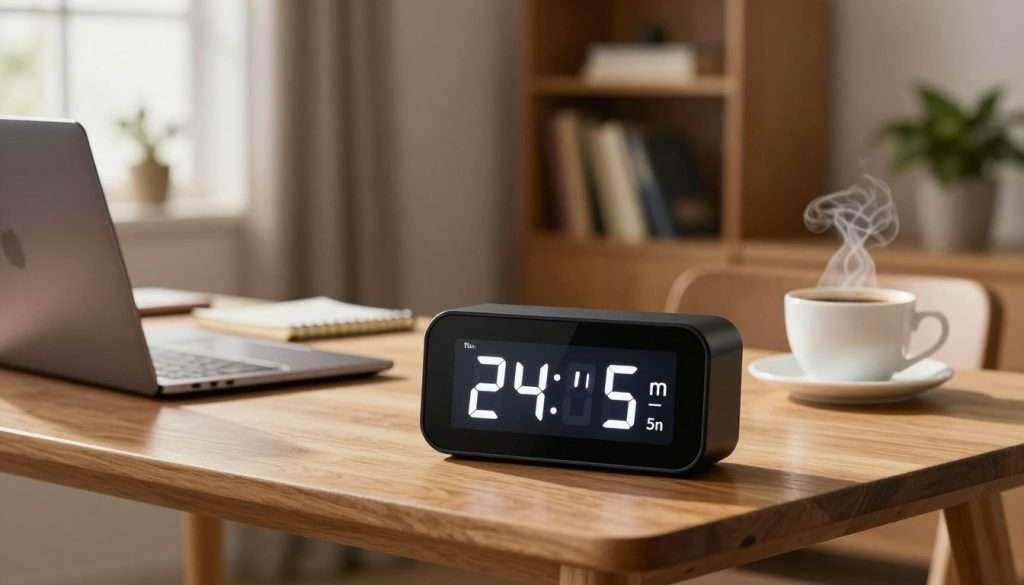
A timer can make “start studying” feel smaller by giving the task a clear finish line. Pomodoro intervals are timed work-and-break cycles that give a session a steady shape. The common format uses 25 minutes of work followed by a short break.
Choose an interval that fits the task, then use each break to reset. The Pomodoro Technique began in the late 1980s. Shorter options, including 24 minutes of work and six minutes of rest, or 12 minutes and three minutes, have also been studied.
| Schedule | Work | Break | What to know |
|---|---|---|---|
| Traditional Pomodoro | 25 minutes | Short break | Common format |
| Shorter option | 24 minutes | 6 minutes | Lower fatigue than self-paced breaks in trials |
| Very short option | 12 minutes | 3 minutes | Lower fatigue than self-paced breaks in trials |
Choose an interval that fits the task
A 2025 scoping review covered 32 Pomodoro Technique studies with 5,270 participants. Study sizes ranged from 25 to 300 people, with a median of 87. In three randomized trials with 87 participants, both 24/6 and 12/3 schedules were linked with about 20% lower fatigue than self-paced breaks.
Those three trials also found a 0.5-point improvement in distractibility and a 0.4-point increase in motivation compared with self-paced breaks. Five quasi-experimental studies reported 15-25% higher self-rated focus and roughly 20% less fatigue. These results can guide a trial, but they do not promise the same outcome for every student.
In the review, 88% of studies reported positive outcomes, while 57% used validated measures of mental states. That means many studies found benefits, but study methods were not the same. Treat the timer as a useful structure, not a guarantee of better productivity.
Use breaks to reset, not to start another scroll
Try this simple cycle when you begin:
- Choose one specific task you can start now.
- Work on that task until the timer ends.
- Take a screen-free break, then repeat the cycle.
After three or four Pomodoro intervals, take a longer break of 15-30 minutes. Stand, stretch or look away from close work instead of filling every pause with more input. If a 25-minute block feels too long, try a shorter interval and adjust based on how you feel.
Protect Focus With Sleep, Breaks, and Energy Basics
Focus is much harder to summon when your body is running on empty. Sleep loss can change how alert you feel and how well you hold attention. Basic recovery helps your brain and body handle the work you ask of them.
Adults are recommended to get at least seven hours of sleep per 24-hour period for optimal health. That recommendation gives you a useful starting point, not a promise that every night will feel the same. Stress, health and daily demands can affect how rested you feel.
Caffeine can stay in your system for hours. In healthy adults, caffeine has a half-life of five to six hours, meaning that amount of caffeine takes that long to drop by half. A controlled trial found that caffeine consumed up to six hours before bedtime reduced total sleep time by an average of 41 minutes.
That timing can matter even when a late coffee feels harmless. If you have trouble winding down, notice when you drink caffeine and how your sleep feels afterward. Your own pattern can help you decide what to change.
A break should give your mind and eyes a genuine pause, not simply swap one demanding screen for another. Try standing, looking into the distance or walking around for a few minutes. Your body gets a change of pace, and your eyes can rest from close work.
After 17-19 hours awake, performance on attention and reaction-time tasks was equivalent to or worse than performance at a blood-alcohol concentration of 0.05%. This is a research comparison, not a legal driving threshold or a diagnosis. It shows why long periods without sleep can make careful work harder.
If caffeine is affecting your sleep, try moving your last serving earlier and notice whether your nights improve.
When Focus Problems Need More Support
If focus problems keep disrupting school, work or everyday life, you do not have to solve the mystery alone. Professional support can help explain what is going on and what may help. Ongoing difficulty is a good reason to talk with someone qualified.
Consider an evaluation when attention problems interfere with daily life, school or work. A clinician can discuss your history, current needs and possible support options. You can bring examples of what feels hard and when it happens.
Talk with a clinician about persistent difficulties
Some adults with ADHD do not get treatment. In the CDC report covering late 2023, roughly one-third of adults with ADHD had received no treatment in the previous year. A clinician can help you discuss options that fit your health and daily needs.
You can prepare by noting the tasks that cause trouble and how often the problems appear. Include examples from more than one setting, such as school and home. Concrete details can make a conversation easier to start.
Be cautious about supplements
Omega-3 supplements are not a proven general concentration aid. A meta-analysis of seven randomized trials involving 654 children with ADHD found small overall symptom improvements, and described the evidence as preliminary and hypothesis-generating.
Results differed by children’s baseline omega-3 levels. Four trials with 369 children who had low baseline levels found a moderate improvement in ADHD symptoms. Six trials with 559 children who had normal or high baseline levels found no improvement.
These child studies do not establish omega-3 as a general concentration aid for adults or a replacement for care.
How to improve concentration and focus while studying with supplements is not a question with a proven omega-3 answer for everyone. The findings involved children with ADHD, not adults seeking a general boost. Before starting a supplement, check with a clinician or pharmacist, especially if you take medication or have a health condition.
Conclusion
You do not need to overhaul your life to give your attention a better place to land. One clear choice can make the next task easier to start. When your thoughts wander, you can return with patience rather than blame.
Choose one small focus habit to try this week, then grab your free copy of How to Become the Smartest Student in the Classroom if you want a fuller study system. Want to go deeper? If this article resonated with you, my free book How to Become the Smartest Student in the Classroom gives you a full system, including memory techniques, study routines, and strategies that actually stick. No cost, no catch. Grab your free copy here: https://www.studyingmachine.com/free-books/.