

Ever felt like your brain is like a leaky bucket? We’ve all been there, staring at notes that just won’t stick. But, improving your memory doesn’t need magic or special talents.
Using accelerated learning strategies changes how we handle complex info. We love sharing fun ways to make studying feel easy, not hard.
This guide will show you 8 learning hacks to help you memorize anything faster. Say goodbye to mental exhaustion!
We believe every student can conquer tough subjects with the right methods. These tips will turn heavy books into easy-to-grasp knowledge.
By focusing on efficiency, you’ll have more time for fun and rest. Join us on this exciting journey of learning and growth.
Key Takeaways
- Active recall boosts long-term storage.
- Spaced repetition prevents forgetting.
- Visual aids clarify complex ideas.
- Teaching others solidifies understanding.
- Healthy habits support brain function.
- Organization reduces mental clutter.
Why Memory Enhancement Matters for Your Success
Memory enhancement is more than a skill; it’s a game-changer. It helps anyone reach their goals. Whether you’re a student, a professional, or someone who wants to stay sharp, better memory can boost your success.
At its core, memory enhancement is about learning better, not just remembering more. When you remember things easily, you can build on what you know. You can connect different pieces of information and use them in new ways.
The Connection Between Memory and Learning Efficiency
Memory and learning efficiency are closely linked. When you remember key concepts, you learn new things faster. Your brain doesn’t have to relearn forgotten info, so you can tackle harder material.
Efficient learning means not just absorbing info but recalling and applying it. Better memory gives you a tool to reach your learning goals quickly and with less effort.
| Benefits of Memory Enhancement | Impact on Learning |
|---|---|
| Better retention of information | Improved understanding and application of learned material |
| Increased learning speed | Ability to take on more challenging subjects or tasks |
| Enhanced confidence | Greater motivation to continue learning and improving |
How These Techniques Transform Your Study Sessions
The techniques we’ll explore make studying more effective. By using memory improvement tips and effective study methods, you’ll study better, remember more, and reach your goals faster.
Techniques like spaced repetition and active recall help you remember complex info. These methods help you understand material deeply, not just memorize it. This understanding is crucial for your studies or career.
Changing how you learn and remember opens up new possibilities. Whether you want to ace an exam, master a new skill, or improve your brain function, the right techniques can help.
Hack 1: Leverage the Spacing Effect for Long-Term Retention
Let’s explore the first hack that changes how you learn: using the spacing effect for long-term memory. This memorization technique is backed by science. It shows that learning in spaced sessions keeps information better than a single session.
This method is great for students and anyone wanting to improve their memory. It helps you remember things better over time. It’s a key part of brain-friendly learning tips.
Understanding the Science Behind Spaced Repetition
Spaced repetition uses the psychological spacing effect. When you first learn something, it’s in your short-term memory. Without review, it’s forgotten. But, reviewing it at longer intervals moves it to long-term memory, making recall easier.
Creating Your Optimal Review Schedule
To use spaced repetition well, you need a review schedule. It doesn’t have to be hard. Start with a simple plan and adjust as you go.
The 1-3-7-14-30 Day Review Pattern
A good review pattern is the 1-3-7-14-30 day schedule. Here’s how it works:
| Day | Review Material |
|---|---|
| 1 | Initial Learning |
| 3 | First Review |
| 7 | Second Review |
| 14 | Third Review |
| 30 | Final Review |
Digital Tools to Automate Your Spacing Practice
Keeping track of your schedule can be done manually or with digital tools. Apps like Anki and Quizlet help with digital flashcards and spaced repetition. They make learning easier.
Using the spacing effect in your studies improves memory and time use. It’s one of many memorization techniques to boost your learning.
Hack 2: Master the Method of Loci Memory Palace Technique
Imagine having a mental storage system that makes remembering easy. Welcome to Memory Palaces. This ancient method, also known as the Method of Loci, boosts memory. It uses your brain’s spatial memory and visualization to recall complex data.
Building Your First Memory Palace Step by Step
Creating a Memory Palace is simple with practice. Pick a place you know well, like your home or school. This makes mental navigation easier.
Let’s say you need to remember a shopping list. Link each item to a spot in your Memory Palace. For example, milk could be in your living room, with a giant carton on your coffee table.
Placing Information in Specific Locations
The Memory Palace technique’s power is in linking new info to memorable spots. Create vivid mental images tied to the information you want to recall.
Choosing Familiar Routes and Physical Spaces
When picking a route or space for your Memory Palace, consider these tips:
- Choose a place you know very well.
- Ensure the space is large enough to accommodate all the information you want to store.
- Select distinct landmarks or areas within the space that can be used to associate with different pieces of information.
Creating Vivid, Multisensory Mental Images
The more vivid and unusual your mental images, the better you’ll remember them. Try to use as many senses as possible. For example, if remembering a historical date, imagine a scene that includes visual, auditory, and tactile elements.
As Joshua Foer, a memory expert, once said,
“The art of memory is about creating vivid, memorable images and associating them with the information you want to recall.”
Let’s look at how to use the Memory Palace technique to remember a sequence of numbers. Here’s a table showing how to link numbers with words or images:
| Number | Associated Word/Image | Memory Palace Location |
|---|---|---|
| 1 | Sun | Living Room Window |
| 2 | Shoe | Front Door |
| 3 | Tree | Backyard |
By using the Memory Palace technique, you can greatly improve your memory. With practice, this mnemonic device becomes a powerful tool for cognitive enhancement.
Hack 3: Use Chunking to Break Down Complex Information
Breaking down complex data into smaller parts is key for learning well. When we face a lot of information, our brains can get too full. Chunking helps by breaking it down into bits we can handle.
How Chunking Works With Your Working Memory Limits
Our brains can only hold so much at a time, known as “the magical number seven, plus or minus two.” Chunking groups information into bigger units. This makes it simpler to remember and recall. For example, phone numbers are broken into groups of three or four to help us remember them.

Practical Chunking Strategies for Different Content Types
Different kinds of information need different ways to chunk. Let’s look at a few good methods.
Grouping Numbers, Dates, and Statistical Data
With numbers, look for patterns or connections. For example, you can split a long number sequence into smaller groups. Or link them to important dates or events. This makes the numbers stick in your memory better.
Organizing Related Concepts Into Meaningful Categories
For ideas, group similar concepts together. This helps you remember and understand better. Categorization is a great way to boost your memory for complex stuff.
Using these chunking tips can really help you learn better and remember more. The main idea is to make the information easier to grasp and meaningful.
Hack 4: Apply Active Recall Instead of Passive Reading
Stop mindlessly re-reading your notes. It’s time for a better learning method. Active recall makes your memory stronger and helps you understand better. It makes you actively engage with what you’re studying.
Active recall beats passive reading because it makes your brain work harder. When you read passively, your brain doesn’t have to do much. But active recall makes your brain work harder to remember. This helps you remember better and understand deeper.
Why Testing Yourself Beats Re-Reading Every Time
Testing yourself through active recall has many benefits. It improves retention by making you remember information better. It also identifies knowledge gaps, helping you study more effectively. Plus, it makes you better at using what you’ve learned in different ways.
Implementing Active Recall in Your Study Routine
Now you know why active recall is good, let’s see how to use it. There are many ways to start.
Flashcard Methods That Actually Work
Flashcards are a great tool for active recall. Here’s how to make them work:
- Make cards with a question or term on one side and the answer or definition on the other.
- Review your flashcards often, trying to remember the answer before looking at the card.
- Use spaced repetition to review cards at longer intervals to help remember them longer.
Self-Quizzing Strategies Without Study Materials
What if you don’t have study materials? Here are some ways to quiz yourself:
- Mental recall exercises: Try to remember important information without looking at your notes.
- Teaching someone else: Explaining what you’ve learned to someone else helps you understand and remember better.
- Make your own quizzes or tests to practice like you’re taking an exam.
Using active recall in your studies will make you remember and understand better. It’s a smarter way to learn. So, try active recall and see how your learning improves!
Hack 5: Create Powerful Mnemonic Devices and Acronyms
Unlock the secret to remembering complex information with mnemonic devices. These tools make learning easier and more fun! Mnemonic devices help by linking new information to something memorable. This way, you can remember things better.
Types of Mnemonics for Different Information Categories
There are many types of mnemonic devices for different kinds of information. Acronyms are great for lists or sequences. Acrostics help with phrases or sentences.
Let’s look at some common types of mnemonics:
- Acronyms: Forming a word from the initial letters of a list or sequence.
- Acrostics: Creating a sentence or phrase where the first letter of each word corresponds to the information you want to remember.
- Rhymes and Jingles: Using rhyming words or catchy tunes to make information more memorable.
- Visual Mnemonics: Associating new information with vivid mental images.
- Story-Based Mnemonics: Creating a story that incorporates the information you want to remember.
Crafting Memorable Acronyms and Acrostic Phrases
Crafting effective acronyms and acrostics requires creativity. The goal is to make them memorable and meaningful to you.
Visual Mnemonics for Sequential Lists
Visual mnemonics are great for sequential lists. They help by linking each item to a vivid image. This creates a mental map for easier recall.
For example, to remember the planets in our solar system, create a visual mnemonic like this:
| Planet | Visual Mnemonic |
|---|---|
| Mercury | Monkey riding a bike |
| Venus | Very elegant spaceship |
| Earth | Elephant balancing on a globe |
Story-Based Memory Hooks for Complex Topics
Story-based mnemonics are perfect for complex topics. They turn information into a narrative. The more bizarre or memorable the story, the better it sticks in your memory.
For example, to remember cell division stages, create a story that links each stage to a character or event.
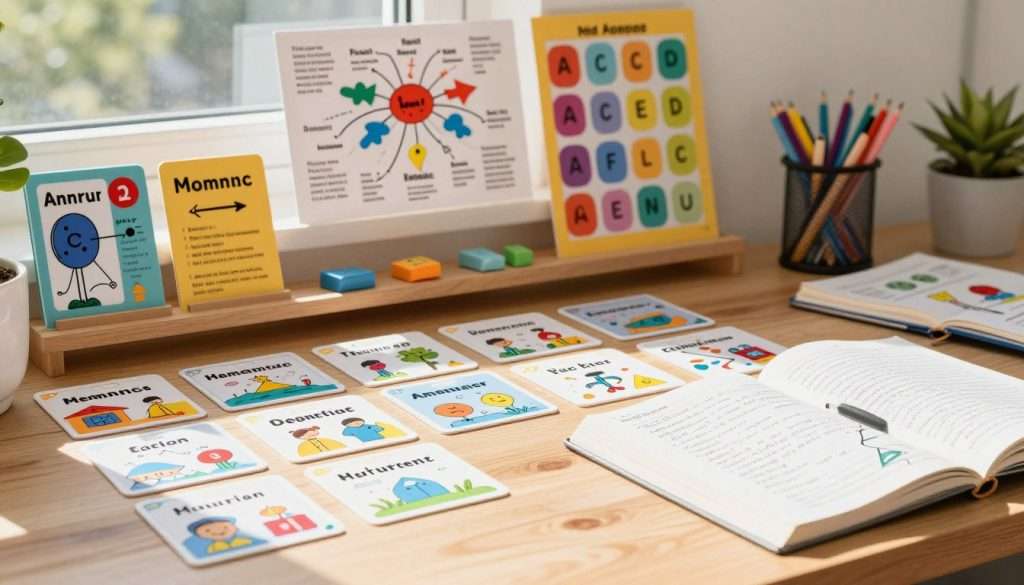
By using mnemonic devices in your learning, remembering complex information becomes easy. Try different types to find what works best for you!
Hack 6: Harness the Power of Dual Coding Theory
The dual coding theory says using both visual and verbal channels boosts learning. It’s based on how our brains handle visual and verbal info differently. By mixing these, we can learn and remember better.
Using both visual and verbal info creates more paths in our brain for remembering. If one path fades, the other can help recall, making it easier and more reliable.
Combining Visual and Verbal Information Channels
To use the dual coding theory, mix visual stuff like images with verbal info like text. You can do this in many ways, like making concept maps or using diagrams for complex topics.
For example, when studying a timeline, make a visual map with dates, events, and images. Add a brief text summary to help remember the timeline better.
Creating Effective Visual Representations of Ideas
It’s key to make your visuals clear and relevant for the dual coding theory. This helps you learn and remember better.
Mind mapping is great for organizing info visually. It uses circles, arrows, and keywords to show connections between ideas.
Mind Mapping Techniques for Connected Concepts
Mind mapping is perfect for subjects with lots of connected ideas. It helps you see how ideas link and remember them better.
To make a mind map, start with a main idea. Then add related ideas or subtopics. Use colors, symbols, and images to make it memorable.
Diagrams and sketch-noting are also good for showing info visually. Diagrams help with complex topics, and sketch-noting combines drawings with text.
These methods make learning fun and help you remember info better. By adding visuals to your study routine, you can boost your learning with the dual coding theory.
Hack 7: Teach What You Learn to Solidify Knowledge
Teaching someone else what you’ve learned helps them and you. It makes your knowledge stronger. This method is based on the idea that teaching others helps you understand and remember better.
The Feynman Technique Explained in Simple Terms
The Feynman Technique is named after physicist Richard Feynman. It’s a simple way to check if you really get a concept. You learn it, teach it to a child, find out what you don’t know, and make it simple.
Here’s how it works: Pick a concept you want to learn. Explain it like you’re teaching a child. This makes you understand it deeply and find out what you don’t know. Then, make your explanation clear and simple.
Practical Ways to Practice Teaching Material
There are many ways to use the Feynman Technique in your learning. Two good ways are teaching a friend or recording your lessons.
Explaining Concepts to a Study Partner or Friend
Teaching a friend or study partner helps you remember better. You can talk, answer questions, and clear up any confusion. This makes the information stick in your memory and boosts your confidence.
Recording Your Own Video or Audio Lessons
Recording yourself teaching is another good way. It lets you see how clear your explanations are, find what needs work, and improve your understanding. You can also share these recordings or watch them later to review.
By using these teaching methods, you’ll learn better and improve your communication skills.
Teaching what you learn is a great way to learn faster and remember better. By making teaching a part of your study routine, you’ll learn and remember more effectively.
Hack 8: Optimize Your Learning Environment and Timing
Creating the right conditions for learning is key. When you optimize your environment and timing, you learn better. Let’s look at how to make your study sessions more effective.
Identifying Your Peak Cognitive Performance Hours
We all have times when our brains work best. Identifying your peak cognitive hours helps you study when you’re most focused.
Notice when you feel most alert and focused. For some, it’s early morning. Others do better later. Experiment with different study times to find what works for you.
Creating a Distraction-Free Study Zone
Your study environment is crucial for focus. A clutter-free and distraction-free space boosts your concentration. Make a specific area for studying that’s quiet and comfortable.
Managing your energy is key for studying. Take regular breaks to avoid burnout. The Pomodoro Technique, with 25 minutes of study and a 5-minute break, is helpful.
Also, maintaining a healthy lifestyle improves your energy and brain function. This includes regular exercise, a balanced diet, and enough sleep.
Using Background Music and Sound Strategically
Background music and sound can help or hinder your study. Some music, like classical or instrumental tracks, improves focus. Try different genres to see what works for you.
Also, certain soundscapes or white noise can block out distractions. Tools and apps that generate these sounds can help create the perfect study atmosphere.
8 Learning Hacks to Help You Memorize Anything Faster: Putting It All Together
We’ve looked at 8 learning hacks. Now, let’s mix them to make a strong memory system. By using these effective study methods, you can remember and keep information better.
To get the most from these hacks, it’s important to see how they work together. Let’s explore how to mix different techniques for the best results.
Combining Multiple Techniques for Maximum Impact
Using several cognitive enhancement techniques at once makes a strong system. For example, you can mix the spacing effect with active recall to make learning stick over time.
Here’s how to mix some hacks:
- Use the method of loci to make a memory palace and store information.
- Apply chunking to break down complex info into smaller parts.
- Employ active recall by testing yourself on what you’ve chunked.
- Create mnemonic devices to help remember specific details.
Creating Your Personalized Memory Enhancement System
To make your own system, first figure out your learning style and needs. Try different combinations of the 8 learning hacks to see what works for you.
If you’re a visual learner, mixing dual coding theory with the method of loci might be great. If you’re more of an auditory learner, using mnemonics and teaching others might be better.
By making your system fit your needs and preferences, you can create a personalized memory enhancement system. This will help you memorize faster and better.
Conclusion
We’ve looked at 8 learning hacks to help you remember things faster. These include using the spacing effect and setting up a good learning space. By adding these tips to your daily routine, you’ll learn and remember better.
Now, it’s your turn to try these strategies. Pick the ones that work best for you and use them in your study time. As you get better, mix different methods to make a system that works just for you.
Improving your memory takes regular practice and patience. With these 8 hacks, you’re on your way to reaching your learning goals. So, start improving your memory today. Learn in a way that’s efficient, effective, and fun.