

Ever wondered why some people tackle tough challenges with ease? It’s often because they see the big picture. Learning strategic thinking skills is like getting a superpower for your career.
When you master this mindset, you stop just reacting to daily problems. Instead, you start shaping your future. It’s not just about planning; it’s about connecting dots to reach your goals quickly. You have the power to change your trajectory.
Companies are always looking for employees who can think logically and act with purpose. To stand out, you need to look beyond the immediate task. Those who become a great strategic thinker often lead projects and drive business growth.
We’re here to help you improve these skills. Let’s explore how to sharpen your perspective and make a lasting impact in your career.
Key Takeaways
- Strategic thinking is a top-tier competency highly valued by modern employers.
- Critical and logical analysis helps you move from reactive to proactive work.
- Developing these skills allows you to influence the long-term success of your organization.
- You can learn to see patterns that others might miss in daily operations.
- Mastering this mindset creates more opportunities for career advancement and leadership.
Understanding the Core of Strategic Thinking
At the heart of every successful organization is a deep grasp of strategic thinking. It’s about seeing beyond today and making choices that lead to success in the future. As we face the challenges of modern business, knowing how to think strategically is key.
Defining Strategic Thinking in a Modern Context
Strategic thinking means intentionally and logically evaluating information to make smart choices. It’s about spotting risks, trends, resources, and chances that can shape plans and goals. In today’s world, it’s about being flexible, looking ahead, and linking different pieces of information together.
To develop a strategic mindset, one must question assumptions, look at things from different angles, and keep eyes on the long-term. This means always learning, reflecting, and adjusting.
The Difference Between Tactical and Strategic Mindsets
A tactical mindset focuses on short-term goals and immediate needs, often dealing with specific tasks or projects. On the other hand, a strategic mindset looks at the bigger picture, thinking about how today’s actions will affect tomorrow. It’s the difference between reacting and acting ahead.
For example, a tactical approach might solve a current problem. But a strategic approach would find the problem’s root cause and plan to avoid it in the future.
Why Strategic Thinking is Essential for Career Growth
Strategic thinking is vital for career growth because it helps make smart decisions, foresee problems, and seize chances. By thinking strategically, professionals can align their work with the company’s goals, show their worth, and prepare for leadership roles.
Also, strategic leadership development is about inspiring and leading others towards a shared vision. It’s not just about personal strategic thinking but also about creating a culture of strategic dialogue in an organization.
How to Become a Great Strategic Thinker
Becoming a great strategic thinker means understanding and using key principles in your decision-making. To get better at making decisions and thinking critically, you need to take a few steps. These steps include being curious, thinking long-term, and avoiding biases.
Cultivating Intellectual Curiosity
Starting with curiosity is key to strategic thinking. It means being open to new ideas and always seeking knowledge. Asking strategic questions helps you improve your planning and spot opportunities.
For example, you can ask why certain trends happen. This curiosity not only widens your understanding but also finds new areas for innovation.
To grow your curiosity, try:
- Reading widely across different subjects
- Talking to people from different backgrounds
- Trying new hobbies and interests
Developing a Long-Term Perspective
Thinking long-term is essential for strategic thinking. It means looking beyond quick wins and thinking about the future. Setting long-term goals and checking your progress regularly helps.
Here’s a simple table to help you track your long-term goals and strategic actions:
| Long-Term Goal | Short-Term Objectives | Strategic Actions |
|---|---|---|
| Enhance Critical Thinking | Read 5 books on critical thinking | Allocate 30 minutes daily for reading |
| Improve Decision-Making | Take an online course on decision-making | Apply decision-making frameworks to daily decisions |
Overcoming Cognitive Biases in Decision-Making
Cognitive biases can hurt your decision-making. To beat these biases, you must know them and work to reduce their impact. This means being open to other views, thinking of different scenarios, and using data to back your choices.
By being curious, thinking long-term, and avoiding biases, you can greatly improve your strategic thinking. This will help you make better decisions and succeed in both your personal and professional life.
Mastering the Strategic Decision-Making Process
Learning to make strategic decisions is key for both individuals and organizations. It helps us make choices that lead to long-term success. We do this by using data, looking at past results, and planning for the future.
Gathering and Analyzing Relevant Data
Data is the base of any strategic decision. Gathering relevant data means digging deep to find trends and drivers. We mix numbers from market research and financial reports with feedback and expert views.
After collecting data, analyzing it well is essential. We use tools to spot patterns and connections that help us decide. It’s not just about having data; it’s about knowing what it tells us.
Evaluating Potential Outcomes and Risks
Next, we look at the possible outcomes and risks of our choices. We think about different scenarios, how likely they are, and their effects. This helps us pick the best options for our goals.
- Identify potential outcomes for each strategic option.
- Assess the risks associated with each outcome.
- Consider the potential impact on long-term goals.
By carefully looking at outcomes and risks, we make better choices. These choices align with our strategic goals.
Applying the Pareto Principle to Strategic Choices
The Pareto Principle, or 80/20 rule, shows that 80% of results come from 20% of causes. Applying this principle means finding the top decisions that will have the biggest impact.
This means focusing on the most important tasks or decisions. It helps us avoid wasting time on less critical details. This way, we can achieve our goals more efficiently.
Enhancing Critical Thinking for Better Outcomes
Improving critical thinking is more than solving problems. It’s about knowing which problems to tackle first. As strategic thinkers, we must question old ways of thinking. This helps us see new opportunities that others might miss.
Critical thinking is key to making smart decisions. It means looking at information, judging evidence, and making choices. By sharpening our critical thinking, we make better choices and get better results.
Questioning Assumptions and Status Quo
Being a critical thinker means always questioning what’s accepted. It’s about being curious and never accepting things as they are. By doubting the usual, we find new insights and chances we might have missed.
For example, when we review a business plan, we should ask, “What are the basic assumptions?” or “Is there solid data to back these up?” This way, we can check if the plan is sound and make needed changes.
Utilizing First Principles Thinking
First principles thinking is a powerful tool for critical thinking. It breaks down big problems into simple principles and then builds up from there. This method helps us get to the heart of issues and find fresh solutions.
Elon Musk is a great example of this. He uses first principles thinking to change industries. By questioning the usual and understanding the basics, he innovates and shakes up markets.
Connecting Disparate Ideas for Innovation
Innovation often comes from linking unrelated ideas. Critical thinkers are good at making these connections. They are open to different views and willing to try new things.
Here’s a table showing how different fields have innovated by linking different ideas:
| Industry | Disparate Ideas Connected | Innovation Outcome |
|---|---|---|
| Technology | AI and Healthcare | Personalized Medicine |
| Finance | Blockchain and Banking | Secure Transaction Systems |
| Retail | E-commerce and Social Media | Influencer Marketing |
By improving our critical thinking, we become better strategic thinkers. We make smarter choices and drive innovation. It’s about being proactive, curious, and open to new ideas.
Implementing Effective Strategic Planning Techniques
Strategic planning techniques are key for making a real difference in your field. Whether you’re looking to grow your career or expand your business, a clear plan is essential.
Let’s explore some practical methods for creating a strong strategic plan. One top method is doing a SWOT analysis, which looks at Strengths, Weaknesses, Opportunities, and Threats.
Conducting a Personal or Organizational SWOT Analysis
A SWOT analysis is a great tool for spotting your strengths and weaknesses, and the opportunities and threats around you. It helps you plan how to use your strengths, fix your weaknesses, grab opportunities, and dodge threats.
To do a SWOT analysis, start by collecting data on your inner strengths and the outside world. Look at your skills, resources, and market trends. Be honest and detailed in your review to get a precise and helpful analysis.
Setting SMART Goals for Strategic Alignment
After understanding your SWOT analysis, set SMART goals that match your strategic aims. SMART means Specific, Measurable, Achievable, Relevant, and Time-bound.
SMART goals make your objectives clear and reachable. This keeps you focused and driven. For instance, instead of saying “I want to be healthier,” aim for “I will cut my body fat to 20% in 6 months by exercising 30 minutes, 3 times a week.”
Creating Actionable Roadmaps for Execution
With your SWOT analysis and SMART goals ready, the next step is to make an actionable roadmap for action. This means breaking down big goals into smaller tasks and setting deadlines.
A good roadmap should be flexible but still keep you on course. Regularly check and update your roadmap to keep up with your goals and make any needed changes.
Building Strategic Leadership Development Habits
Strategic leadership is more than just knowing strategies. It’s about building habits that lead to success. Leaders must create an environment that supports growth, innovation, and smart decision-making.
Fostering a Culture of Strategic Dialogue
It’s key to have a culture that values strategic dialogue. This means encouraging open talk where everyone feels heard and valued. Strategic leaders create a space for creativity and new ideas to flourish, knowing innovation keeps them ahead.
To build such a culture, try these steps:
- Encourage open and honest communication
- Value different views and ideas
- Give team members chances to share their thoughts
Peter Drucker said, “The most important thing in communication is hearing what isn’t said.” This shows how crucial it is to have a safe space for everyone to speak up.
“The most important thing in communication is hearing what isn’t said.”
Mentorship and Seeking Diverse Perspectives
Mentorship is essential for growing as a strategic leader. Getting advice from mentors and considering different viewpoints helps leaders make better choices.
| Benefits of Mentorship | Benefits of Diverse Perspectives |
|---|---|
| Guidance from seasoned leaders | Deeper understanding of various markets and cultures |
| Personalized feedback and plans for growth | Unique solutions to tough problems |
| Networking chances | Better decision-making with diverse insights |
Refining Emotional Intelligence for Strategic Influence
Emotional intelligence is vital for strategic leadership. Leaders with high emotional intelligence understand themselves and their teams better, leading to stronger influence.
To improve emotional intelligence, work on:
- Self-awareness: Knowing your strengths, weaknesses, and feelings
- Empathy: Understanding and sharing others’ feelings
- Social skills: Building good communication and relationships

By focusing on these habits and strategic leadership development, leaders can build a more innovative, collaborative, and successful team.
Improving Strategic Problem-Solving Abilities
In today’s fast world, it’s crucial to improve your strategic problem-solving skills. Strategic thinkers dig deep to find the real causes of complex issues. They don’t just fix the surface problems. We’ll show you how to boost your skills to face challenges head-on.
Breaking Down Complex Challenges
Complex challenges can feel overwhelming. But breaking them down into smaller parts is key. This means finding the main parts of the problem and studying each one. This way, you get a clear picture of what’s going on.
For example, when tackling a big project, split it into smaller tasks. This makes the project less scary and lets you focus on one thing at a time. Good task management is vital for solving problems strategically.
Identifying Root Causes Versus Symptoms
It’s important to tell the difference between a problem’s symptoms and its root cause. Symptoms are what you see, while the root cause is why you see them. Finding the root cause is key to fixing the problem for good.
Let’s say a company’s sales are dropping. The symptom is the lower revenue. But the real cause could be bad marketing or more competition. Knowing the root cause helps you fix the problem right.
| Problem-Solving Approach | Description | Outcome |
|---|---|---|
| Symptom-based | Addresses the visible effects of a problem | Temporary solution |
| Root cause-based | Targets the underlying reason for the problem | Lasting solution |
Iterative Prototyping and Feedback Loops
Iterative prototyping means making a solution in stages, testing it, and improving it based on feedback. This way, you can check if your solution works and tweak it as needed.
In product development, testing a prototype with a few users can give you great feedback. Feedback loops help you refine your solution and make sure it meets your audience’s needs.
Using iterative prototyping and feedback loops in your problem-solving can lead to better, lasting solutions.
Leveraging Tools and Frameworks for Strategy
In today’s fast-paced business world, the right tools and frameworks are key to success. As strategic thinkers, we must be skilled in using various methods to stay ahead.
To become a great strategic thinker, knowing a variety of tools is essential. These tools aid in planning, decision-making, and execution. Let’s look at some important tools and frameworks.
Using Scenario Planning to Prepare for Uncertainty
Scenario planning lets us imagine different futures and prepare for them. It helps us understand the business world and make smart choices.
By thinking about different scenarios, we can:
- Spot potential risks and chances
- Make strategies that can change with new information
- Be ready for surprises
Applying Game Theory to Competitive Situations
Game theory helps us study competitive situations by looking at how players interact. It helps us guess what competitors will do and make smart moves.
| Game Theory Concept | Description | Application in Strategy |
|---|---|---|
| Nash Equilibrium | A state where no player can improve their outcome by unilaterally changing their strategy | Understanding competitive balance |
| Prisoner’s Dilemma | A scenario where individual rationality leads to a suboptimal outcome for all | Analyzing cooperation and competition |
| Zero-Sum Game | A situation where one player’s gain is equal to another’s loss | Competitive strategy formulation |
Visualizing Strategy with Mind Mapping and Flowcharts
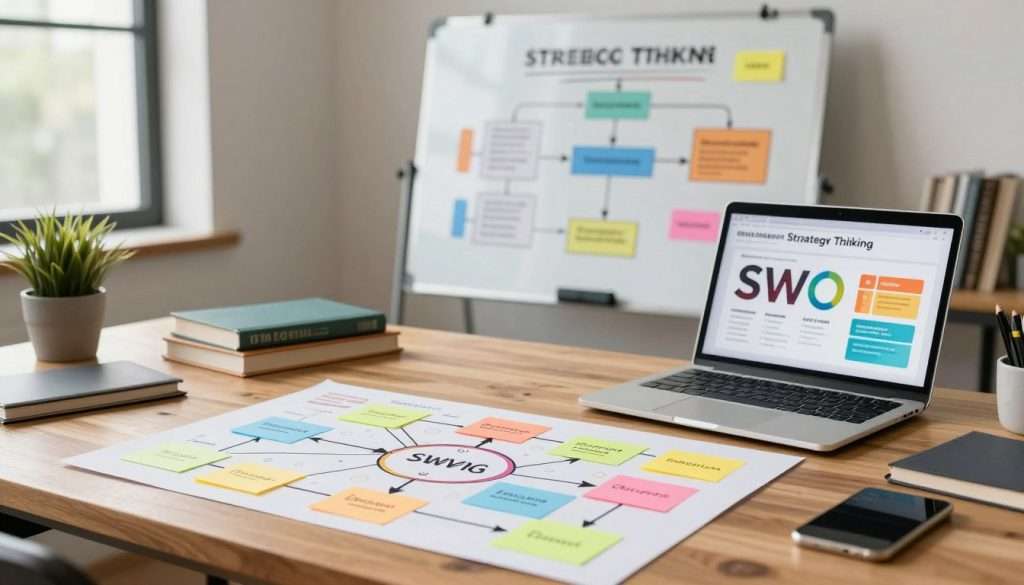
Tools like mind mapping and flowcharts are great for making complex strategies clear. Mind maps help brainstorm and organize ideas. Flowcharts show processes and decision paths.
Using these tools, we can:
- Make complex info simple
- Help teams work together better
- Find and fix problems
In conclusion, using the right tools and frameworks is key for good strategic thinking. By using scenario planning, game theory, and visual tools, we can better navigate business challenges and reach our goals.
Overcoming Common Barriers to Strategic Thinking
To improve decision-making, we must first tackle common barriers to strategic thinking. We face obstacles in strategic decision-making. This section will cover these challenges and offer ways to overcome them.
Managing Information Overload
In today’s world, we’re hit with data from everywhere. This can cause information overload, making it hard to know what’s important. We need to learn how to filter information effectively.
Here are some tips to handle information overload:
- Prioritize information based on relevance and urgency
- Use tools and software to streamline data collection and analysis
- Set clear goals and focus on information that aligns with those goals
By using these strategies, you can cut through the noise and focus on what’s important.
Avoiding Analysis Paralysis
Analysis is key in strategic thinking, but too much can cause analysis paralysis. This happens when fear of making a wrong decision stops us from making any decision.
To avoid this, consider the following:
- Set deadlines for decision-making to prevent overthinking
- Use decision-making frameworks to structure your analysis
- Practice iterative decision-making, where decisions are made in stages, allowing for adjustments as needed
Balancing Short-Term Demands with Long-Term Vision
Strategic thinkers must balance immediate needs with long-term goals. This requires a fine balance between responding to current demands and planning for the future.
| Short-Term Focus | Long-Term Vision |
|---|---|
| Immediate problem-solving | Strategic planning |
| Tactical decision-making | Visionary thinking |
| Reactive measures | Proactive strategies |
Understanding the value of both short-term and long-term views helps develop a strong strategic mindset.
Conclusion
Cultivating strategic thinking skills is a powerful way to unlock your potential. It helps you become a great strategic thinker. By understanding strategic thinking, mastering decision-making, and improving critical thinking, you’re on your way to achieving your goals.
Developing a strategic mindset takes time and practice. With self-exploration, critical questioning, and formal training, you can refine your skills. We encourage you to keep challenging yourself and seeking out opportunities to grow as a strategic thinker.
By doing so, you’ll not only enhance your career prospects but also become more effective in your personal and professional life. So, take the first step today and start building the strategic thinking skills that will propel you towards success.