

Ever left a lecture or meeting feeling like your brain is foggy? We’ve all been there, looking at pages of scribbles that don’t make sense. It’s a chore, but it doesn’t have to be.
Learning the right note-taking methods can make learning a superpower. You’ll understand concepts, not just words. We’re here to help you capture, organize, and recall information easily.
These strategies are your success toolkit. By improving how you document your day, you’ll feel empowered, not overwhelmed. Let’s explore the best ways to make studying stick.
Key Takeaways
- Transform passive listening into active, meaningful learning.
- Use proven strategies to clear the mental fog after meetings.
- Improve your ability to recall complex information quickly.
- Organize your thoughts to boost daily productivity levels.
- Turn study sessions into an enjoyable and effective experience.
The Psychology Behind Why We Take Notes
Taking notes is more than just writing on paper. It’s a secret weapon for your brain. Using effective note-taking techniques makes your brain work hard. It keeps your focus sharp and stops your mind from drifting off.
Encoding vs. Storage
We often see our notebooks as a storage device. But the real power is in the encoding phase. This is when your brain processes the information as you write it.
Writing down ideas in your own words makes your brain work. It helps move information from short-term to long-term memory. Using effective note-taking techniques helps you build knowledge, not just store facts.
The Cognitive Benefits of Active Listening
Ever sat through a lecture and felt like you missed everything? That’s what happens when you listen passively. But when you take notes actively, you turn it into a constructive thinking exercise.
This keeps you focused and encourages critical thinking. You’re always deciding what’s key and what’s not. Here’s how your brain changes from passive to active listening:
| Feature | Passive Listening | Active Note-Taking |
|---|---|---|
| Mental State | Distracted | Focused |
| Memory Retention | Low | High |
| Critical Thinking | Minimal | Deep |
| Outcome | Information Loss | Knowledge Mastery |
By engaging actively, every session becomes a chance to grow. Learning these effective note-taking techniques will change your learning forever.
Evaluating Your Current Note-Taking Style
Let’s take a moment to pause and think about how you handle information during your busy day. Before you can adopt the best note-taking strategies, you need to understand your current habits. It’s easy to fall into a routine without questioning if it really serves your goals.
Identifying Common Pitfalls
Many of us fall into the transcription trap. This happens when you try to write down every single word a speaker says. While it feels productive, this habit actually prevents your brain from synthesizing key concepts in real-time.
When you focus solely on speed, you lose the chance to process the meaning behind the words. Active engagement is far more valuable than a perfect transcript. If you find yourself mindlessly typing or writing without understanding, it’s time to shift your approach.
Assessing Your Learning Environment
Your surroundings play a massive role in how well you retain information. Take a look at your workspace to see if your current tools are helping or hurting your concentration. Are you constantly distracted by digital notifications or a cluttered desk?
Sometimes, the best note-taking strategies require a change in scenery rather than a change in software. If your environment is chaotic, your notes will likely reflect that same energy. Creating a calm space is often the first step toward building a system that truly works for your unique brain.
The Cornell Note-Taking Method Explained
If you’re searching for effective note-taking methods, you’re in the right spot. The Cornell system is a classic for a reason. It helps you organize your thoughts into a clear structure. It turns your messy notes into a roadmap for success.
Structuring Your Page for Success
To start, divide your paper into three sections. You’ll have a narrow column on the left for cues, a wide column on the right for notes, and a summary space at the bottom. This layout is incredibly helpful because it keeps data separate from your analysis.
This layout creates a visual hierarchy that speeds up reviewing. It’s not just dumping information; it’s building a system for your brain. That’s why the cornell note-taking method is a favorite among top students.
The Review Process for Long-Term Retention
The magic happens with the 5 R’s: Record, Reduce, Recite, Reflect, and Review. During lectures, you Record facts in the main column. Then, you Reduce those notes into keywords or questions in the cue column.
Next, you Recite the information out loud to test your memory. You then Reflect on how these concepts relate to what you already know. Lastly, you Review your notes regularly to keep the information fresh. This cycle turns your notes into a powerful study guide.
Mastering Mind Mapping for Visual Learners
Ever wished your notes could jump off the page? If linear lists put you to sleep, mind mapping for note-taking could wake up your study routine. It’s a great way to see the big picture and keep your brain active.
Learning how to take notes efficiently doesn’t mean writing long sentences. Start with a central idea in the middle of your page and branch out. This creates a visual web of knowledge, showing how different ideas connect.
Connecting Ideas Through Non-Linear Thinking
Breaking free from margins lets your brain make new connections. This non-linear method is perfect for visual learners. It turns lectures into dynamic, interactive documents.
“The mind map is the external mirror of your own radiant or easy-to-learn thinking.”
Begin with a main topic in the center and let sub-topics grow like branches. This keeps your focus sharp and makes recalling information easier. It’s a top way to master how to take notes efficiently during brainstorming.
Tools for Digital and Analog Mind Mapping
Whether you like the feel of a whiteboard or a tablet, there’s a tool for you. The right medium is crucial for successful mind mapping for note-taking. Here’s a quick comparison to find what suits you best:
| Tool Type | Best For | Key Advantage |
|---|---|---|
| Paper & Markers | Quick sketches | No distractions |
| Whiteboard | Group sessions | Large canvas space |
| Digital Apps | Complex projects | Easy to edit/move |
If you love tech, apps like MindMeister or XMind are great for organizing thoughts. Or, if you prefer the classic way, colored pens and a blank sheet of paper work well. Just choose the method that sparks your creativity and start!
Handwritten Notes vs Digital Notes
The debate over handwritten notes vs digital notes is more than just a matter of preference. It’s a choice that affects how your brain handles new information. To improve note-taking skills, knowing the strengths of each medium is key.
The Science of Pen and Paper Retention
There’s something special about the connection between your hand and the page. Writing by hand makes you slow down and think deeply about what you’re writing. This cognitive engagement helps you understand the material better than just typing it out.
Studies show that this hands-on process improves memory of complex topics. Because you can’t write as fast as type, your brain must focus on the most important points. This active filtering turns a lecture into a powerful learning experience.
Leveraging Digital Tools for Searchability and Organization
While paper is charming, digital tools offer unmatched speed and convenience. They’re perfect for handling large amounts of data. You can search, tag, and reorganize your notes easily. Plus, you never have to worry about losing a notebook or running out of space.
We recommend a hybrid approach that combines the best of both worlds. Write your initial thoughts by hand to boost memory, then move them to a digital platform for long-term storage. This way, your digital library stays organized, and your brain gets the exercise it needs to master the material.
Essential Digital Note-Taking Tools
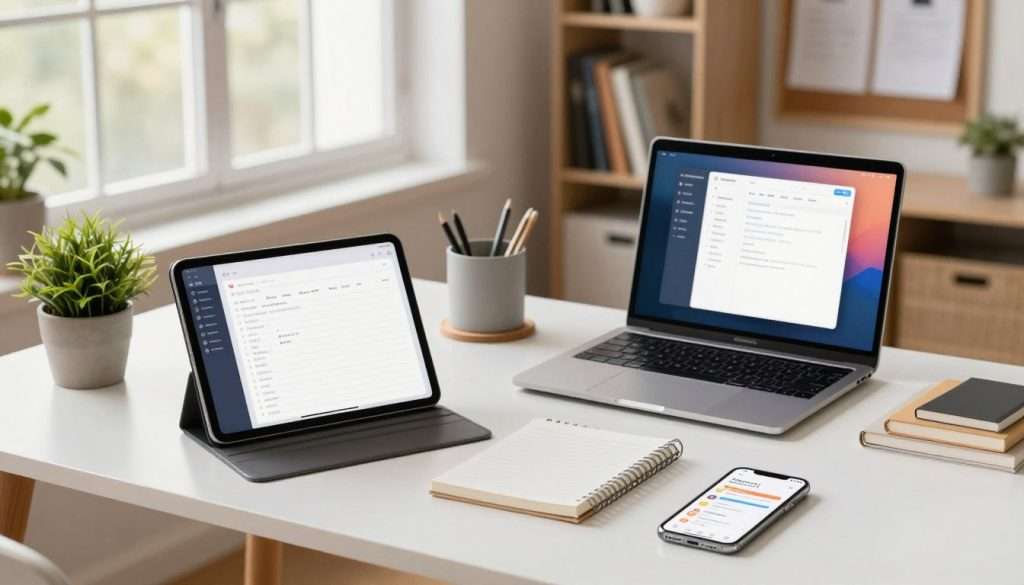
Managing your study materials is easier with the right software. The best digital note-taking tools can boost your productivity. It’s all about finding an interface that fits your workflow.
Features of Notion and Obsidian
Notion is great for those who like to build a system that grows. It lets you create databases, calendars, and wikis in one place. It’s perfect for organizing your life in a clean, modular way.
Obsidian helps you build a personal knowledge base with linked thoughts. It uses a non-linear approach to show connections between topics. Both digital note-taking tools are great for students who want more than simple lists.
Using Microsoft OneNote for Academic Success
Microsoft OneNote is a favorite among students. It acts like a digital binder, making it easy to track lecture slides, notes, and annotations. If you’re already using Microsoft 365, this tool will feel like a natural part of your workspace.
Exploring the Microsoft 365 Fundamentals Specialization is a good idea. It helps you get the hang of these apps so you can focus on learning. Here’s a quick comparison of these popular tools for your daily needs:
| Tool Name | Best For | Key Strength | Learning Curve |
|---|---|---|---|
| Notion | Project Management | High Customization | Moderate |
| Obsidian | Knowledge Linking | Offline Privacy | Steep |
| OneNote | Lecture Notes | Structured Layout | Low |
Effective Note-Taking Methods for Lectures
Ever feel like you missed half the lecture? It’s common when professors zip through slides fast. The right note-taking methods can make you feel like you’ve got it all.
Capturing Key Concepts in Real-Time
Lectures are quick, and trying to write down every word is tiring. Instead, focus on the main ideas and how they connect. This keeps you interested without getting lost in too much info.
In fast-paced lectures, the sentence method is your ally. It’s easy and works well when you’re not sure what to expect. Write each new idea on a new line to keep your notes easy to read.
- Focus on main arguments rather than minor details.
- Use abbreviations to save time during quick explanations.
- Draw arrows to show how one concept leads to another.
Summarizing Information After the Session
Reviewing your notes for just five minutes after the lecture can really help. It makes you think about the info again, which helps you remember it better.
Try to write a short summary of what you learned. By doing this, you turn notes into real knowledge. It’s a small effort that helps a lot when exams come around!
Strategies for Reading and Research Notes
Reading for research is different from listening to a lecture. It needs a careful approach to really understand the material. To find the best note-taking strategies, slow down and engage with the text.
The SQ3R Method for Textbooks
The SQ3R method is a classic technique for mastering textbooks. It stands for Survey, Question, Read, Recite, and Review. This method turns passive reading into an active learning experience.
- Survey: Scan chapter headings and summaries for the big picture.
- Question: Turn headings into questions to focus your brain.
- Read: Find the answers to your questions as you read.
- Recite: Say key points out loud to remember them better.
- Review: Check your notes to make sure everything is clear and organized.
Synthesizing Multiple Sources into One Document
When you move to multiple textbooks, you’ll deal with different authors and views. The magic happens when you combine these sources into one document. This is a top best note-taking strategy for a deep understanding of complex topics.
Instead of keeping separate notes, try to link them together. Find common themes and note where authors disagree. This level of synthesis sets apart students who truly grasp their subjects.
| Strategy | Primary Goal | Best For |
|---|---|---|
| SQ3R | Deep Comprehension | Textbooks |
| Synthesis | Connecting Ideas | Research Papers |
| Outlining | Structure | General Reading |
Organizing Your Notes for Future Retrieval
Your notes are only as useful as your ability to find them when you need them. Many of us capture information without a plan for where it goes. By improving note-taking skills, you turn a messy pile of thoughts into a valuable, searchable resource.

The Importance of Tagging and Categorization
Think of your notes like a library. If the books were thrown in a pile, finding what you need would be hard. A simple system of tagging and categorization makes your past insights easy to find.
Start with these basic habits to keep your workspace tidy:
- Use descriptive titles: Avoid generic names like “Meeting Notes.” Use “Project X Update – Oct 2023” instead.
- Apply consistent tags: Use keywords like #research, #todo, or #ideas to group related content.
- Date your entries: Always include a timestamp to track your thinking over time.
Building a Personal Knowledge Management System
Building a personal knowledge management system might seem daunting, but it starts with small habits. You don’t need complex software to begin. Even a simple folder structure can boost your productivity.
The goal is to create a workflow that feels natural. Treating your notes like a curated collection ensures your hard work pays off. Here’s a simple comparison of organizational methods:
| Method | Best For | Effort Level |
|---|---|---|
| Folder Hierarchy | Strict, top-down projects | Low |
| Tagging System | Cross-referencing ideas | Medium |
| Search-Based | Fast-paced, digital notes | Very Low |
Improving note-taking skills is a journey of refinement. As you grow, your system will evolve. Stay consistent, keep categories simple, and watch how fast you can find your best ideas.
Overcoming Common Note-Taking Challenges
Note-taking can feel like trying to catch a waterfall in a tiny cup. We’ve all been there, staring at pages full of scribbles. Feeling overwhelmed by too much information is common. Learning how to take notes efficiently is not about speed; it’s about knowing what to leave out.
Dealing with Information Overload
When you feel overwhelmed, pause and pick the three most important takeaways. You don’t need to write down every word. Quality always beats quantity when building a useful knowledge base.
“The art of simplicity is a puzzle of knowing what to leave out.”
Focus on the core message to process information better. By filtering out the noise, you learn how to take notes efficiently without getting tired. Keep your focus on the big picture, not the small details.
Staying Focused During Long Meetings or Classes
Staying sharp during long sessions gets better with practice. Use symbols to mark tasks, questions, or key definitions quickly. This keeps your hand moving and your brain active.
- Use a star (*) for critical action items.
- Use a question mark (?) for topics you need to research later.
- Use an arrow (→) to link related concepts.
Remember, your goal is to capture value, not write down every word. When you stop trying to be a human recorder, you find how to take notes efficiently and enjoy it. Stay present, stay curious, and keep your notes simple.
Advanced Techniques to Deepen Your Understanding
To really own what you study, you must go beyond basic note-taking. These advanced methods help your knowledge stick in your brain. By using effective note-taking techniques, you turn your notes into a dynamic guide for mastery.
The Feynman Technique for Concept Mastery
The Feynman Technique is a smart way to check if you get a topic. It’s simple: try explaining a complex idea in simple words, as if teaching a child. If you struggle or use hard words, you know you need to learn more.
When you find these gaps, go back to your notes and study those parts again. Keep doing this until you can explain the idea clearly. This method is great because it helps you understand and simplify information, not just memorize it.
Using Spaced Repetition to Combat the Forgetting Curve
Ever feel like you learn something, then forget it a week later? That’s the forgetting curve at work. But you can fight it with spaced repetition.
Review your notes at increasing intervals over time instead of cramming. This strengthens your brain’s memory paths. It makes remembering information easier during exams or important meetings. Adding this to your routine can be a big change for lasting results.
Conclusion
Learning to take notes well is a journey that benefits you a lot. It helps in school and work. By picking the right tools and reviewing notes often, you make learning from lectures or meetings effective.
We want you to do well in every challenge. You can change how you handle information today. Choose what works for you, whether it’s a notebook or digital tools.
Ready to improve? Get my free book, How to Become the Smartest Student in the Classroom, here: https://www.studyingmachine.com/free-books/. It has memory tips, study plans, and strategies that really work.
There’s no cost and no catch. We’re excited to see these strategies help you reach your goals and make studying easy!