

Ever feel like you’re on a treadmill, working hard but getting nowhere? We’ve all been there. The key to changing your life isn’t about working harder than everyone else. It’s about changing how you see the world.
To become a top 1% thinker, stop the habits that make life harder. It’s not about beating others. It’s about being a little wiser each day.
True growth begins when you simplify your approach. By clearing mental clutter, you make room for clarity. Let’s start this journey together and unlock your hidden potential.
Key Takeaways
- Focus on personal wisdom rather than competing with others.
- Identify and remove habits that create unnecessary friction in your life.
- Prioritize mental clarity to improve your daily decision-making.
- Understand that intellectual growth is a continuous, manageable journey.
- Shift your perspective to simplify complex problems effectively.
The Foundation of High-Level Cognitive Performance
Building a high-performance brain starts with how you see the world. When you decide to improve critical thinking skills, you’re upgrading your brain. It’s not about being the smartest, but about being the most aware.
Understanding the Mindset of the Top 1%
The top 1% of thinkers don’t just take in information; they question it. They see every challenge as a puzzle, not a barrier. This mindset helps them stay calm when others get stressed.
They focus on long-term growth over quick fixes. By diving deep, they build a mental library that lasts. You can do this by asking “why” more and not settling for simple answers.
Breaking Free from Cognitive Biases
Our brains love shortcuts, but these can mislead us. To improve critical thinking skills, you must spot these biases. Whether it’s confirmation bias or sunk cost fallacy, these patterns hold you back.
The table below shows how to replace common biases with better thinking:
| Common Bias | The Trap | Rational Alternative |
|---|---|---|
| Confirmation Bias | Seeking only familiar info | Actively searching for disproof |
| Sunk Cost Fallacy | Staying because of past effort | Evaluating based on future value |
| Availability Heuristic | Judging by recent memories | Analyzing long-term data trends |
By recognizing these biases, you can make better choices. It takes effort, but the reward is a sharper, more reliable mind. This helps you improve critical thinking skills every day.
Mastering Advanced Problem-Solving Techniques
Sometimes, the best way to move forward is to stop and rethink how you approach challenges entirely. When you face a massive wall, you do not need more effort; you need advanced problem-solving techniques to cut through the noise. By changing your perspective, you can turn impossible tasks into manageable steps.
Applying First Principles Thinking
First principles thinking is like being a detective who refuses to accept surface-level assumptions. Instead of looking at how things are usually done, you strip a problem down to its fundamental truths. You ask “why” until you reach the bedrock of reality.
Think of it like cooking from scratch rather than using a pre-made meal kit. You identify the raw ingredients of your challenge and build a solution from the ground up. This method allows you to innovate because you are not limited by the way others have solved the problem before.
“It is important to view knowledge as sort of a semantic tree—make sure you understand the fundamental principles, i.e., the trunk and big branches, before you get into the leaves/details.”
Utilizing Inversion to Identify Hidden Risks
If you want to succeed, you should also learn to think backward. Inversion is one of the most powerful advanced problem-solving techniques because it forces you to look for failure before it happens. Instead of asking, “How do I succeed?” you ask, “What would guarantee my failure?”
By identifying the paths to disaster, you can proactively avoid them. It is much easier to steer clear of a cliff than it is to climb back up after you have fallen. This approach helps you spot hidden risks that everyone else ignores.
| Approach | Primary Focus | Best Used For |
|---|---|---|
| Traditional Thinking | Following established patterns | Routine, low-stakes tasks |
| First Principles | Core truths and logic | Innovation and complex design |
| Inversion | Avoiding failure points | Risk management and strategy |
Mastering these advanced problem-solving techniques will change how you view the world. You will stop feeling overwhelmed by complexity and start seeing the simple, logical structures underneath. Keep practicing these shifts in perspective, and you will find that no problem is truly unsolvable.
How to Become a Top 1% Thinker Through Deliberate Practice
Becoming a top 1% thinker is not luck; it’s a skill you build daily. We often think brilliance is just given, but it’s not. You can train your brain to think clearer and faster by doing specific things every day.
Step One: Cultivating Intellectual Curiosity
To be a top 1% thinker, you must love learning. Curiosity drives your learning every day. Instead of just accepting facts, ask why things work the way they do.
Try to learn something new outside your comfort zone each week. Seeing the world as a classroom keeps your mind sharp and ready for new challenges.
Step Two: Implementing Structured Reflection Cycles
Doing things without thinking is just busywork. Set aside time each week to review your decisions and thoughts. Ask yourself what worked well and what didn’t.
This structured reflection helps you see patterns in your behavior. By spotting these patterns, you can improve how you approach problems and avoid repeating mistakes.
Step Three: Seeking Diverse Mental Models
Your view of the world is narrow if you only see things one way. To broaden your view, seek out different mental models from fields like physics, biology, and history. These models are tools that help you solve complex problems.
Using different ways of thinking gives you a big advantage in solving real-world problems. Keep adding to your collection of models, and you’ll find you can handle almost any challenge.
Optimizing Decision-Making Skills Under Pressure
Ever felt your heart racing when a big decision comes up? It’s normal to feel overwhelmed, but you can optimize decision-making skills by staying in the moment. Instead of worrying about all the bad things that could happen, think about one small, positive step you can take today. This can help improve your tomorrow.

The Art of Probabilistic Thinking
Many of us get stuck because we look for a single “right” answer. But life is rarely just black and white. Probabilistic thinking helps you see choices as a range of possible outcomes, not just yes or no.
When you’re deciding, try to guess the likelihood of each outcome. This helps you avoid getting caught up in trying to be perfect. By doing this, you can optimize decision-making skills even when you don’t have all the information.
- Identify the three most likely outcomes of your choice.
- Assign a rough probability to each scenario.
- Focus your energy on the path with the highest upside and manageable risk.
Managing Emotional Interference in High-Stakes Choices
Your feelings are strong, but they can sometimes cloud your judgment. When the stakes are high, your brain might push you toward the safest or most comfortable option. Emotional interference can make you see threats where there are only challenges.
To stay clear-headed, try to separate your feelings from the facts. Writing down your concerns can help you see them objectively. When you separate your emotions from the data, you can make a smart, calculated move. Remember, you are in control of your own mind, and you can navigate through tough times.
Sharpening Mental Acuity Through Information Dieting
To sharpen mental acuity, treat your information like a pro athlete treats their diet. Just as bad food drains energy, bad content clouds your mind. Be strict about what you let in.
Filtering High-Signal Content
Most of what we see daily is just noise. It looks busy but doesn’t help much. To sharpen mental acuity, choose content that challenges you and teaches timeless lessons, not just trends.
Think of your brain as a top processor. Bad data means bad results. Check your social media and newsletters to make sure they’re worth your time.
| Content Type | Impact on Mind | Action Required |
|---|---|---|
| Clickbait Headlines | High Distraction | Unsubscribe |
| Deep-Dive Essays | High Signal | Prioritize |
| Social Media Feeds | Low Signal | Limit Time |
The Importance of Deep Work and Focused Attention
After cleaning up your info diet, protect your focus. Deep work means focusing without distractions on tough tasks. It’s key for top results in a world full of distractions.
“The ability to focus is a superpower in an age of distraction.”
By setting aside time for single tasks, you get into a flow state. This is where you do your best work. By focusing deeply, you go from average to amazing. It’s not about doing more, but doing it better.
Enhancing Cognitive Abilities via Strategic Rest
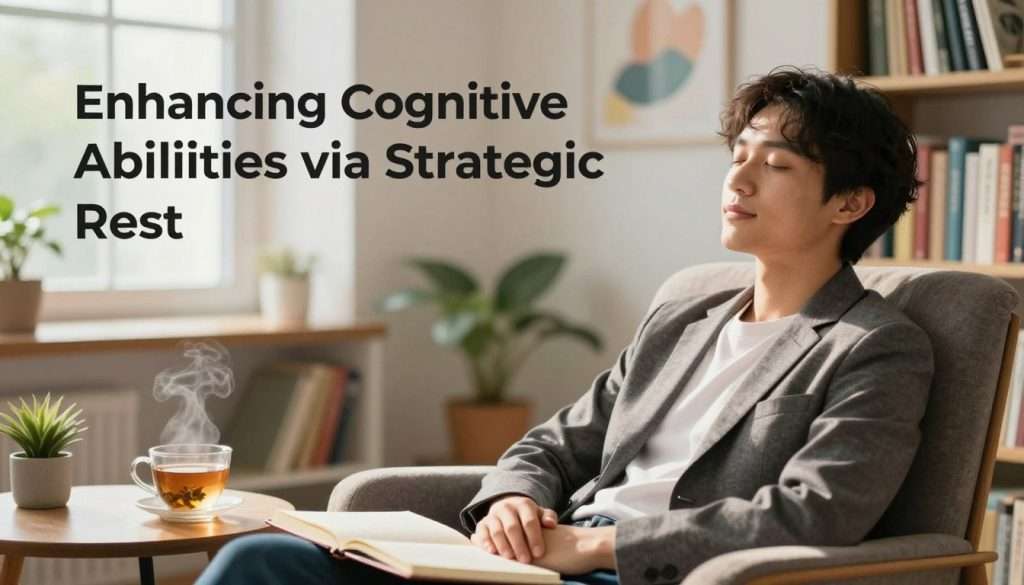
Ever wonder why your best ideas pop up while you are taking a shower or walking the dog? You might think that grinding away at your desk is the only path to success. But your brain actually craves a break. Strategic rest is the secret weapon you need to enhance cognitive abilities and keep your mind performing at its peak.
The Role of Sleep in Memory Consolidation
Think of sleep as the ultimate save button for your brain. When you drift off, your mind is busy sorting through the day’s information. It moves facts from short-term storage into long-term memory. Without enough quality rest, you are leaving your hard work unsaved.
Prioritizing a consistent sleep schedule is one of the most effective ways to sharpen mental acuity. When you wake up well-rested, your brain is ready to process complex information with ease. As the saying goes:
“Sleep is the best meditation.”
Leveraging Idle Time for Subconscious Problem Solving
Have you ever felt stuck on a difficult task, only to find the answer while doing something completely unrelated? This happens because your subconscious mind never really stops working. When you step away from your screen, you allow your brain to connect disparate dots in the background.
To truly enhance cognitive abilities, you must embrace periods of “productive idleness.” Whether it is a short walk or simply staring out a window, these moments of downtime allow your brain to untangle complex knots. By giving yourself permission to relax, you actually sharpen mental acuity and return to your work with a fresh, clear perspective.
Developing Advanced Analytical Thinking Frameworks
Most people see problems as isolated events. But you can see more. To improve critical thinking skills, you need to look at the big picture. This way, you can handle complex situations with ease.
Systems Thinking for Complex Environments
Systems thinking is like having a map for a maze. It lets you see how all parts of a system connect. This is a key advanced problem-solving technique today.
Seeing your world as a web of relationships changes how you react. You start to tackle the root causes of problems. This way, you can predict how changes in one area affect the whole project.
Synthesizing Disparate Data Points
Too much information can be overwhelming. To boost analytical thinking, you need to find meaning in scattered facts. It’s not about knowing everything. It’s about connecting the right dots for a clear plan.
Imagine yourself as a detective gathering clues. You combine data from different sources into a clear story. This turns confusing information into a sharp plan for your next step.
| Thinking Style | Primary Focus | Outcome |
|---|---|---|
| Linear Thinking | Single cause and effect | Basic solutions |
| Systems Thinking | Interconnected patterns | Sustainable results |
| Data Synthesis | Connecting disparate facts | Strategic clarity |
Elevating Intellectual Capacity Through Continuous Learning
We believe that true growth happens when you treat your entire life as a continuous learning project. When you stop viewing education as a chore, you unlock a new level of curiosity. This curiosity helps you elevate intellectual capacity in every area of your life. It’s all about staying hungry for knowledge and finding joy in the process of discovery.
Building a Personal Knowledge Management System
Ever had a brilliant idea, only to forget it a few days later? A Personal Knowledge Management (PKM) system acts as your second brain. It ensures that every insight you encounter is saved for later use. By using tools like Notion, Obsidian, or even a simple notebook, you can organize your thoughts and connect dots that others might miss.
This system allows you to store articles, book notes, and fleeting thoughts in one accessible place. Over time, this habit will significantly enhance cognitive abilities. It lets you retrieve and synthesize information whenever you need it. You’ll never have to worry about losing a great idea again!
The Feynman Technique for Mastery
Once you have gathered your information, you need to make sure you actually understand it. Our favorite way to do this is the Feynman Technique, named after the brilliant physicist Richard Feynman. The core idea is simple: if you cannot explain a concept in plain language, you do not truly understand it yet.
To practice this, try teaching a complex topic to a child or a friend who knows nothing about it. If you find yourself using jargon or getting stuck, go back to your source material and fill in those gaps. This process is a powerful way to enhance cognitive abilities and ensure your knowledge is rock solid.
| Method | Primary Benefit | Best For |
|---|---|---|
| PKM System | Information Retention | Long-term storage |
| Feynman Technique | Deep Understanding | Mastering new topics |
| Active Recall | Memory Strength | Exam preparation |
Conclusion
You now have the tools to sharpen your mind. By using these strategies, you’re on your way to a smarter you. You’ll see the world in a new light.
Feel empowered to think more deeply and make better choices. This journey will make you wiser than before.
Make these habits a daily part of your life. Stay curious about everything. What small change will you make this week?
Let us know how you’re doing or if you need help. We’re excited to hear how you’re using these tools. Your growth is our reward.