
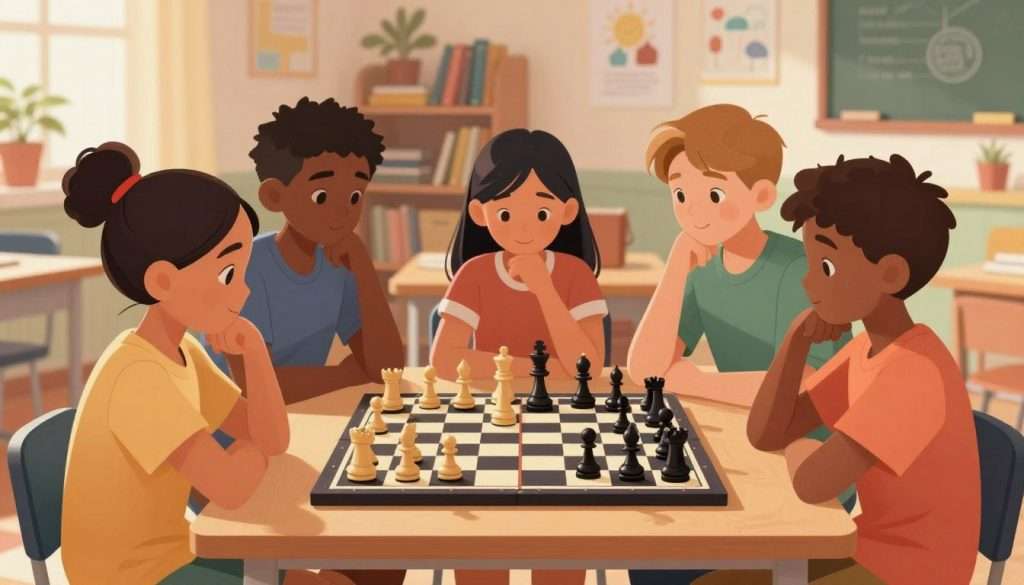
Ever felt like your brain needed a workout that wasn’t boring? We often see chess as just a hobby. But what if it’s actually a key to unlocking cognitive growth?
Chess is more than a game. It’s a tool for developing a strategic mind. It helps you see patterns and plan ahead.
The benefits of chess for learning are vast. It improves focus and patience. It’s a unique way to exercise your mind, benefiting everyone!
Key Takeaways
- Boosts critical thinking and logical reasoning.
- Improves long-term memory and information recall.
- Promotes better concentration during difficult study sessions.
- Encourages creative and out-of-the-box problem-solving.
- Builds emotional resilience and patience under pressure.
- Trains the brain to recognize complex patterns quickly.
The Scientific Connection Between Chess and Brain Development
Science shows a strong link between chess and brain development. This connection helps improve brain function. We’ll look at how chess training affects the brain, its impact on learning, and how it changes the brain for better learning.
Neuroplasticity and Chess Training
Chess training boosts neuroplasticity, the brain’s ability to make new connections. Research shows long-term chess players have stronger thinking skills (Gliga & Flesner, 2014). These skills are key for learning and adapting to new things.
Playing chess is more than moving pieces. It works out your brain, using areas for planning, logic, and memory (Ortiz-Pulido et al., 2019). This mental exercise improves flexibility and resilience.
Research Studies on Chess and Academic Performance
Many studies have looked at chess and school performance. They find chess players often do better in school, thanks to problem-solving and critical thinking skills. Chess training boosts cognitive skills that help in school.
For example, a study might compare students who play chess with those who don’t. It shows chess improves focus, memory, and analytical skills.
How Chess Rewires Your Brain for Better Learning
Regular chess play rewires your brain for better info processing and problem-solving. This is due to neuroplasticity, where the brain adapts to new challenges.
As you play and challenge yourself, your brain creates new paths and strengthens old ones. This makes you better at learning and remembering new things.
Core Cognitive Skills Enhanced by Chess
Chess is more than a game; it’s a tool that boosts learning skills. It sharpens our brain’s ability to think, remember, and solve problems.
Playing chess makes our brain work better. It improves memory, attention, and analytical thinking. This is because chess requires constant problem-solving and quick decision-making.
Critical Thinking and Analytical Reasoning
Chess teaches us to think critically and analytically. Players analyze positions, predict outcomes, and adjust strategies. This sharpens our ability to evaluate information and make informed decisions.
For example, chess players often do better in math and science. They apply analytical thinking to solve complex problems.
Key benefits of enhanced critical thinking and analytical reasoning include:
- Better decision-making skills
- Improved problem-solving abilities
- Enhanced ability to evaluate complex information
Working Memory and Long-Term Retention
Chess boosts working memory by requiring players to remember moves and strategies. This makes our brain better at storing and recalling information.
Chess practice improves our ability to hold and manipulate information. This leads to better performance in tasks that require remembering instructions or following complex procedures.
Spatial Intelligence and Visualization
Chess enhances spatial intelligence by requiring players to visualize the board and pieces. This skill is useful in fields like architecture and engineering.
Chess players also become better at planning and executing strategies. This skill is valuable in real-life situations.
Executive Function Development
Executive functions include planning, decision-making, and controlling inhibitions. Chess enhances these functions by requiring players to plan ahead and make strategic decisions.
Chess helps develop these skills, making individuals more organized and focused. This is beneficial in both personal and professional life.
The development of executive functions through chess can lead to:
- Improved planning and organization skills
- Enhanced ability to focus and avoid distractions
- Better self-control and decision-making
In conclusion, chess is a game that educates and enhances cognitive skills. It improves critical thinking, working memory, spatial intelligence, and executive functions. By playing chess regularly, individuals can see significant improvements in these areas.
How Playing Chess Can Improve Your Learning Through Problem-Solving
Playing chess is more than just moving pieces on a board. It sharpens your mind for solving complex problems. You learn to analyze positions, predict outcomes, and adjust strategies. These skills help in school and real life.
Breaking Down Complex Problems Into Manageable Steps
Chess teaches you to break down big problems into smaller steps. Players face complex positions that need deep understanding. They learn to identify key factors, prioritize moves, and plan step by step.
For instance, solving a tough math problem becomes easier with chess skills. You can break it down into smaller parts, making it simpler to solve.
Evaluating Multiple Solutions Simultaneously
Chess players learn to look at many solutions at once. They consider different moves and their outcomes. This skill is key in school and work, where weighing options and predicting outcomes is important.
Key Benefits:
- Improved analytical thinking
- Enhanced decision-making skills
- Better risk assessment
Learning from Mistakes and Failed Strategies
Chess teaches you to learn from mistakes. By analyzing failures and adjusting strategies, players grow resilient and improve their problem-solving.
Did you know? Studies show chess players do better in school and have better cognitive skills.
Here’s a comparison of problem-solving skills in chess and academics:
| Skill | Chess Application | Academic Application |
|---|---|---|
| Analytical Thinking | Analyzing positions and predicting outcomes | Breaking down complex math problems |
| Strategic Planning | Developing a game plan | Creating study plans for exams |
| Adaptability | Adjusting strategy based on opponent’s moves | Adapting to new information or challenges |
Getting Started: Your Foundation for Chess-Based Learning
Chess is more than a game; it’s a tool to boost your learning. As we start with chess-based learning, you’ll learn the basics that unlock its educational power.
Understanding Basic Chess Rules and Notation
First, learn the basic rules and notation of chess. Chess notation helps you study and improve games. Knowing how pieces move and basic strategies is key to starting your chess journey.
Key concepts to grasp include:
- How each piece moves and captures
- Basic checkmate patterns
- Understanding check, checkmate, and stalemate
- Familiarity with algebraic notation
Choosing the Right Learning Platform for Your Level
There are many resources out there, making it hard to choose. Think about your skill level and what you like to learn when picking a platform.
Chess.com and Lichess for Beginners
For beginners, Chess.com and Lichess.org are great. They offer:
- Interactive tutorials and lessons
- Puzzles and exercises to improve tactics
- Opportunities to play against other players of various skill levels
If you like learning offline, there are many chess books. “Logical Chess” by Irving Chernev and “My 60 Memorable Games” by Bobby Fischer are great for beginners.
Setting SMART Goals for Chess Improvement
To improve at chess, set SMART (Specific, Measurable, Achievable, Relevant, Time-bound) goals. This could be:
- Improving your chess rating by a certain number within a specific timeframe
- Mastering a particular opening or endgame strategy
- Dedicating a certain amount of time each week to studying chess
Clear goals help you track your progress and stay motivated in your chess learning journey.
Step-by-Step Process to Leverage Chess for Learning Enhancement
To get the most out of chess for learning, follow a step-by-step guide. This structured method helps you enhance your learning through chess and boost your school grades.
Step 1: Establish a Consistent Practice Schedule
First, create a regular practice schedule. This habit ensures steady progress and improvement.
Daily 15-Minute Sessions for Beginners
Beginners should start with 15-minute daily sessions. It’s enough to be helpful but easy to fit into your day.
Progressive Time Increases as Skills Develop
As you get better, increase your practice time. This keeps the challenge level up and keeps you engaged.
Step 2: Focus on Tactical Puzzles to Build Pattern Recognition
Working on tactical puzzles is key. They boost your pattern recognition and analytical skills, vital for chess strategies for improved learning.
Step 3: Analyze Every Game You Play
Reviewing every game you play is crucial. It helps spot mistakes and shows where you can get better.
Using Engine Analysis Effectively
Chess engine analysis offers deep insights into your games. It shows the best moves and where you went wrong.
Identifying Your Recurring Mistakes
By reviewing your games, you can find common mistakes. Knowing these patterns lets you focus on specific areas for improvement.
Step 4: Study Master Games and Classic Strategies
Studying master games and classic strategies broadens your understanding. It introduces you to various tactics and strategies.
Step 5: Apply Chess Thinking to Academic Challenges
Using chess thinking in your schoolwork is very beneficial. It trains you to solve problems logically and analytically.
“The key to pursuing excellence is to maintain a sense of freshness.”
By sticking to these steps and keeping your approach fresh and challenging, you can fully benefit from chess for learning.
Transferring Chess Skills to Academic Learning
Playing chess can greatly improve your schoolwork. The game teaches you to plan, solve problems, and be patient. These skills help you do better in school.
Using Strategic Planning for Study Sessions
Chess teaches you to plan strategically. This skill helps you study more effectively. You’ll get more done and do it better.
The Opening Phase: Planning Your Study Approach
In chess, the start is crucial. You set up your pieces for success. Studying is similar. You need to plan your study goals and gather your resources.
The Middlegame: Executing Your Learning Strategy
Chess players make tactical moves in the middlegame. When studying, you engage with the material, connect ideas, and apply what you’ve learned.
The Endgame: Review and Consolidation
The endgame in chess requires precision. In studying, it’s about reviewing and solidifying your knowledge. This step helps you remember and understand better.
Applying Chess Tactics to Problem-Solving in Math and Science
Chess tactics boost your problem-solving skills, mainly in math and science. You learn to analyze, spot patterns, and think of various solutions. This helps you tackle tough school tasks more effectively.
“The ability to analyze complex positions and think critically is a skill that transcends the chessboard, benefiting many areas of academic study.”
Utilizing Chess Patience for Long-Term Projects
Chess teaches patience and persistence. These qualities are key for finishing long projects. By seeing progress as valuable, you stay motivated and focused on your goals.
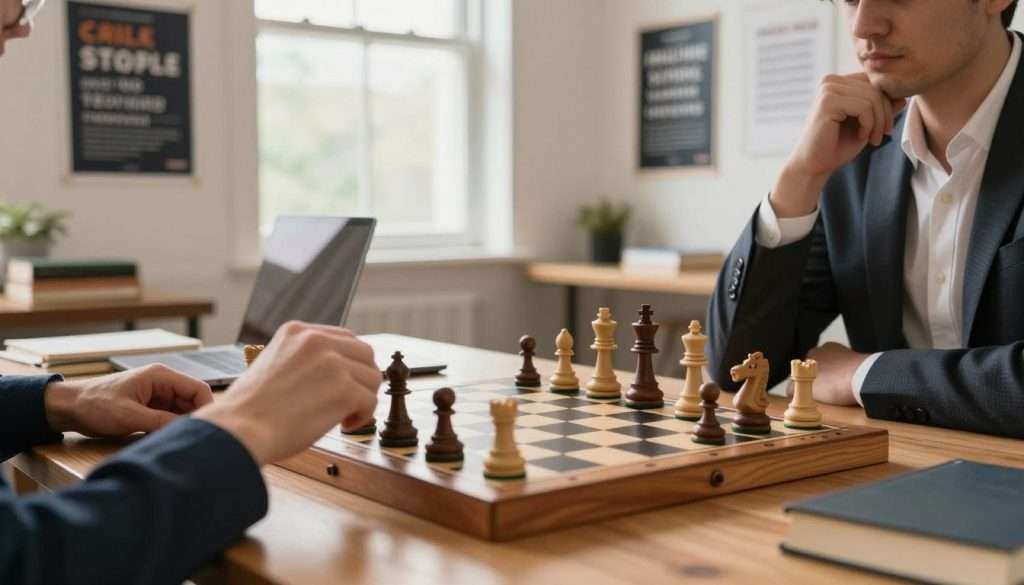
Using chess skills in school can lead to big improvements. You’ll learn more and do better in your studies.
Memory Enhancement Techniques Learned from Chess
Chess is more than just a game; it’s a way to boost your memory. Players learn to remember chess positions and patterns. These skills help in many areas of life, not just chess.
Let’s look at some memory techniques from chess and how to use them in everyday life.
The Method of Loci Applied to Chess Positions
The method of loci, or “memory palace,” uses a familiar place to remember things. Chess players use it to recall complex positions and moves. They imagine the chessboard and link pieces with locations.
You can use this method to remember lists, speeches, or dates. For example, imagine walking through your house and linking each room with items on your grocery list.
Chunking Information Like Chess Patterns
Chess players also use chunking to break down complex info into smaller parts. They see patterns of pieces, not just individual ones. This makes it easier to remember and process information.
Chunking can help you in daily life too. For example, when trying to remember a phone number, break it into smaller groups. This makes it easier to recall.
Spaced Repetition Through Regular Chess Practice
Regular chess practice is essential for improving and memory. Spaced repetition, reviewing material at longer intervals, helps solidify chess knowledge. This makes it easier to recall later.
Using spaced repetition in your studies or daily life can improve memory. Review notes or flashcards at longer intervals to strengthen your memory.
By using these chess-based memory techniques, you can enhance your memory. This leads to better performance in school, work, and daily life.
Developing Focus and Concentration Through Chess Training
Chess is a game that needs a lot of mental focus. It can really help you improve your concentration and attention. By playing chess, you’re not just getting better at the game. You’re also sharpening your brain skills for other areas of life.
Chess is great for keeping your attention sharp. Long games require players to stay focused. They need to think ahead, plan their moves, and adjust their strategies.
Building Sustained Attention During Long Games
Chess games can go on for hours. Players must keep their minds sharp for a long time. Regular practice helps improve your focus, making it easier to handle complex tasks without getting tired.
To improve your focus, try these tips:
- Play longer games or study complex chess positions.
- Focus on one task at a time, without switching.
- Use chess puzzles or tactics training to sharpen your concentration.
Eliminating Distractions: Lessons from Tournament Play
Top chess players face a lot of pressure and distractions. Yet, they stay focused. By learning from them, you can improve your own focus. Techniques like pre-game routines, mindfulness, and mental preparation can help you stay sharp under pressure.
To avoid distractions, consider these tips:
- Develop a pre-game routine to get ready.
- Use mindfulness to stay present and focused.
- Identify and reduce distractions during study or play.
The Pomodoro Technique Inspired by Chess Time Controls
The Pomodoro Technique was inspired by chess time controls. It involves working in focused, timed blocks (usually 25 minutes) followed by a short break. This method can boost your productivity and keep you focused during study or work.
To use the Pomodoro Technique:
- Choose a task you want to tackle.
- Set a timer for 25 minutes and work without breaks.
- Take a 5-minute break when the timer goes off.
- Repeat the cycle, with longer breaks every four cycles.
By using these strategies in your chess training and daily life, you can improve your focus and concentration. This will help you get better at chess and enhance your brain skills in general.
Meta-Cognitive Skills: Learning How to Learn with Chess
Chess can greatly improve our learning skills. It makes us think about our games, spot mistakes, and change our plans. This helps us develop important skills for learning and solving problems.
These skills are key for effective learning. We’ll see how chess boosts our ability to learn and solve problems. We’ll look at analyzing games, finding what we don’t know, changing how we learn, and growing as learners.
Self-Assessment Through Post-Game Analysis
Chess teaches us to evaluate ourselves. After each game, we look back at our moves. This post-game analysis shows us what we did right and wrong.
For example, we might find we’re weak in certain openings or endgames. Knowing this, we can work on those areas. This makes our chess better overall.
Identifying Knowledge Gaps and Blind Spots
Chess also helps us find what we don’t know. When we try new strategies, we might see where we’re missing knowledge. Spotting these gaps is the first step to getting better.
- Reviewing games to identify recurring mistakes
- Seeking guidance from more experienced players or coaches
- Studying chess theories and strategies to fill knowledge gaps
Adapting Your Learning Strategy Based on Results
Chess teaches us to be flexible. By looking at our game results, we can change how we learn. This flexibility is useful in many areas of life.
For instance, if we struggle with endgames, we might study them more. This helps us get better at chess.
Developing Growth Mindset Through Chess Challenges
Chess also helps us grow as learners. Every game is a chance to learn and get better. This encourages us to face challenges head-on.
Having a growth mindset means we believe we can get better with effort. This positive attitude helps us learn more effectively.
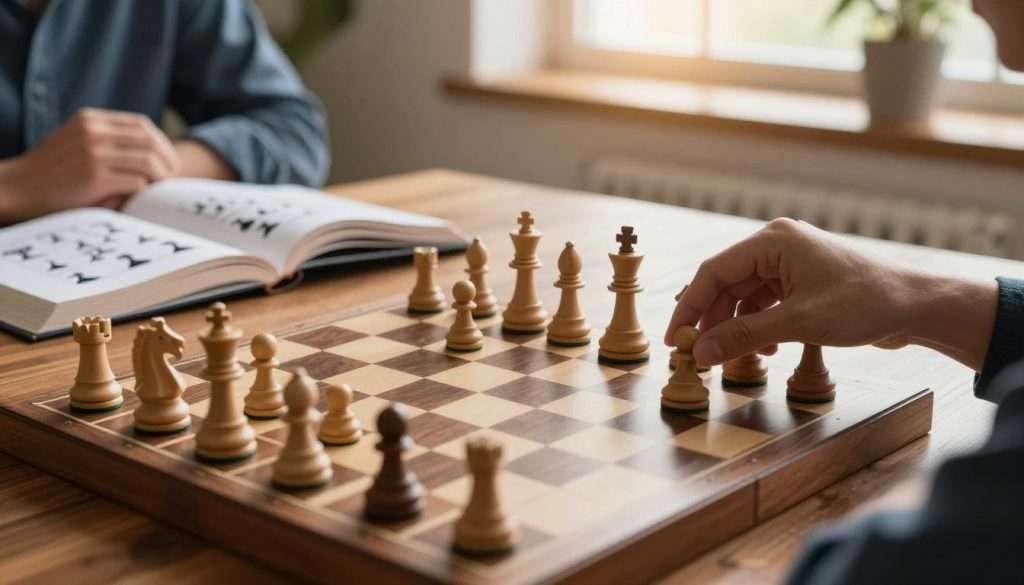
In conclusion, chess is great for learning. It helps us evaluate ourselves, find what we don’t know, adapt our learning, and grow as learners. Chess makes us better at learning and solving problems.
Creating an Effective Chess Practice Routine for Maximum Learning Benefits
A good chess practice routine can help you do better in school. To enhance learning through chess, make sure your practice is well-organized. This way, you get the most out of it.
Structuring Your Weekly Chess Schedule
Plan your chess practice to focus on different skills each day. This keeps your game improving in all areas.
Tactical Training Days
Work on tactical puzzles to get better at recognizing patterns and making quick decisions. Websites like Chess.com and Lichess have lots of puzzles to try.
Strategy Study Sessions
Set aside time to study master games and classic strategies. Look at the moves, understand the thinking behind them, and learn how to use these strategies in your games.
Competitive Play Time
Play chess against others, online or offline. This is key for putting what you’ve learned into practice and seeing how you do under pressure.
Integrating Chess Practice with Academic Study
To use chess for better academic performance, mix your chess practice with studying. The focus and concentration chess helps you develop can also help with your schoolwork.
- Try the Pomodoro Technique, inspired by chess time controls, to stay focused while studying.
- Use chess strategies for planning your approach to big projects and assignments.
Tracking Progress and Adjusting Your Approach
Check your chess progress often and change your routine if needed. Keep a journal of your games, noting what worked and what didn’t.
By organizing your chess practice well and linking it to your schoolwork, you can enhance your learning. This will help you do better in school.
Measuring and Maintaining Your Cognitive Improvements
Playing chess can really show how much you’ve learned over time. As you play more, you’ll see big changes in how you think. We’ll talk about how to keep track of these changes and keep them going.
Observable Changes in Academic Performance
Playing chess can make you smarter in school. Kids who play chess get better at solving problems and thinking critically. These skills help them do well in many subjects.
You might find it easier to focus on hard tasks. Chess teaches you to think strategically. This skill is great for math and science.
Rating Progress as a Proxy for Cognitive Development
Your chess rating shows how smart you’re getting. A higher rating means you’re getting better at solving problems. It’s a sign of your growing brain power.
Watching your rating go up can tell you a lot about your brain. It shows you’re getting better at making smart choices.
Long-Term Habits for Sustained Benefits
To keep getting smarter from chess, you need to keep playing. Playing regularly helps your brain stay sharp. It makes sure you keep getting better.
Here are some tips to keep playing:
- Make time every day to play chess.
- Join a chess club or group to stay excited.
- Play in online tournaments to challenge yourself.
- Look over your games to see where you can get better.
| Cognitive Skill | Before Chess Practice | After Chess Practice |
|---|---|---|
| Critical Thinking | Limited analytical ability | Enhanced analytical reasoning |
| Problem-Solving | Struggled with complex problems | Improved ability to break down complex problems |
| Concentration | Easily distracted | Improved focus and sustained attention |
By keeping track of your progress and playing regularly, you can really improve your mind. You’ll see better grades and sharper thinking.
Conclusion
Playing chess can really change your learning game. It boosts your brain in ways that help you do better in school. Chess sharpens your thinking, memory, and spatial skills, making you a better learner.
Using the tips from this article, you can get better at solving tough problems and remembering things. Chess is great for students wanting to improve their grades or anyone wanting to stay mentally sharp.
So, why not start playing chess today? With regular practice, you’ll see how it can make you a better learner. You’ll also join a community of people who love learning and improving themselves.