
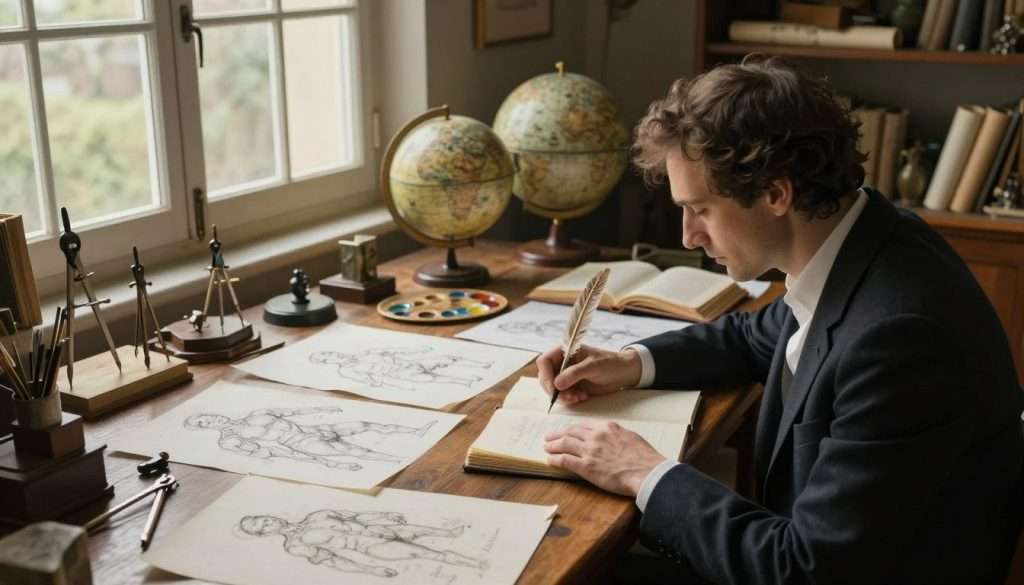
Ever feel like your brain is stuck in a boring cycle? We’ve all been there, staring at dull notes until they blur. But what if we could unlock a spark of genius, turning learning into an exciting journey?
Michael Gelb’s book on Leonardo da Vinci offers valuable insights into a legendary mindset. It gives us practical ways to boost creativity and broaden our minds. By using these strategies, we make learning an exciting adventure.
We’re not just talking about art or inventions. It’s about igniting your passion for knowledge and seeing the world anew. Let’s dive into these methods and level up our learning.
Learning shouldn’t be a chore. Instead, we can see it as a work of art, just like Leonardo da Vinci did centuries ago.
Key Takeaways
- Practice relentless curiosity about every subject you encounter.
- Learn via sensory experience rather than just reading.
- Embrace ambiguity and mystery without seeking instant answers.
- Balance logic and science with creative imagination.
- Develop whole-body fitness for a sharper mental state.
- Recognize the global interconnectedness of all different things.
- Refine visual observational skills to notice hidden details.
Understanding Leonardo da Vinci’s Philosophy of Self-Education
Da Vinci’s curiosity was endless, leading him to learn on his own terms. This method wasn’t just about gathering facts. It was about really understanding the world through observing, trying things out, and asking questions.
At the core of Da Vinci’s thinking was the idea that learning is a lifelong journey. He believed that learning wasn’t just for school. Instead, it was a way to see how art, science, and math are all connected.
The Renaissance Man’s Approach to Knowledge
Da Vinci’s way of learning was all about curiosity and seeing connections. He studied water, birds, and the human body with the same passion. He saw the common threads in these different areas.
This way of learning led to amazing discoveries and art. For Da Vinci, knowledge was always changing. It grew as he learned and applied new ideas.
| Key Elements | Da Vinci’s Approach | Modern Application |
|---|---|---|
| Curiosity | Asked questions about everything | Maintain a daily list of questions to explore |
| Observation | Studied nature and human anatomy | Practice detailed visual observation daily |
| Interdisciplinary Learning | Connected art, science, and mathematics | Study different subjects in relation to each other |
Why Traditional Education Wasn’t Enough for Da Vinci
In Da Vinci’s day, school was strict and narrow, focusing on old texts and rules. Da Vinci felt trapped by this, wanting to explore the world and learn through trying things.
So, he chose to learn on his own. This way, he could learn at his own speed and challenge old ideas. It let him find his own path.
By learning on his own, Da Vinci became a true Renaissance man. His story shows us that with the right mindset, we can all learn effectively and reach our goals.
Cultivate Insatiable Curiosity in Everything You Encounter
To learn like Da Vinci, you must always be curious. Da Vinci was always asking questions and seeking answers. This curiosity fueled his creativity and innovation.
Ask “Why?” and “How?” About Ordinary Phenomena
Have you ever stopped to think about everyday things? Da Vinci did this all the time. He wondered about water flow and bird flight patterns. Asking “why?” and “how?” helps you understand the world better.
As Da Vinci once said,
“The noblest pleasure is the joy of understanding.”
This joy comes from questioning the ordinary and seeking answers.
Create a Daily List of Questions to Explore
Building curiosity means setting time to think about what you’re curious about. Start a “curiosity journal” to write down your questions. This keeps you engaged and motivated.
- What are the principles behind a phenomenon I’m observing?
- How can I apply this knowledge in a practical way?
- What are the implications of this discovery?
Follow Your Curiosity Down Unexpected Paths
Da Vinci’s curiosity took him on unexpected journeys. He explored new interests, even if they seemed unrelated. This helped him connect different fields.
Curiosity is not just about asking questions; it’s about being open to new experiences and knowledge. Following your curiosity makes learning more fulfilling and engaging.
Master the Art of Scientific Observation
By improving our observation skills, we can gain a deeper understanding of the world, just like Da Vinci did. Scientific observation was key for Leonardo da Vinci. It helped him learn and innovate.
Da Vinci didn’t just see things; he understood them deeply. He spent hours studying nature, from water to the human body. This helped him connect different things in new ways.
Practice Detailed Visual Observation Daily
To be like Da Vinci, we must observe regularly. Spend a few minutes each day observing closely. Look at shapes, colors, and textures around you.
For example, study a leaf. Notice its shape, vein patterns, and how it’s attached. This sharpens your detail noticing.
Study Nature as Your Primary Teacher
Nature was Da Vinci’s main teacher. He believed studying nature could reveal much about the world. Spend time outdoors to observe weather, animal behavior, and plant growth.
This practice improves your observation skills and deepens your appreciation for nature’s complexity and beauty.
Document What You Actually See, Not What You Assume
Da Vinci was known for accurate documentation. He drew what he saw, not what he thought he’d see. This helped him avoid assumptions and base his understanding on facts.
To follow this, keep a notebook for your observations. Include sketches, diagrams, and notes. Review your entries to find patterns and connections you might have missed.
| Observation Skill | Daily Practice | Benefit |
|---|---|---|
| Detailed Visual Observation | Observe an object or scene for 10 minutes daily | Improved attention to detail |
| Studying Nature | Spend 30 minutes outdoors observing natural phenomena | Deeper understanding of natural patterns |
| Accurate Documentation | Maintain a daily notebook of observations | Enhanced ability to record and recall information |
How to Educate Yourself Like Leonardo da Vinci Through Interdisciplinary Learning
Leonardo da Vinci’s work shows us that learning has no limits. To educate yourself like a polymath, you must see how different subjects are connected. Da Vinci didn’t stick to one field. He explored many, from anatomy to engineering, linking them together.
Learning in many areas helps you understand the world better. It’s about being curious and seeing how subjects relate. For example, Da Vinci’s study of water flow helped his art and engineering. You can do the same by seeing how one idea can help another.
Connect Disparate Fields of Knowledge Deliberately
Start by finding areas that interest you and look for links between them. For instance, you could mix biology with art by studying human anatomy. Da Vinci’s Vitruvian Man shows how art and math can come together.

Study Art Through the Lens of Science and Mathematics
When you study art, think about the science and math behind it. For example, perspective uses geometry, and color involves physics. Using science in art can make your work more creative and innovative. Da Vinci’s chiaroscuro technique is a great example of science meeting art.
Apply Scientific Principles to Creative Projects
Don’t hesitate to use science in your creative projects. You can apply physics to motion or chemistry to create new materials. Da Vinci’s inventions were groundbreaking because he used science to solve problems.
Build Your Personal Web of Connected Knowledge
As you learn more, you’ll see how subjects are connected. Building a web of knowledge means recognizing these links. Keep a journal to record your thoughts and look for patterns.
By learning like Da Vinci, you can develop self-study techniques that are fun and effective. The goal is to understand the world and your role in it deeply.
Keep Detailed Notebooks and Document Your Learning Journey
To learn like a genius, start by keeping detailed notebooks like Da Vinci did. He wrote down his observations, ideas, and insights in his notebooks. This helped him reflect, find patterns, and connect different pieces of information.
Da Vinci’s notebooks were more than just notes. They were tools for learning and creativity. By using a similar approach, you can better capture and retain knowledge. You’ll also gain a deeper understanding of the world.
Capture Ideas Effectively
Creating your own notebook system is key to capturing ideas. Choose a method that feels right to you, whether it’s digital or physical. The goal is to make recording your thoughts a regular habit.
Tips for Developing Your Notebook System:
- Choose a medium that you’re comfortable with, whether it’s digital or analog.
- Make it a habit to carry your notebook or access your digital tool regularly.
- Organize your notes in a way that makes sense to you, using indexes, tags, or categories.
Combine Written Notes with Visual Elements
Da Vinci mixed written notes with sketches and diagrams. This method helps you understand and remember complex information better. Adding visuals to your notes makes learning more engaging and effective.
Benefits of Visual Note-taking:
| Method | Benefits |
|---|---|
| Written Notes | Captures detailed information, allows for reflection |
| Sketches and Diagrams | Enhances understanding, aids memory retention |
| Combination of Both | Provides a comprehensive view, fosters creativity |
Regular Review and Cross-Referencing
Reviewing and cross-referencing your notes regularly is crucial. Da Vinci believed in reviewing his notes to spot patterns and gain new insights. This practice reinforces your learning and connects different ideas.
Strategies for Reviewing Your Notes:
- Schedule regular review sessions to go through your notes.
- Use your notes to identify patterns and connections between different ideas.
- Update your notes with new information and insights.
Embrace Hands-On Experimentation and Direct Experience
For Da Vinci, learning wasn’t just about reading or watching; it was about doing and experimenting. This hands-on approach allowed him to deepen his understanding of the world. It helped him develop practical skills essential for his innovative work.
Da Vinci’s method of learning through direct experience and experimentation is powerful. By engaging in hands-on activities, we can test theories and challenge assumptions. This way, we gain a more nuanced understanding of complex concepts.
Learn by Doing, Not Just Reading or Watching
Learning by doing engages multiple senses and cognitive processes. This can lead to better retention and understanding of the material. It encourages experimentation, creativity, and problem-solving.
- Try new activities and hobbies to discover your hidden talents.
- Participate in projects that challenge you and push you out of your comfort zone.
- Use hands-on materials and tools to explore complex concepts in a tangible way.
Test Theories Through Physical Experiments
Da Vinci tested his theories through physical experiments. This allowed him to validate his ideas and refine his understanding of the world. By conducting experiments, we can gain hands-on experience and develop a deeper appreciation for the underlying principles.
Key benefits of testing theories through experiments:
- Validation of hypotheses through empirical evidence.
- Development of critical thinking and problem-solving skills.
- Enhanced understanding of complex concepts through practical application.
Seek Out Apprenticeships and Mentorship Opportunities
Da Vinci recognized the value of learning from others. He sought out apprenticeships and mentorship opportunities to gain new skills and insights. By working with experienced individuals, we can gain valuable guidance, support, and feedback.
Consider the following ways to find mentorship opportunities:
- Reach out to professionals in your desired field and ask for guidance.
- Join online communities or forums related to your area of interest.
- Participate in workshops, conferences, or seminars to meet experts and learn from their experiences.

Develop Visual Thinking and Drawing Skills
Visual thinking and drawing were key for Da Vinci’s learning. These skills help you better observe and understand complex information.
Drawing as a Learning Tool
Da Vinci saw drawing as more than art; it was a learning tool. Drawing engages your brain in a unique way. It helps you understand and remember information better.
Start by sketching what you’re studying. For example, if you’re learning about anatomy, draw the structures. If you’re studying machines, sketch their parts and how they work.
Creating Visual Maps
Creating visual maps is another great technique. It involves diagramming complex concepts to see the big picture. Visual maps help organize your thoughts and connect ideas.
To make a visual map, start with the main concept. Then, add related ideas, using lines and symbols to show connections. Use colors to highlight themes.
Practice Sketching
Regular sketching boosts your visual thinking. Make sketching a daily habit, covering everything from science to art. Sketching makes you observe closely and think deeply.
Here’s a simple table to help you start sketching daily:
| Day | Subject to Sketch | Observation Focus |
|---|---|---|
| Monday | Plants and flowers | Shapes, colors, and structures |
| Tuesday | Animals or insects | Movements, textures, and anatomy |
| Wednesday | Man-made objects | Forms, functions, and mechanisms |
By improving your visual thinking and drawing, you’ll learn better. You’ll also see the world in a new way.
Apply Systematic Study Habits and Daily Practices
Let’s dive into how Da Vinci’s daily habits can change our learning. Da Vinci was disciplined in his learning, setting a daily routine. He spent time observing, experimenting, and recording his findings. By adopting these habits, we can make our learning more structured and effective.
Consistent Daily Learning Routine
Creating a consistent daily learning routine is key. Choose a specific time each day for learning and stick to it. It could be early morning or late evening, whatever works for you. The important thing is to be consistent.
For example, start your day with 30 minutes of reading or observing nature. This habit can deepen your appreciation for the world and spark new ideas.
Dedicating Time to Different Disciplines
Da Vinci mastered many disciplines, from art to engineering. To follow his example, allocate specific times for different studies. This prevents burnout and keeps learning exciting.
| Discipline | Time Allocation | Activity |
|---|---|---|
| Art | Monday, Wednesday, Friday | Drawing and sketching |
| Science | Tuesday, Thursday | Reading scientific literature and conducting experiments |
| Mathematics | Saturday | Solving problems and exploring new concepts |
Deliberate Observation Exercises
Do deliberate observation exercises throughout your day. Pay close attention to details you might miss. For example, notice how light falls on surfaces or human behavior patterns.
Tip: Carry a notebook to jot down your observations. This will improve your observation skills over time.
Balancing Solo Study with Collaborative Learning
While solo study is vital, balance it with collaborative learning. Join study groups or find a mentor for support. This balance can make learning more enjoyable and enriching.
By using these systematic study habits and daily practices, you’ll be well on your way to learning like Leonardo da Vinci. Remember, the key is to be consistent and open to learning from every experience.
Integrate Da Vinci’s Methods Into Modern Self-Education
Da Vinci’s way of learning is still great today. It’s all about mixing different subjects in a fun way. With today’s tech, we can make learning even better.
Let’s see how tech can help us learn. We have many tools now, like digital notebooks and online classes. These tools make learning easier and more fun.
Digital Tools That Support Renaissance-Style Learning
Back then, notebooks were key for Da Vinci. Now, we have digital tools that are even better. Here are some tools for learning like Da Vinci:
- Digital Note-taking Apps: Evernote, OneNote, and Notion let you jot down ideas and organize them.
- Online Courses and Tutorials: Sites like Coursera and Udemy have lots of classes on many topics.
- Digital Drawing and Design Tools: Adobe Creative Cloud and Sketchbook Pro let you draw and design online.
- Virtual Labs and Simulations: Online labs and simulations let you do experiments and learn complex stuff.
Building Your Personal Polymathic Curriculum
Da Vinci mixed art, science, math, and engineering in his learning. To learn like him, you need a mix of subjects in your studies.
Here’s how to make your own mix of subjects:
- Identify Your Interests: List the subjects you really like.
- Connect Disparate Fields: Find links between your interests and other subjects.
- Set Learning Goals: Decide what you want to learn in each subject.
- Curate Resources: Collect books, online classes, and other learning materials.
Finding Modern Resources for Interdisciplinary Education
The internet has lots of learning resources. Here’s how to find them:
- Online Communities and Forums: Join forums and groups about your interests.
- Podcasts and YouTube Channels: Listen to and watch educational content online.
- MOOCs and Online Courses: Take online classes and MOOCs.
- Interdisciplinary Conferences and Events: Go to events where experts from different fields meet.
By using Da Vinci’s methods with today’s tools, you can learn in a powerful way. This approach makes learning fun and helps you become a polymath.
Conclusion
Embracing Leonardo da Vinci’s way of learning can change how we study. We’ve seen how curiosity, observation, and learning across subjects can make education better. Da Vinci’s approach shows that learning is a lifelong adventure, not just for school.
As you keep learning, remember that learning from da vinci’s approach is more than just getting facts. It’s about seeing connections between different areas. This way, you’ll become like a genius, gaining new views that can improve your life.
Begin your journey now by asking questions, observing, and always exploring. Da Vinci’s legacy shows the power of learning on your own. His methods can help you reach your highest potential.