

Ever feel like your brain is a messy junk drawer? We’ve all been there, trying to find one clean sock in a pile of chaos. To make sense of it all, we need a better way to filter the constant noise around us.
These useful frameworks are simply a deep explanation of how something functions in reality. A concept or a worldview that you carry in your mind helps you navigate life. Such internal structures act like a personal map for your complex thoughts.
Learning how to think more clearly: mental models every learner should know are the tools that change everything. They help you process info faster and make smarter choices without the stress. We believe that mastering these ideas makes studying feel like a total breeze.
By the end of this guide, you will see why these internal tools are so vital. You will gain a fresh perspective on how to tackle any challenge. Let’s start building your new library of smart ideas together!
Key Takeaways
- Mental models are internal maps used to understand how the world works.
- These frameworks help simplify complex information for better decision-making.
- Using smart concepts allows you to filter out mental noise and focus.
- Building a toolkit of these ideas transforms the learning experience.
- Seeing patterns in chaos becomes easier with the right worldview.
- A personal map approach makes studying more effective and enjoyable.
Why Mental Models Transform Your Thinking and Productivity
To think more clearly, you need to understand the mental models that drive your thought process. Mental models are frameworks or concepts that help us understand, interpret, and make decisions about the world around us. They are crucial for clear thinking and effective problem-solving.
What Mental Models Are and Why They Matter
Mental models are like maps that guide us through complex territories. Just as a map helps you navigate through unfamiliar terrain, mental models help you navigate through the complexities of life. For instance, the concept of supply and demand is a mental model that helps you understand how economies work. By applying mental models, you can simplify complex problems, make better decisions, and improve your overall thinking.
- Improved decision-making
- Enhanced critical thinking
- Better problem-solving skills
The Cognitive Science Behind Better Decision-Making
The cognitive science behind mental models reveals that our brains are wired to respond to patterns and frameworks. By using mental models, you can tap into this natural tendency and make more informed decisions. Research in cognitive psychology shows that mental models help reduce cognitive biases and improve critical thinking. For example, the availability heuristic is a cognitive bias that occurs when people overestimate the importance of information that readily comes to mind. Being aware of this bias through mental models can help you make more balanced decisions.
“The mind is a powerful tool, and mental models are the keys that unlock its full potential.”
How Top Learners Use Mental Models to Boost Performance
Top learners and high achievers often attribute their success to the effective use of mental models. They use these frameworks to analyze situations, predict outcomes, and make strategic decisions. For instance, Elon Musk is known for applying first principles thinking to innovate and solve complex problems. By adopting similar mental models, you can enhance your learning, improve your decision-making, and boost your performance in various areas of life.
To leverage mental models effectively, consider the following strategies:
- Identify relevant mental models for your field or situation.
- Practice applying these models to real-world problems.
- Continuously update and refine your mental models based on new information.
First Principles Thinking: Breaking Down Complex Problems Into Basic Truths
First principles thinking helps us break down big problems into simple truths. By understanding the basic parts of a problem, we can find new solutions. These solutions might not be obvious at first.
Understanding the First Principles Approach
The first principles approach breaks down big problems into simple parts. It makes us question our assumptions and find the real truths behind an issue. It’s about finding the root causes or basic principles that drive a problem.
Key characteristics of first principles thinking include:
- Identifying and challenging assumptions
- Breaking down complex problems into basic elements
- Creating new solutions based on these fundamental truths
Step-by-Step Process for Deconstructing Any Problem
To use first principles thinking, follow these steps:
- Identify the problem or challenge
- Break it down into its basic elements
- Question your assumptions about each element
- Understand the fundamental truths governing these elements
- Reconstruct the problem with the new understanding
This process helps us understand problems deeply and find new solutions.
Real-World Examples: From Elon Musk to Ancient Philosophers
Many people have used first principles thinking throughout history. Elon Musk is a great example. He used this approach to make space travel cheaper at SpaceX.
Ancient philosophers also used first principles thinking. They questioned old beliefs to find deep truths. Their insights still shape our thinking today.
| Historical Figure | Application of First Principles Thinking |
|---|---|
| Elon Musk | Innovations at SpaceX through understanding fundamental principles of rocket propulsion |
| Ancient Philosophers | Questioning established beliefs to understand the nature of reality and human knowledge |
How to Practice First Principles Thinking Daily
To use first principles thinking every day, start with small problems. Question your assumptions and break down complex issues. Seek the basic truths that govern them.
This skill helps in many areas, from making personal decisions to solving work problems.
The Inversion Model: Solve Problems by Thinking Backward
Inversion thinking is a powerful tool for finding creative solutions. It flips problems around to reveal new insights and approaches. This way, you can tackle challenges in a fresh light.
How Inversion Thinking Reveals Hidden Solutions
Inversion thinking means tackling obstacles from the opposite end. It encourages you to think about what you want to avoid, not achieve. This mental model helps you find new ways to solve problems.
For example, to improve public speaking, think about what makes a bad speaker. Avoid those traits to become a better speaker. This method helps you spot and avoid common pitfalls.
Key benefits of inversion thinking:
- Identifies potential failure points
- Encourages creative problem-solving
- Helps develop strategies to avoid common pitfalls
Using Inversion to Identify and Avoid Failure Points
To use inversion thinking, define your problem or goal. Then, invert it by asking what would lead to the opposite outcome.
For instance, to have a successful career, think about what could lead to failure. Is it lack of networking, poor time management, or inadequate skills? By spotting these risks, you can plan to avoid them.
Practical Applications in Career and Life Planning
Inversion thinking applies to many areas of life, including career and personal development. It helps you make informed decisions and plan effectively.
Some ways to use inversion thinking include:
- Identifying risks and planning to avoid them
- Anticipating obstacles and making backup plans
- Learning from past failures to improve
By using inversion thinking, you gain a deeper understanding of challenges. This enhances your logical reasoning skills and helps you find effective solutions.
Second-Order Thinking: See Beyond Immediate Consequences
Second-order thinking goes beyond the obvious. It helps us see the deeper effects of our choices. This way, we can create a chain of events that shapes our future.
What Second-Order Thinking Means for Better Decisions
Second-order thinking makes us think about the future effects of our actions. It’s a form of analytical thinking that prepares us for long-term outcomes. This helps us make smarter choices.
Charlie Munger, vice chairman of Berkshire Hathaway, once said,
“I think Warren Buffett and I are big fans of considering the secondary and tertiary effects of our actions.”
This way of thinking is key to avoiding surprises and making better choices.
How to Identify Ripple Effects and Long-Term Outcomes
To use second-order thinking, we need to ask a few key questions. We should think about the immediate and future effects of our decisions.
- What are the immediate consequences of our action?
- What are the potential secondary effects of those consequences?
- How might these secondary effects impact our long-term goals?
By answering these questions, we can understand the long-term effects of our choices.
Applying This Model to Strategic Planning and Goal Setting
Second-order thinking is great for planning and setting goals. It helps us see the long-term effects of our actions. This way, we can create strategies that really work towards our goals.
| Decision | Immediate Effect | Long-Term Outcome |
|---|---|---|
| Investing in education | Short-term financial outlay | Long-term career advancement and increased earning potential |
| Implementing a new technology | Initial disruption and training costs | Increased efficiency and competitiveness |
By applying second-order thinking, we can make choices that support our long-term goals.
The Map Is Not the Territory: Distinguishing Reality from Representation
The phrase “the map is not the territory” tells us our mental pictures of the world are imperfect. This idea, first shared by philosopher Alfred Korzybski, shows the gap between what we think and what really is. Our mental maps are just simplified versions of the real world.
Why Your Mental Maps Often Mislead You
Our brains make complex things simple for us. This helps us get around easily, but it can also lead to mistakes. Cognitive biases can mess up our mental pictures, making us miss or misunderstand things.
For example, confirmation bias makes us pick information that backs up what we already believe. This can make our mental maps wrong. To fix this, we should look for different views and question our beliefs.
Recognizing When Your Assumptions Need Updating
It’s important to know when to change our mental maps. This means being open to new info and ready to change our minds. Staying curious and always learning helps keep our mental pictures current.
One good way to do this is by questioning our beliefs and looking at other sides of things. As Charlie Munger, vice chairman of Berkshire Hathaway, said,
“I constantly see people rise in life who are not the smartest, sometimes not even the most diligent, but they are learning machines. They go to bed every night a little wiser than when they got up.”
Improving Analytical Thinking Through Accurate Mental Models
To get better at thinking analytically, we need to keep improving our mental models. This means not just learning new things but also knowing our limits. By recognizing our mental maps might be wrong, we can make smarter choices.
One good way to do this is by using cognitive bias mitigation methods. This includes thinking about other possibilities, looking at different views, and reflecting on our thoughts. By doing this, we can think more clearly and make better predictions.
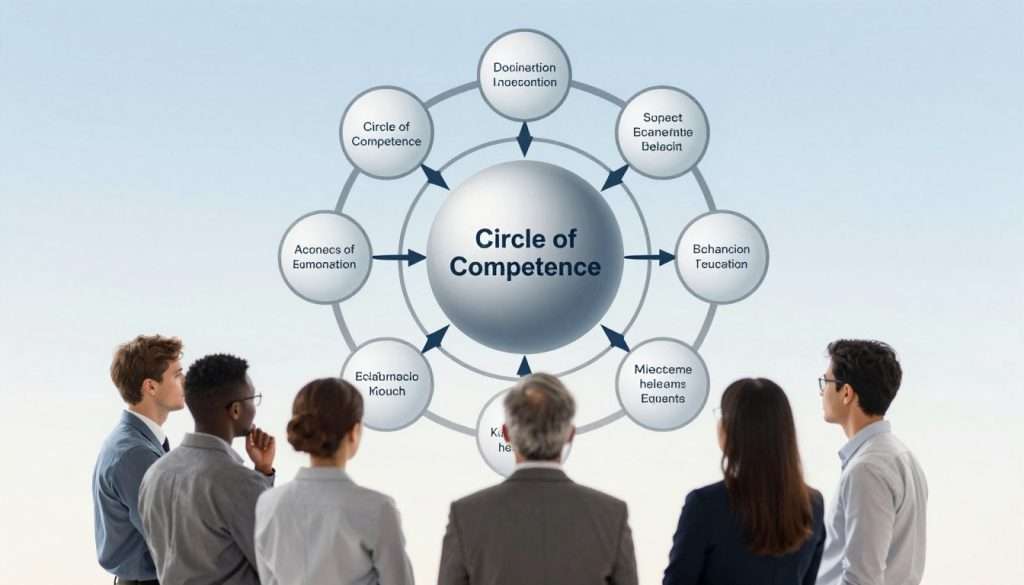
Circle of Competence: Master What You Know and Expand Wisely
Knowing your circle of competence is key to making smart choices and achieving success. It’s the area where you’re most skilled and knowledgeable.
Defining and Mapping Your Circle of Competence
To use your circle of competence well, you need to define and map it. This means finding areas where you really know your stuff.
- Reflect on Your Experience: Think about your past experiences, successes, and failures. What skills have you built up over time?
- Assess Your Skills: List your skills and rate how good you are at each. This shows your strengths and weaknesses.
- Seek Feedback: Get feedback from others in your field. They can tell you where you’re really good.
By mapping your circle of competence, you can focus on areas where you’re most likely to succeed.
How to Operate Within Your Circle for Maximum Success
Once you’ve defined your circle of competence, it’s key to stay within it for the best results. This means doing tasks and making decisions that match your expertise.
- Prioritize Tasks: Focus on tasks that play to your strengths. Delegate or avoid tasks that don’t fit your circle.
- Make Informed Decisions: Use your knowledge to make smart decisions. Ask yourself if a decision fits within your circle.
- Continuously Improve: Keep learning and improving to grow your circle of competence.
Strategies for Expanding Your Knowledge Boundaries
While staying within your circle is important, expanding your knowledge is also crucial. Here are ways to do that:
- Continuous Learning: Keep learning by reading, attending seminars, and taking courses that challenge you.
- Explore Adjacent Fields: Look into fields related to your current expertise. This can open up new opportunities.
- Network with Experts: Connect with experts in related fields. They can share insights and help you grow.
By using these strategies, you can master what you know and also expand your knowledge. This leads to more success and personal growth.
Occam’s Razor: Choose Simplicity for Clearer Logical Reasoning
Occam’s Razor is a key mental model for solving problems and making decisions. It tells us to choose the simplest explanation. This makes our thinking clearer.
The Principle of Parsimony Explained
Occam’s Razor, or the principle of parsimony, says the simplest explanation is usually the best. It doesn’t mean complex explanations are always wrong. But, they need more scrutiny.
For example, if you hear a noise in your attic, it might be the wind or a stray animal. A complex explanation like paranormal activity needs more proof. Occam’s Razor helps us pick the most likely explanation without getting lost in complexity.
When to Apply Occam’s Razor in Problem-Solving Frameworks
Occam’s Razor is great for solving complex problems with many possible answers. It helps us find the simplest explanation or solution. When choosing options, ask which one needs fewer assumptions or is simpler?
This model works in science, philosophy, and everyday choices. In science, it favors simple yet explanatory theories. In business, it helps find the problem’s root cause without getting lost in complex theories.
Avoiding Overthinking and Analysis Paralysis
Occam’s Razor is also good at preventing overthinking and analysis paralysis. It encourages simplicity, making decisions faster and avoiding endless debates.
To use Occam’s Razor well, do the following:
- Be ready to simplify your assumptions and explanations.
- Choose the most straightforward solution or explanation.
- Don’t add unnecessary variables or assumptions to issues.
By adding Occam’s Razor to your mental models, you’ll solve complex problems more clearly and confidently. The aim is not to oversimplify but to approach problems with a clear mind, favoring evidence-based explanations that need fewer assumptions.
How to Think More Clearly: Mental Models Every Learner Should Know in Practice
Mental models are powerful when used in real life. Having many mental models helps you make better choices and think clearer. We’ll show you how to use these models in everyday situations to boost your critical thinking and problem-solving skills.
Building Your Personal Mental Model Toolkit
To start using mental models, you need a personal toolkit. First, pick the models that interest you the most. Then, learn how to apply them well.
Start with models that fit your goals and interests. For example, if you want to make better decisions, try First Principles Thinking and Second-Order Thinking. As you get better, add more models to your toolkit.
It’s key to know when to use each model. For example, Occam’s Razor is great for simplifying complex problems. Inversion helps spot potential problems in your plans.
Combining Multiple Models for Comprehensive Analysis
Using one mental model alone is not enough. The best results come from mixing different models.
By mixing models, you get a deeper understanding of complex issues. For example, use First Principles Thinking to break down problems. Then, apply Second-Order Thinking to think about the long-term effects.
Let’s say you’re starting a new business. Use Inversion to find out why it might fail. Use Circle of Competence to know your strengths and weaknesses. And Occam’s Razor to make your business model simple.
| Mental Model | Application in Business Launch |
|---|---|
| Inversion | Identify potential reasons for business failure |
| Circle of Competence | Understand your strengths and weaknesses |
| Occam’s Razor | Simplify your business model |
Creating Daily Habits to Reinforce Clear Thinking
To make mental models a part of your thinking, practice them every day.
Start each day by thinking about a mental model and how to use it. You can also keep a journal to write down your thoughts and insights. This helps you see patterns and areas to improve.
Tracking Your Progress and Measuring Improvements
It’s important to track how well you’re doing with mental models.
Set specific goals for your mental model practice and check your progress often. For example, track how often you use a model or how it helps you make better decisions.
By watching your progress, you can fine-tune your approach. This helps you get the most out of your mental model toolkit.

Overcoming Cognitive Bias and Common Thinking Traps
Cognitive biases can mess up our decision-making. Knowing them is key to better thinking. It’s important to spot the pitfalls that can change how we see things.
Distortion by Cognitive Biases
Cognitive biases can mess up our thinking. For example, confirmation bias makes us pick information that agrees with us. Anchoring bias makes us stick to the first info we get, even if it’s wrong.
Hanlon’s Razor helps us not to think the worst of people. It tells us to think they might not know better, not that they’re trying to be bad.
Mitigating Cognitive Biases
To fight cognitive biases, we can use a few tricks. First, we should know our own biases and question them. Second, getting different views can balance out our own. Third, thinking about our choices can show us where we might be wrong.
| Bias | Description | Mitigation Strategy |
|---|---|---|
| Confirmation Bias | Favoring information that confirms preconceived notions | Seek diverse perspectives and challenge assumptions |
| Anchoring Bias | Relying too heavily on the first piece of information received | Consider multiple sources and evaluate information objectively |
| Availability Heuristic | Overestimating the importance of readily available information | Take time to gather and evaluate a wide range of data |
When Mental Models Can Lead Astray
Mental models are great, but they can fail us. Relying too much on one model or not updating it can lead to bad choices. We need to stay flexible and change our models as things change.
Developing Flexibility and Critical Thinking
To be flexible and critical, we need to question our beliefs. We should be open to new ideas and ready to change our models. This helps us make better choices.
By using these strategies and staying open-minded, we can beat cognitive biases. This leads to clearer and smarter thinking.
Conclusion
We’ve looked at many mental models to help you think better and make smarter choices. Models like First Principles Thinking and Occam’s Razor are great for solving complex problems. They also boost your critical thinking skills.
To get better at thinking clearly, use these mental models every day. This will help you analyze situations, spot patterns, and make informed decisions.
Keep practicing and be open to change as you learn more. Using these models with real-life experiences will help you face challenges and reach your goals.
So, start using these mental models in your daily life today. You’ll see your thinking become clearer over time.