
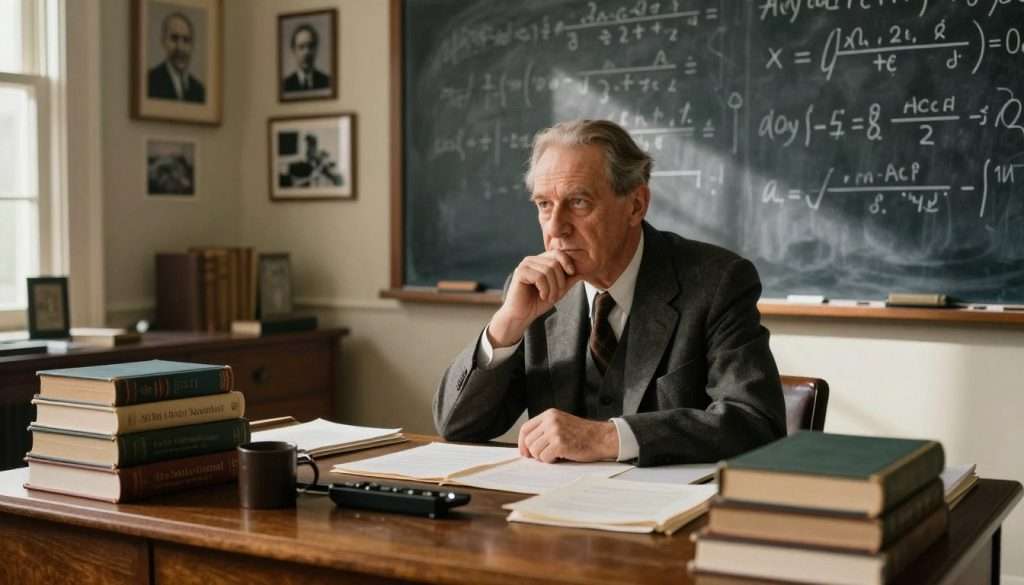
John von Neumann was a Hungarian-American mathematician whose work shaped computing, game theory, quantum mechanics, and science. Often mistyped as Jon von Neumann, he showed how far a quick mind could travel across fields. A stored-program computer is a computer that keeps its instructions in electronic memory alongside its data.
His memory seemed almost unreal, yet we should not mistake an unusual gift for a study plan. We can learn from his curiosity without expecting ourselves to match his abilities. If you want to study well, his story offers a useful question: which habits can any learner practice?
Key Takeaways
- Von Neumann’s work reached mathematics, physics, computing, and economics.
- His famous memory was an extraordinary talent, not a documented study routine.
- His mathematical work helped shape quantum mechanics and game theory.
- His computer design grew from a wider team effort.
- Small, repeatable study habits can help knowledge last.
We can admire his wide reach while keeping our own learning goals realistic. His story matters because abstract ideas can travel far beyond the classroom.
How a Budapest Prodigy Built His Mathematical Foundation
As a child in Budapest, von Neumann could memorize a page of telephone-book entries and recite the numbers and addresses. That striking feat points to exceptional recall, not to a proven way of studying. A John von Neumann biography begins in Budapest, where formal lessons met unusual early ability.
He was born there on December 28, 1903, and grew up in a multilingual home. His route joined strong formal study with a lasting interest in clear mathematical foundations. The memory story is an anecdote, not evidence of a routine he taught or followed.
A rare gift can be remarkable without becoming a rule for everyone else. Build your own learning habits from methods you can repeat.
A childhood shaped by languages and numbers
Von Neumann’s family spoke Hungarian, German, and French, and he learned several languages as a child. Numbers also came easily to him. His telephone-book feat became famous, but no record shows that he used it as a study technique.
His early skill did not mean that formal learning was unnecessary. Mathematical ideas still required careful definitions and proof. That mix of fast recall and disciplined reasoning became part of his public image.
From Budapest studies to European mathematics
His education and early jobs crossed several cities and subjects. The path combined engineering, mathematics, and academic work:
- Chemical engineering at ETH Zurich, completed in 1925.
- A mathematics doctorate from the University of Budapest in 1926.
- Postdoctoral work with David Hilbert at Göttingen in 1926-27.
- Academic positions in Berlin from 1927-29 and Hamburg from 1929-30.
His doctoral thesis focused on the axiomatic construction of general set theory. He completed the thesis in 1925, before receiving his doctorate the next year. Set theory gave mathematicians a formal way to describe collections of objects and build further ideas.
In 1930, he moved to the United States to teach at Princeton University. He became an original faculty member of the Institute for Advanced Study in 1933. His unusual academic route joined formal mathematical training to an early interest in how ideas could be built from clear foundations.
What Jon von Neumann Is Best Known For
Two of von Neumann’s best-known books brought mathematical structure to quantum physics and strategic decision-making. His work shaped both quantum mechanics and game theory, though each field asks different questions. His books connected abstract mathematics to problems in physics and human choices.
Quantum mechanics describes how matter and energy behave at very small scales. Von Neumann gave it a rigorous mathematical framework. Game theory, by contrast, helps analyze choices when each person’s outcome depends on what others do.
John von Neumann’s books include works on both subjects, along with an early paper that proved a key result for games.
Quantum mechanics made mathematically rigorous
Published in 1932, The Mathematical Foundations of Quantum Mechanics set out a precise mathematical account of the field. The book helped physicists work with quantum ideas in a clear, formal way. It remains one of the best-known examples of his work linking mathematics and physics.
Quantum theory deals with behavior that can seem strange compared with everyday objects. A mathematical framework gives researchers a shared way to state what the theory predicts and test its logic.
Game theory turns strategy into mathematics
In 1928, von Neumann published “Theory of Parlor Games.” It proved the minimax theorem for finite, two-person, zero-sum games. In plain terms, each player can choose a strategy that limits the worst outcome the other can force.
He and economist Oskar Morgenstern later published Theory of Games and Economic Behavior in 1944. Their book established game theory as a mathematical field and helped bring it into economics. It gave people a way to study decisions shaped by competition and cooperation.
A 2023 TU Delft symposium discussed his 1928 minimax theorem and its place in his wider mathematical work. The result applies to a specific kind of game, not every choice people make.
| Work and year | Field | What it contributed |
|---|---|---|
| The Mathematical Foundations of Quantum Mechanics, 1932 | Quantum mechanics | Rigorous mathematical formulation |
| “Theory of Parlor Games,” 1928 | Game theory | Minimax theorem |
| Theory of Games and Economic Behavior, 1944 | Game theory and economics | Established the mathematical field with Oskar Morgenstern |
His lasting contribution was showing how mathematical theory could clarify problems that once seemed to belong to separate worlds.
How His Computer Design Changed Computing
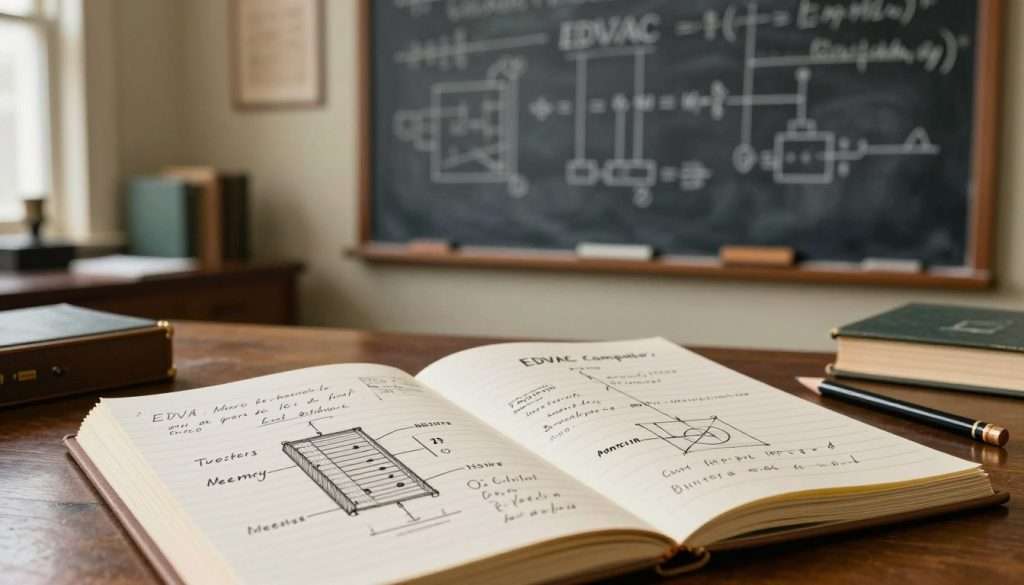
Von Neumann’s 1945 EDVAC report described a computer that could store instructions in memory alongside the data it worked on. This approach, called stored-program architecture, let a computer keep both kinds of information together. The design made it possible to change a computer’s task by changing its instructions.
The First Draft of a Report on the EDVAC described memory, an arithmetic unit, a control unit, input and output, and an outside recording medium. These parts formed a plan for a digital computer, not a claim that one person built the whole machine.
A computer that stores instructions and data
Earlier machines often needed physical changes to handle a new job. A stored-program computer could read its instructions from memory. That made the system more flexible and helped computers handle many kinds of work.
The IAS computer began running in 1951. It used binary arithmetic and shared memory for code and data. The John von Neumann architecture became a widely used model, though the design came from a wider effort.
| Component | Role in the EDVAC design | What it lets the computer do |
|---|---|---|
| Memory | Holds data and instructions | Keeps both available to the system |
| Arithmetic unit | Performs calculations | Processes mathematical operations |
| Control unit | Directs operations | Coordinates the system’s work |
| Input and output | Receives information and returns results | Connects the computer with users and other systems |
| Outside recording medium | Stores information beyond main memory | Preserves or transfers recorded information |
The people and ideas behind EDVAC
John Mauchly and J. Presper Eckert’s work also shaped the EDVAC design. Giving von Neumann sole credit for inventing stored-program architecture would erase their role. His report described key ideas, while many people helped turn them into working computers.
The Institute for Advanced Study’s Electronic Computer Project archive includes reports on computer design, physical construction, programming, and memory. Those records show that the project continued through many linked efforts. The report remains a useful way to understand the basic layout of a computer.
What Von Neumann Did on the Manhattan Project
During World War II, von Neumann applied his expertise in hydrodynamics and shock waves to the Manhattan Project. Hydrodynamics is the study of how liquids and gases move. His specific work used mathematics to study forces involved in atomic bomb development.
His role was technical and distinct from the many other jobs in the project. Von Neumann and J. Robert Oppenheimer were both associated with the Manhattan Project, but they did not have identical roles or jointly design the weapon.
Applying mathematics to shock waves
Shock waves are sudden changes in pressure that move through a material. Their motion can be hard to predict, so researchers use equations to model how forces travel. Von Neumann brought mathematical analysis to this problem.
His described technical contributions included:
- Hydrodynamics, the study of moving liquids and gases.
- Calculations about shock waves.
- Mathematical analysis applied to bomb development.
These contributions fit his broader work in physics and applied mathematics. They did not make him the sole designer of the atomic bomb. The Manhattan Project brought together many scientists, engineers, and workers with different skills.
From wartime research to government service
Von Neumann’s government work continued after the war. In 1955, he joined the U.S. Atomic Energy Commission. That appointment came years after the wartime project and belongs to a separate period of public service.
The atomic bomb raised questions that went beyond physics and engineering. His role in its development is part of a wider history, but the technical record matters too. Keep his specific technical contribution distinct from the many people and roles involved in the project.
What Students Can Learn From His Thinking
Von Neumann’s famous memory is a striking fact, but it is not a study plan you need to copy. No reliable, verified IQ score is established for him, and one number could not capture his range of work. His example can inspire curiosity, not set a standard students must match.
His 1948 work on automata explored machines that could reproduce, grow, and evolve. In the 1950s, he also considered how brains and computers worked. Those ideas touched questions now linked with artificial intelligence, but he did not invent modern AI.
We do not have a documented study routine behind his telephone-book memory. The ideas below are practical suggestions for learners, not methods attributed to him:
- Try to recall an idea before checking your notes.
- Revisit the material over spaced study sessions.
- Explain a concept in plain language.
- Break a hard problem into smaller questions.
Use a remarkable life as a source of questions, not as a measuring stick. Your next small study step matters more than matching someone else’s talent.
Von Neumann was born on December 28, 1903, and died in Washington, D.C., on February 8, 1957, at age 53. His cancer was diagnosed in 1955. He accepted Catholic baptism in 1930 to marry, did not practice the faith, and sought a Catholic priest and the Church’s last sacraments while dying.
Pick one idea from class and make it easy to explain in your own words. Choose one idea you want to remember and test yourself on it tomorrow.
Conclusion
You do not need a prodigy’s memory to build knowledge that lasts. Curiosity across subjects can help, while steady habits make learning easier to keep. We can admire von Neumann and still choose study methods that fit our own lives.
Want to Go Deeper? If you enjoyed this article, you’ll love my free book, How to Think Like a Mathematician. Inside, you’ll discover a practical system for learning math more effectively, including proven memory techniques, smarter study routines, and thinking strategies that help knowledge stick for the long term. No cost. No catch. Just practical ideas you can start using today. Grab your free copy here → https://www.studyingmachine.com/free-books/.