

Are you tired of feeling like your brain is running a marathon while you just sit at your desk? We are so excited to help you dive into the fascinating world of learning science to supercharge your study habits. You might think multitasking is a secret superpower, but research shows it actually forces your mind to switch gears rapidly rather than focusing.
We want to show you how to move past these common pitfalls. It is time to start absorbing information in a way that feels natural and effective. Let’s explore how you can transform your daily routine into a fun and productive experience starting right now!
By applying the principles of learning science, you can stop fighting your own biology. We are here to guide you through simple shifts that make a massive difference in your retention and focus.
Key Takeaways
- Multitasking is a myth that drains your mental energy.
- Focusing on one task at a time improves memory retention.
- Small changes to your routine lead to big academic results.
- Understanding how your brain works makes studying feel less like a chore.
- You can master new skills faster by using evidence-based techniques.
The Foundations of Learning Science
Ever wondered how your brain handles new info? Knowing how your mind works can help you learn better. This is the heart of learning science, and it’s easier than you think.
Understanding How the Brain Encodes Information
Your brain loves stories and patterns. Making facts into vivid images or using mnemonics helps your brain remember. These educational resources help move info from short-term to long-term memory.
The Role of Neuroplasticity in Skill Acquisition
Did you know your brain changes every time you learn something new? This is called neuroplasticity. As you learn more, your brain makes new connections and gets stronger.
Learning is like making a trail in a forest. The more you use it, the clearer and faster it gets. You can grow your brain by choosing to learn more.
Creating Effective Flashcards and Self-Testing Materials
Just reading passively can make you feel like you’re learning, but you’re not. Use educational technology to make active study tools. Flashcards work best when you try to recall the answer before looking at the card.
Practicing Retrieval Without Relying on Source Text
The real magic is when you try to explain something from memory without looking at your notes. This is the heavy lifting that builds true mastery. Relying on notes just means you’re recognizing, not really learning.
Strategies for Testing Yourself During Lectures
Make any lecture active by summarizing what you just heard. Write down one question for every ten minutes of content. This keeps your brain sharp and ready for complex ideas.
Using Peer-to-Peer Quizzing for Better Recall
Teaching someone else is a great way to learn more yourself. Peer-to-peer quizzing helps you find gaps in your knowledge. It’s a fun way to improve your science curriculum and help a friend, too!
Mastering Spaced Repetition for Long-Term Retention
Are you tired of forgetting what you study? It’s time to try spaced repetition. Cramming might seem quick, but it doesn’t stick. By reviewing at different times, you tell your brain the info is truly important.
Structuring Your Review Schedule
Being consistent is key. You don’t need a fancy plan to start. A simple calendar or notebook works great. Review your notes at intervals like one day, three days, one week, and a month later.
This stops the “forgetting curve.” When you recall info just before forgetting it, you strengthen your brain’s connections.
Utilizing Software for Automated Spaced Repetition
Technology can simplify your study routine. Many digital tools help teachers and students by automating schedules. They track your progress and focus on what you struggle with.
- Focus on active recall rather than passive reading.
- Use digital flashcards to keep your sessions snappy.
- Let the software handle the timing so you can focus on learning.
Setting Up Anki for Personalized Study
Anki is great for serious learners. Start by making a deck for each subject and adding core concepts. You can add images or audio to make cards more engaging.
The app shows you cards based on how well you know them. If you get a card right, it appears less often. If you miss it, it comes back sooner to help you master the material.
Managing Review Intervals for Complex Subjects
When studying a dense science curriculum, some topics are harder than others. Adjust your intervals based on the subject’s difficulty. For tough topics, review them more often.
Customizing your schedule keeps even the toughest topics in your mind. It’s about working smarter, not harder, to build lasting knowledge.
Optimizing Your Environment for Cognitive Development
Creating the right environment is key for your cognitive development. A chaotic space makes your brain work hard to ignore distractions. By simplifying your area, you let your mind focus better.
Reducing Cognitive Load Through Workspace Organization
A messy desk can make your mind feel cluttered too. Clearing out what you don’t need lowers your mental load. This makes learning complex ideas easier. Keep only what’s essential within reach for a calm and productive flow.
Looking for help? There are many resources for teachers and students on setting up your space. Here are some simple steps to organize your area:
- Keep your main study area free of non-study items.
- Use digital tools to cut down on paper clutter.
- Make sure your lighting is good to avoid eye strain.
- Have a special place for your most-used study materials.
The Impact of Physical Health on Mental Performance
Your brain is part of your body, so it needs care to work well. Even the best study methods won’t help if you’re tired. Taking care of your physical health is crucial for learning.
Sleep Hygiene and Memory Consolidation
Sleep is when your brain works hard to memorize things. Without enough sleep, remembering new info gets harder. Try to have a regular bedtime routine to help your brain remember what you learned.
Nutrition and Hydration for Sustained Focus
What you eat and drink affects your mental clarity. Drinking water helps keep your focus sharp during long study times. Eating well prevents the afternoon slump and keeps your energy up.
Leveraging Educational Technology and Online Learning Platforms
Ever felt overwhelmed by all the apps and websites claiming to make you a genius fast? With so many online learning platforms out there, it’s easy to get lost. We aim to help you find the right tools that match your study style.

Selecting the Right Tools for Your Learning Goals
Not every app is right for every student. When looking at educational technology, choose tools that help you actively learn and remember. Make sure the platform is backed by solid research, like The Science of Learning.
“The beautiful thing about learning is that no one can take it away from you.”
Here’s a quick guide to help you pick the best digital resource:
| Feature | Why It Matters | Best For |
|---|---|---|
| Active Recall | Boosts memory retention | Flashcards |
| Progress Tracking | Keeps you motivated | Long-term goals |
| Community Access | Provides social support | Complex subjects |
Navigating Massive Open Online Courses Effectively
MOOCs are great educational resources for learning new skills. But, they need discipline to complete. Treat them like a real class by setting aside time each week.
Don’t try to watch every lecture at once. Break it down into smaller chunks to avoid burnout. This way, you’ll actually learn the material instead of just clicking through.
Maximizing Engagement in Virtual Classrooms
It’s easy to get distracted when learning alone on a screen. Stay focused by participating in discussions or joining study groups. Engagement turns a passive video into an active learning experience.
Keep a notebook handy to jot down questions. Interacting with the material makes your educational technology a powerful tool for growth.
Applying Metacognition to Monitor Your Progress
Have you ever thought about how you think? This is called metacognition, a vital skill for your brain’s growth. It’s like stepping back to watch your own thinking while you work.
Mastering this skill makes you more than just a learner. You become the builder of your own knowledge. It is the secret sauce that makes some students stand out.
Reflecting on Your Learning Process
Make it a habit to reflect on your study sessions right after. Think about what worked, what was hard, and where your mind wandered. This pause helps you spot patterns in your focus.
“We do not learn from experience… we learn from reflecting on experience.”
Keep a small journal or digital note for these quick thoughts. This way, every study session becomes a valuable lesson about how you learn best.
Adjusting Strategies Based on Performance Data
Modern online learning platforms offer lots of data to improve your learning. Look beyond just your grades. Dive into the analytics to see where you spend most of your time.
If you keep missing questions on certain topics, it’s time to change your approach. You might need to switch to active recall or practice more.
- Review your quiz results to spot recurring knowledge gaps.
- Use time-tracking features to see if your study sessions are actually productive.
- Experiment with new techniques when your data shows a plateau in progress.
By using this data to guide your cognitive development, you make sure your time on online learning platforms is always moving you forward. Stay curious, keep adjusting, and watch your learning efficiency grow!
Integrating Interactive Learning Tools into Your Routine
Why stick to just reading when you can explore interactively? Interactive learning tools make studying fun and keep your mind sharp. They turn you from a passive learner to an active creator of knowledge.
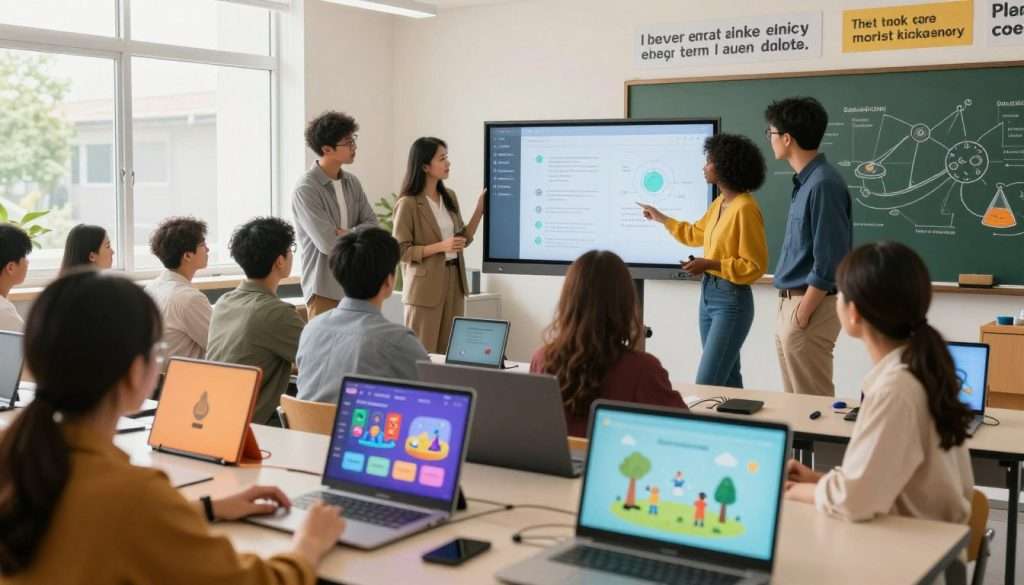
Using Simulations to Understand STEM Education Concepts
STEM education can seem dull without hands-on experience. Simulations offer a virtual space to play with variables. They let you see complex science and math in action, something you can’t do in class.
“Tell me and I forget, teach me and I may remember, involve me and I learn.” — Benjamin Franklin
These educational resources make hard concepts real. You learn by doing, not just memorizing. This way, you understand the “why” behind the math and science.
Collaborating Through Digital Whiteboards and Mind Maps
Sharing your ideas is a great way to learn. Digital whiteboards and mind maps are perfect for this. They help you organize your thoughts and work with a study partner.
These interactive learning tools make studying fun and collaborative. You can share your work with friends to work together in real-time. It’s a great way to make studying a team effort for your STEM education.
Overcoming Common Barriers to Effective Study
Ever feel like your brain is empty while looking at your books? We all hit walls sometimes. But, procrastination and burnout don’t have to stop you. It is perfectly normal to feel overwhelmed when the workload piles up.
Managing Procrastination with Time-Blocking
The secret to staying on track is often simpler than you think. Time-blocking is a powerful way to protect your focus. It involves dedicating specific chunks of your day to single tasks.
Instead of staring at a massive to-do list, you give every assignment a home on your calendar. When you know exactly when you will work, you stop wasting energy on deciding what to do next. This method helps you build momentum and keeps you from falling into the trap of endless delay.
By setting clear boundaries, you make sure you have enough time for both deep study and well-deserved rest.
Addressing Cognitive Fatigue and Burnout
If you are working on intense stem education projects, it is easy to feel drained after a few hours. Your brain is a muscle, and just like any other, it needs recovery time to function at its best. Ignoring these signals often leads to burnout, which makes learning feel like a chore rather than an adventure.
To keep your energy levels high, try using interactive learning tools to break up the monotony of reading or note-taking. These tools can turn a dry subject into an engaging experience, helping you stay curious and alert. Remember to be kind to yourself and recognize when your mind needs a break to avoid hitting that wall of fatigue.
Conclusion
You now have the power to reach your full potential. By using these science-backed strategies, you take control of your growth. Learning becomes an exciting journey, not a burden.
Using active recall and spaced repetition changes how your brain learns. You strengthen your brain’s connections with each challenge. A supportive environment makes this journey smoother and more rewarding.
Think of your mind as a muscle that grows with practice. Tools like Anki or Quizlet help you stay organized and track your progress. You can master any subject with the right mindset.
Lifelong learning is a journey without an end. We encourage you to keep trying these methods to find what works best for you. Your brain is ready to adapt and grow right now.
What new skill will you learn this week? Share your goals with a friend or join a community of learners to stay motivated. Your hard work will lead to amazing results you can’t yet imagine.