
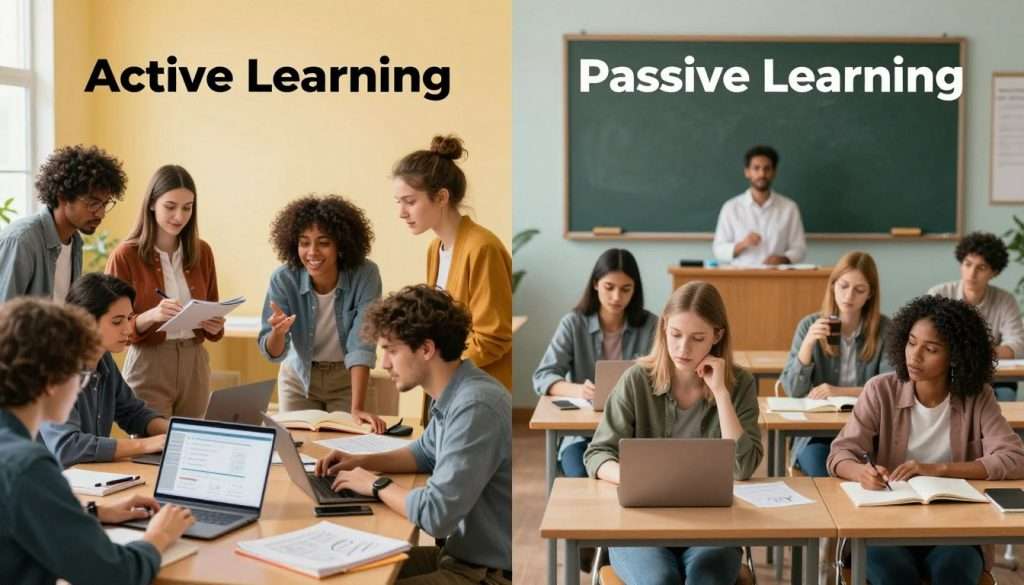
Hey there, fellow student! Ever feel like a sponge just soaking up facts? We’ve all been there, sitting through long, sleepy lectures. This is what we call passive learning.
Knowing the difference is key for better study habits. Education methods like this seem easy because you just listen or read. But, by comparing styles, we can choose the best path for our growth.
Imagine building a cool project. You’re moving, thinking, and creating. This is active learning because you’re fully involved!
We aim to help you find your best learning styles. Choosing smart ways can make your school day better. Let’s explore these major differences together!
Key Takeaways
- Identify how you absorb new ideas effectively.
- Discover why doing beats just watching and listening.
- Boost your memory with engaging study techniques.
- Find joy in your daily school work.
- Pick tools that fit your unique needs.
- Turn boring notes into exciting projects.
What Is Passive Learning?
Let’s explore the world of passive learning. It’s a traditional way of teaching where you don’t do much. You might have seen it before, as it’s been around for a long time.
So, what makes passive learning work? Let’s look at its main features.
Characteristics of Passive Learning
Passive learning has some key traits. It’s known for one-way information and not much learner interaction.
One-Way Information Transfer
In passive learning, information mainly goes from teacher to student. You mostly listen and don’t get to ask questions. For example, sitting in a lecture without talking back is a classic case.
Limited Learner Interaction
Another key point is little interaction with the material or others. You might take notes or ask a question now and then. But overall, you don’t get to do much.
Common Examples in Educational Settings
Now, let’s see some examples of passive learning in schools.
Traditional Lectures and Presentations
Traditional lectures are a big part of passive learning. An instructor talks to students, but there’s little chance to talk back. Lectures can be interesting, but you mostly listen and take notes.
Another example is reading textbooks without doing anything with the information. If you just read without summarizing or discussing, it’s passive learning. This method can share a lot of info, but it might not help you remember it well.
What Is Active Learning?
Imagine a classroom where you’re not just a passive listener, but an active participant. That’s what active learning is all about. It involves students in the learning process through activities and discussions. This way, students understand concepts better by being part of the lesson.
Core Principles of Active Learning
Active learning has several key principles that set it apart from traditional learning. Two main principles are student-centered participation and higher-order thinking requirements.
Student-Centered Participation
Active learning makes you, the student, the center of the educational experience. You’re not just listening; you’re actively engaging with the material. Through discussions, writing, or hands-on activities, you’re fully involved in the learning process.
Higher-Order Thinking Requirements
Active learning goes beyond just memorizing facts. It’s about understanding the subject matter deeply. You apply, analyze, and evaluate what you learn. This helps you develop critical thinking skills, useful in school and life.
Active Learning in Practice
So, what does active learning look like in school? It can be many things, like group discussions, collaborative projects, and problem-solving activities.
Group Discussions and Collaborative Projects
Group discussions and projects are great for active learning. Working together, you share insights, challenge each other, and learn from each other’s strengths and weaknesses.
Problem-Solving Activities
Problem-solving activities are also effective for active learning. They challenge you to apply what you’ve learned to real-world scenarios. This helps deepen your understanding and develops practical skills.
The Truth About Passive vs. Active Learning (And Why It Matters)
The difference between passive and active learning is real and important for students. You’ll see how picking the right learning style can change your school experience.
Why This Distinction Is Critical for Students
Knowing if you’re in passive or active learning is key. It affects how well you learn and remember things. Knowing your learning style helps you study better.
Active learning is more than just paying attention. It’s about understanding deeply. You’re not just memorizing; you’re grasping the material.
The Impact on Long-Term Knowledge Retention
Active learning boosts long-term knowledge retention. When you’re involved, you’re more likely to remember. It’s because you’re processing and connecting information, and applying it to real life.
Studies show active learning keeps information better than passive methods. This is great for exams and real-world use.
Real-World Implications for Academic Success
Choosing between passive and active learning affects more than school. Active learning sharpens critical thinking, problem-solving, and teamwork. These are skills employers want.
Using active learning strategies boosts your grades and prepares you for your career. Employers seek those who can think, work in teams, and adapt. These are skills you develop through active learning.
Key Differences Between Passive and Active Learning
Let’s explore the main differences between passive and active learning. Knowing these differences helps us choose the best learning strategies.
Level of Cognitive Engagement
The main difference is in cognitive engagement. This refers to how deeply we engage with what we’re learning.
Surface-Level vs. Deep Processing
Passive learning is about surface-level processing. We just receive and memorize information without thinking much. Active learning, on the other hand, encourages deep processing. Here, we dive deeper into the material, making connections and applying what we’ve learned.

Role of the Learner
The role of the learner is another key difference. How we see our role affects our learning.
Recipient vs. Active Participant
In passive learning, we’re just recipients of information. We absorb it without much interaction. Active learning makes us active participants. We engage with the material, ask questions, and explore topics deeply.
Information Processing Methods
Passive and active learning use different methods to process information.
Memorization vs. Application
Passive learning focuses on memorization. We memorize facts and figures without understanding their context. Active learning, though, emphasizes application. We use what we’ve learned in practical ways or to solve problems.
Understanding these differences helps us see the value of both passive and active learning. Using both can lead to better learning outcomes and improved retention.
The Science Behind Active Learning Effectiveness
Active learning changes the game for students wanting to really get new information. We’ll look into why it’s so effective and how our brains react to it. This will show how active learning beats passive learning.
Research Findings on Learning Outcomes
Many studies have shown active learning’s impact on learning. The results are clear: it boosts learning in all kinds of educational settings.
Meta-Analysis Results from Educational Studies
A big study on active learning found it makes students do better. Active learning techniques lead to higher scores and better memory than just sitting and listening.
- Improved test scores
- Better retention rates
- Enhanced student engagement
Measurable Performance Improvements
Studies prove active learning leads to real improvements. Students who talk, solve problems, and do interactive stuff really get the material.
“Active learning is not just a buzzword; it’s a scientifically-backed approach to education that yields tangible results.”
How the Brain Processes Active vs. Passive Information
It’s important to know how our brains handle information. Active learning engages our brain in a way that passive learning doesn’t.
Neural Pathways and Memory Formation
Active learning makes new connections in our brains, helping us remember things better. This is key for keeping knowledge over time.
Active learning also makes our brain happy, releasing dopamine. This makes us want to learn more. This is why active learning works better than just sitting there.
Knowing the science behind active learning shows its value in schools. The research backs up using active learning to get better results and keep students engaged.
Advantages of Passive Learning
Passive learning has its own benefits. It’s not just about sitting back and listening. It has strengths that make it useful in some situations.
When Passive Learning Works Best
Passive learning is great in certain situations. Let’s look at two scenarios where it stands out.
Introducing New Concepts and Foundational Knowledge
When you start learning something new, passive learning is helpful. It lets you soak up basic ideas and get a feel for the subject before diving deeper.
Large Group Settings
In big classrooms or lecture halls, passive learning is practical. It lets teachers share information with many students at once. This saves time and resources.
Efficiency in Information Delivery
Passive learning is good at delivering lots of information quickly. It’s perfect for teaching a lot to many students.
Time-Saving Benefits
Teachers save time with passive learning. They can use lectures, videos, or readings to cover a lot without adjusting for each student’s style.
Let’s compare passive and active learning:
| Learning Method | Time Efficiency | Information Coverage |
|---|---|---|
| Passive Learning | High | High |
| Active Learning | Variable | Variable |
The table shows passive learning is better for saving time and covering a lot of information. It’s a valuable method in some educational settings.

Advantages of Active Learning
Active learning offers many benefits, including better knowledge retention and critical thinking and problem-solving skills. It makes students more involved in their learning. This approach has been proven to greatly improve educational results.
Enhanced Critical Thinking Skills
Active learning boosts critical thinking skills by making students analyze and evaluate information. They learn to draw solid conclusions. This is done through debates, case studies, and problem-based learning.
Developing Analytical Abilities
Active learning helps students develop analytical skills. They learn to break down complex information into simpler parts. This way, they can think critically and make informed choices.
For example, group discussions and reflective journaling help deepen their understanding of subjects.
Improved Student Engagement and Motivation
Active learning also boosts student engagement and motivation. When students are actively learning, they tend to be more interested and committed to their studies.
Increased Interest and Participation Rates
Active learning leads to higher interest and participation rates. Methods like think-pair-share and peer teaching make learning fun. They also build a sense of community and teamwork among students.
Better Preparation for Real-World Applications
Active learning also prepares students for real-world challenges. It develops transferable skills like teamwork, communication, and problem-solving. These skills are highly sought after by employers.
Transferable Skills Development
The development of transferable skills is a major advantage of active learning. Students work on real-world problems and collaborate with peers. This way, they gain skills useful in many contexts and industries.
This not only improves their job prospects but also prepares them to adapt to different professional settings.
Drawbacks and Limitations of Each Approach
Both passive and active learning methods have their downsides. Knowing these can help you choose the best learning strategy for you.
Challenges of Passive Learning
Passive learning is useful in some ways but has its challenges. It can lead to less retention and understanding, and lower student motivation.
Limited Retention and Understanding
Passive learners often remember less over time. This is because they don’t engage deeply with the information they receive.
Retention rates are usually lower in passive learning. This is because learners aren’t actively processing the information.
Decreased Student Motivation
Passive learning can make students less motivated. When students aren’t engaged, they often lose interest in the subject.
Potential Obstacles in Active Learning Implementation
Active learning has many benefits but can be hard to implement. Two main challenges are the need for more time and resources, and the initial learning curve for students.
Time and Resource Requirements
Active learning needs more time and resources than passive learning. This can be a problem for educators and learners with limited budgets.
Initial Learning Curve for Students
Students may find it hard to start with active learning. They need to get used to new ways of learning.
Here’s a comparison of the drawbacks of passive and active learning methods:
| Learning Method | Drawbacks |
|---|---|
| Passive Learning | Limited retention, decreased motivation |
| Active Learning | Time and resource-intensive, initial learning curve |
Effective Learning Strategies: Combining Both Methods
To get the most out of learning, it’s key to mix passive and active learning. This way, you get the best of both worlds. It helps you learn better and more efficiently.
Creating a Balanced Learning Approach
A balanced learning approach lets you enjoy the ease of passive learning and the fun of active learning. There are many ways to do this.
The Flipped Classroom Model
The flipped classroom model is a new way of learning. Students learn the basics at home (passive learning) and do hands-on work in class (active learning). It makes learning more fun and effective.
Blended Learning Techniques
Blended learning mixes online learning with classroom activities. It offers a flexible and tailored learning experience. This way, you can learn at your own pace.
| Learning Method | Benefits | Examples |
|---|---|---|
| Passive Learning | Efficient information delivery, foundational knowledge | Watching lectures, reading textbooks |
| Active Learning | Enhanced engagement, improved retention | Group discussions, hands-on projects |
| Blended Learning | Flexibility, personalized experience | Online courses with in-class activities |
Practical Techniques for Active Engagement
Being actively involved in learning is key to understanding and remembering information. Techniques like Think-Pair-Share and case studies work well.
Think-Pair-Share Activities
Think-Pair-Share is a team learning method. Students think about a question, discuss it with a partner, and then share with the class. It boosts teamwork and learning from each other.
Case Studies and Simulations
Real-world case studies and simulations help students apply what they’ve learned. They improve critical thinking and problem-solving.
Using Passive Learning as a Foundation
Passive learning lays the groundwork for more active learning. It helps you understand and appreciate the material better when you engage with it.
Building Knowledge Before Application
Knowing the basics well is crucial before diving into active learning. This solid foundation prepares you for more complex tasks.
“The beautiful thing about learning is that no one can take it away from you.”
By mixing passive and active learning, you create a strong learning strategy. It meets your needs and makes learning more enjoyable.
How to Transform Passive Learning into Active Learning
Changing from passive to active learning can really help students learn more. You might wonder how to do this. It’s easier than you think!
We’ll look at some good ways to make learning more active and fun. These methods can improve your learning and make it more enjoyable.
Interactive Note-Taking Techniques
Using interactive note-taking is a simple way to make learning more active. It’s not just about writing down what the teacher says. It’s about really engaging with the material.
Cornell Method and Mind Mapping
The Cornell Method helps you organize your notes. It divides your paper into sections for notes, summaries, and review. Mind mapping is a visual way to connect ideas and concepts. It makes it easier to remember information.
Annotation and Questioning Strategies
When you read your study materials, don’t just absorb the information passively. Annotate the text by highlighting important points, asking questions, and making notes. This active approach helps you understand and remember better.
Self-Testing and Retrieval Practice
Testing yourself on the material you’re learning is a powerful way to reinforce your understanding. It’s not just about finding out what you don’t know. It’s also about strengthening your memory.
Flashcards and Practice Quizzes
Flashcards are a classic tool for self-testing. You can make digital or physical cards with key terms on one side and definitions on the other. Practice quizzes are another good way to test your knowledge and find areas that need more work.
Spaced Repetition Systems
A spaced repetition system involves reviewing material at longer intervals to solidify it in your memory. This method works well with flashcards or quizzes.
Teaching Others What You’ve Learned
Teaching others what you’ve learned is a great way to reinforce your own understanding. This can be through study groups or peer instruction, where you explain concepts to your peers.
Study Groups and Peer Instruction
Being part of a study group can keep you motivated and help you learn from others. By explaining concepts to your peers, you’re not only helping them. You’re also reinforcing your own understanding.
Debunking the Passive Learning Myths
There’s a common myth that passive learning is useless. While active learning has its benefits, passive learning can be useful too.
Why Listening Alone Isn’t Enough
Listening is important, but relying only on passive listening limits your understanding and retention. Using active learning techniques can greatly improve your learning experience.
What Active Learning Doesn’t Mean
It’s also important to know what active learning doesn’t mean. It’s not just about physical movement or a specific learning style.
It’s Not Just About Physical Movement
Active learning isn’t just about moving around. It’s about engaging your mind. You can learn actively while sitting still, as long as you’re mentally involved.
Avoiding Confusion with Learning Style Theories
Active learning is sometimes mixed up with learning style theories. These theories say people have preferred ways of learning (e.g., visual, auditory, kinesthetic). But active learning is about engaging with the material, not about a specific learning style.
Conclusion
It’s important to know the difference between passive and active learning to get better results. We’ve looked at the main differences and how they affect your learning. By understanding both, you can pick the best learning strategies for you.
Passive learning is good for getting information quickly. But active learning helps you think critically and solve problems. The best approach is to mix both, making your learning fit your style.
To get the most out of learning, know what works for you. Start with passive learning and then actively engage with the material. Try self-testing and teaching others what you’ve learned.
Using a balanced learning approach helps you face challenges and reach your goals. So, take charge of your learning and try different methods to find what suits you best.