

Are you tired of reading without remembering what you read? Do you find it hard to stay focused? You’re not alone! We have a solution that will change how you read: the Layered Reading Method.
This method involves several layers to help you understand and remember better. It’s designed to improve your reading skills and make your reading time more valuable. With it, you’ll read more efficiently and effectively.
We’re excited to share this powerful technique with you. By the end of this article, you’ll have the tools to start reading like a pro. Let’s explore the benefits of the Layered Reading Method together!
Key Takeaways
- Discover the Layered Reading Method and its benefits for readers.
- Learn how to improve your reading skills with multiple layers of comprehension.
- Understand how to retain information more effectively.
- Explore strategies for staying focused while reading.
- Apply the Layered Reading Method to your daily reading routine.
The Problem with Traditional Reading
The traditional way of reading is familiar but often loses a lot of information quickly. It’s not because we’re not paying attention. It’s because the way we’re taught to read isn’t the best for keeping information.
Why Most People Struggle with Reading Retention
When we read traditionally, we read everything at the same pace and with the same focus. This can cause mental tiredness and lower understanding, mainly with complex or dense texts. Research shows many people have trouble keeping information because of this linear method.
| Reading Method | Retention Rate | Cognitive Load |
|---|---|---|
| Traditional Reading | Low | High |
| Layered Reading | High | Managed |
The Cognitive Overload of Linear Reading
Linear reading makes our brains work hard to follow information step by step. This cognitive overload makes it hard to tell main ideas from supporting details. This leads to confusion and less information kept.
As we dive into the Layered Reading Method, we’ll learn how it solves these problems. It offers a better way to read and keep information.
What is the Layered Reading Method?
Imagine getting more out of what you read. The Layered Reading Method helps you do just that. It breaks down reading into easy-to-follow layers.
Definition and Core Principles
This method involves reading a text multiple times. Each time, you focus on something different. It’s based on the idea that our brains learn better when information is layered.
At its heart, the Layered Reading Method is a multi-pass reading strategy. It’s not just about reading once. It’s about diving into the text several times, each time with a new goal.
How It Differs from Other Reading Techniques
The Layered Reading Method is different from traditional methods. It’s not a single, straight-through read. Instead, it’s a dynamic approach that works well with complex texts.
“The art of reading is not just about understanding the words on the page, but about grasping the underlying ideas and connecting them to our existing knowledge.”
The Three-Layer Framework Overview
The Layered Reading Method uses a three-layer framework: Preview, Active Reading, and Integration. Each layer has its own role in the reading process.
| Layer | Purpose |
|---|---|
| Preview | Initial scan to understand the structure and key points |
| Active Reading | Engaged reading with note-taking and questioning |
| Integration | Connecting new information to existing knowledge |
By using this layered method, readers can improve their understanding and retention. It makes reading more rewarding.
The Science Behind Layered Reading
Ever wondered how your brain handles reading information? It’s key to understanding layered reading’s power. Our brains process info in complex ways, and layered reading boosts comprehension and memory.
How Your Brain Processes Information
Our brains don’t just soak up reading info passively. They actively process it through many channels. Layered reading fits right into this natural flow. It breaks down reading into layers for better info absorption and retention.
Cognitive Benefits of Multi-Pass Reading
This method offers big cognitive perks. By looking at material from different angles, readers deepen their grasp and boost recall. This iterative process also strengthens brain connections, making it simpler to remember important details. Plus, it spreads out the mental load, easing cognitive strain.
Research Supporting the Method
Studies in educational psychology back layered reading’s success. They show that multi-pass reading strategies improve understanding and memory. This method fits with learning techniques that aim for deeper knowledge and better recall.
Grasping the science behind layered reading reveals its true value. It’s not just a method; it’s a reading approach that aligns with our brain’s natural info processing.
Read Like a Pro: The Layered Reading Method Your Brain Will Love
Unlock your reading skills with the Layered Reading Method. This method boosts comprehension and retention. It breaks down reading into layers for easier complex texts.
Overview of the Complete Method
The Layered Reading Method has three layers: Preview, Active Reading, and Integration. Each layer has a role in the reading process. Mastering these layers lets you read like a pro with confidence.
Who Benefits Most from This Approach
This method helps students, professionals, and lifelong learners. It’s great for academic, professional, or personal reading. The Layered Reading Method improves your reading skills and enhances your reading experience.
Students can handle complex texts and papers. Professionals stay updated with industry news. An expert says, “Effective reading is not just about reading more, but reading better.”
“The art of reading is not just about understanding the text, it’s about understanding the context and making connections.” –
Preparing Your Mind and Environment
To use the Layered Reading Method well, prepare your mind and space. Create a quiet reading area and clear your mind. This helps you focus and use effective reading methods better.
By following these steps, you’ll become a more efficient reader. So, get ready to read like a pro and unlock your reading potential!
Layer 1: The Preview Phase
To read like a pro, start with a strong foundation. The preview phase is all about getting ready to absorb and process information well.
Setting Your Reading Intention
Before you start reading, define why you’re doing it. Are you looking for specific info or a general overview? Setting your reading intention keeps you focused and helps you get the most important info.
Scanning for Structure and Key Points
Quickly look at headings, subheadings, and any bold or highlighted text. This helps you see the structure and find key points. Scanning is like making a mental map, making it easier to follow as you read.
Creating Mental Hooks for Information
As you scan, make mental connections to remember important details. You can link new info to something you already know or picture concepts.
The 5-Minute Preview Technique
Here’s a simple way to use your preview phase:
- Spend 1 minute looking at the title, abstract, and introduction.
- Use 2 minutes to scan headings and subheadings.
- Take 1 minute to glance at any summaries or conclusions.
- In the final minute, jot down your reading intention and any initial thoughts.
| Step | Time | Action |
|---|---|---|
| 1 | 1 minute | Review title, abstract, and introduction |
| 2 | 2 minutes | Scan headings and subheadings |
| 3 | 1 minute | Glance at summaries or conclusions |
| 4 | 1 minute | Jot down reading intention and initial thoughts |
By following these steps, you’ll be ready to dive into the material with clarity and purpose.
Layer 2: The Active Reading Phase
Now that we’ve previewed our reading material, it’s time to engage with it actively in Layer 2. This phase is where we truly interact with the text, making it a meaningful part of our knowledge base.

Strategic Note-Taking Techniques
Active reading starts with effective note-taking. It’s not just about writing down what’s on the page; it’s about capturing the essence of the information. Use a combination of highlighting, margin notes, and summarizing key points in your own words.
- Highlight key terms and concepts
- Write questions or insights in the margins
- Summarize main ideas in your own words
By doing so, you’re not just passively absorbing information; you’re actively engaging with it.
Question Formulation While Reading
Formulating questions as you read is a powerful way to stay engaged. It helps you clarify your understanding and make connections between new and existing knowledge.
“The art of reading is not just about understanding what’s on the page, but also about questioning it.”
As you read, ask yourself questions like “What is the main idea of this section?” or “How does this relate to what I already know?”
Managing Cognitive Load
Managing cognitive load is crucial during active reading. It’s easy to get overwhelmed by new information, but there are strategies to help.
The Pause-Process-Proceed Method
One effective strategy is the Pause-Process-Proceed Method:
- Pause: Stop reading at regular intervals to reflect on what you’ve read.
- Process: Summarize the information and ask yourself questions about it.
- Proceed: Continue reading with a clear understanding of how the new information fits into the bigger picture.
By using this method, you can manage your cognitive load effectively and retain more information.
Active reading is a skill that takes practice, but with these techniques, you’ll be well on your way to becoming a more engaged and effective reader.
Layer 3: The Integration Phase
The integration phase is where the magic happens. It turns new information into lasting knowledge. This final layer is crucial for reinforcing what you’ve learned and making it a part of your long-term memory.
Connecting New Information to Existing Knowledge
To truly integrate new information, you need to connect it to what you already know. Think of your brain as a vast network of interconnected ideas. When you link new information to existing knowledge, you’re strengthening this network.
For example, if you’re reading about a new scientific theory, try to relate it to concepts you already understand. Ask yourself, “How does this fit with what I already know about the subject?”
Tip:Use analogies to make connections between new and existing information. This helps in creating a more robust and flexible understanding.
Summarization and Synthesis
Summarizing what you’ve read is a powerful way to reinforce your understanding. It forces you to distill the main ideas into their essence.
- Summarize key points in your own words.
- Create concept maps or diagrams to visualize relationships between ideas.
- Discuss what you’ve learned with others to reinforce your understanding.
Memory Reinforcement Techniques
To make your learning stick, you need to reinforce your memory. Here are some effective techniques:
- Spaced repetition: Review material at increasingly longer intervals.
- Active recall: Test yourself on the material rather than simply re-reading it.
The 24-Hour Review Strategy
One simple yet effective technique is the 24-hour review. Within 24 hours of reading, take a few minutes to review what you’ve learned. This can be as simple as glancing over your notes or summarizing the main points again.
“The key to retaining information is not just in how you learn it, but in how you review it.”
–
| Technique | Description | Benefit |
|---|---|---|
| Spaced Repetition | Review material at increasingly longer intervals | Long-term retention |
| Active Recall | Test yourself on the material | Strengthens memory |
| 24-Hour Review | Review what you’ve learned within 24 hours | Immediate reinforcement |
By implementing these strategies, you’ll find that your ability to retain and apply new information improves significantly. The integration phase is not just about finishing what you start; it’s about making what you learn a lasting part of your knowledge base.
Practical Applications of Layered Reading
The Layered Reading Method is more than just a technique. It’s a flexible tool for different reading situations. It can help students, professionals, and book lovers alike.
Academic Reading and Research
In schools and research, Layered Reading shines. It helps students and researchers understand complex texts better. They can spot important points and remember information more easily.
By using this method, readers can handle thick books with ease. It makes studying and research less overwhelming.
Professional Development Reading
Professionals also find Layered Reading useful. It’s great for reading technical or industry-specific books. This method lets readers quickly get the main ideas and see how they apply to their work.
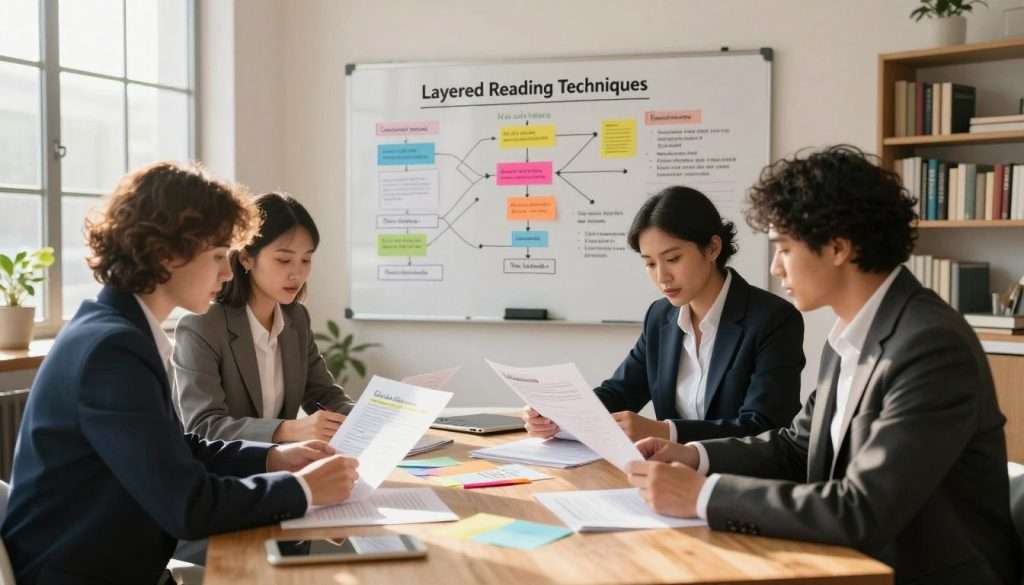
Recreational Reading Enhancement
Layered Reading can also make reading for fun better. It helps readers understand the story deeper and enjoy it more. They can appreciate the book’s structure and feel more connected to the story.
Digital vs. Physical Reading Considerations
Layered Reading works for both digital and physical books. The basic ideas stay the same, but the method can change a bit. Digital reading might use apps, while physical reading might use notes.
Knowing how to use Layered Reading in different ways makes it a valuable skill. It can be adapted to fit your reading needs, whether for school, work, or just for fun.
Conclusion
The Layered Reading Method is a great way to improve your reading skills. It makes reading more effective, engaging, and fun. You’ll learn to absorb and remember more of what you read.
This method has a three-layer framework. It helps you tackle complex texts easily. It’s perfect for students, professionals, and anyone who loves to learn.
By using this method, you’ll understand and remember more. It’s great for reading for school, work, or just for fun. So, why not start using it today? Grab that book or article you’ve been meaning to read, and dive in!