
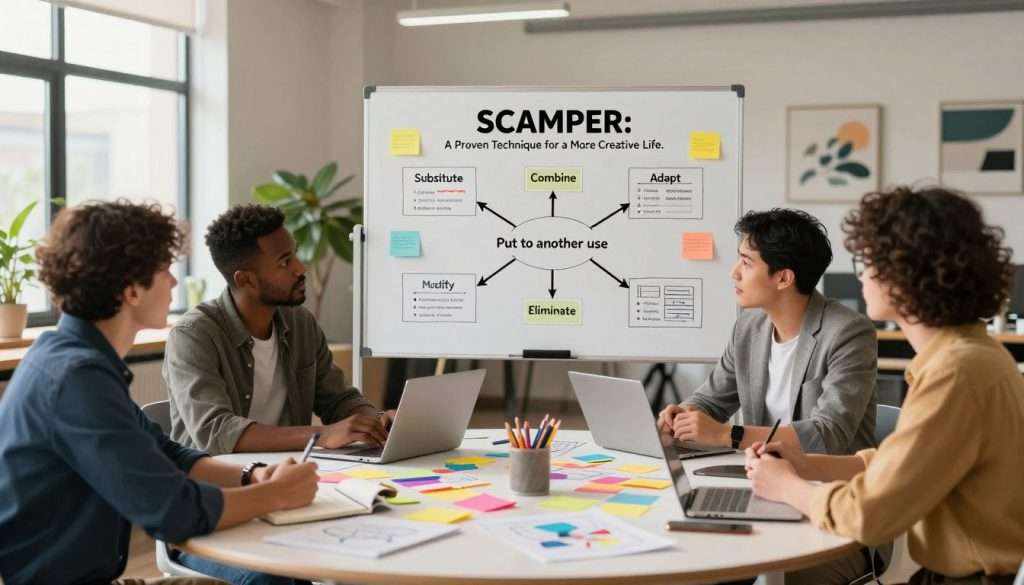
Ever feel like your brain is stuck in oatmeal? We all hit mental walls where every idea feels stale. What if you could flip one switch to see things differently?
We are diving into secret weapons designers use to spark innovation. These help us break boring routines.
This system asks us to substitute or rearrange parts of our challenges. It belongs to creative thinking techniques we use to unlock fresh perspectives. Think of this like gyms for our minds.
Using the scamper method for a more creative life transforms habits. This tool suggests we Substitute, Combine, Adapt, Modify, Put to use, Eliminate, or Rearrange. Explore these prompts to boost your output today!
Key Takeaways
- Learn to view problems through seven unique lenses.
- Transform boring tasks into exciting learning opportunities.
- Apply design principles to solve everyday challenges.
- Break free from traditional thinking patterns instantly.
- Boost your problem-solving skills with practical steps.
- Unlock fresh ideas by rearranging existing concepts.
1. What Is the SCAMPER Method and Why It Matters
Imagine having a simple way to come up with lots of new ideas. The SCAMPER method is just that. It’s a way to think creatively by asking specific questions for each letter in SCAMPER. It was first used by Alex Osborn in 1953 and improved by Bob Eberle in 1971. Now, it’s a key tool for boosting creative thinking.
Origins and Development of SCAMPER
The SCAMPER technique started with brainstorming ideas by Alex Osborn. Bob Eberle then turned it into the easy-to-remember SCAMPER. It’s now used in many areas as a way to solve problems and think creatively.
The Seven Questions That Drive Creative Thinking
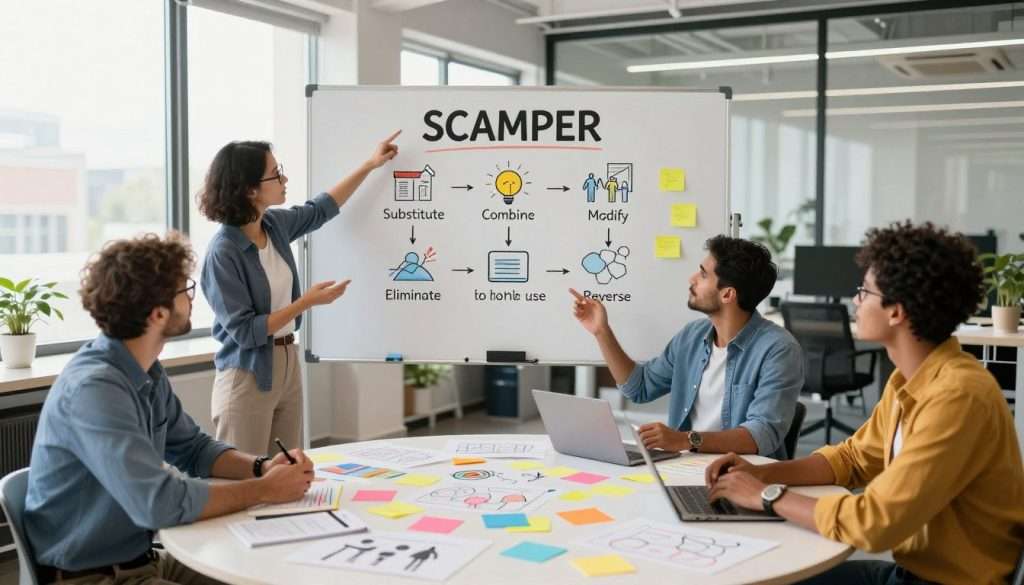
SCAMPER stands for seven ways to think creatively: Substitute, Combine, Adapt, Modify, Put to Another Use, Eliminate, and Reverse. Using these strategies helps people find new solutions to problems.
| SCAMPER Letter | Strategy | Creative Thinking Question |
|---|---|---|
| S | Substitute | What can be replaced or exchanged? |
| C | Combine | What can be merged or combined? |
| A | Adapt | What can be adapted or modified for a new use? |
| M | Modify | What attributes can be changed or altered? |
| P | Put to Another Use | What else can this be used for? |
| E | Eliminate | What can be removed or simplified? |
| R | Reverse | What happens when things are reversed or rearranged? |
Why SCAMPER Works for Everyone
The SCAMPER method is great because it offers a clear way to think creatively. It uses seven strategies to help people come up with lots of ideas. This makes it a valuable tool for anyone wanting to improve their creative thinking and problem-solving skills.
2. Substitute: Swapping Elements for Fresh Perspectives
Ever wondered how some of the most innovative products come to be? It’s often through simple substitution. By swapping out elements, we can give new life to familiar things.
What Can You Replace or Exchange?
Substitution means finding parts to swap for something new or better. This could be materials, processes, or ideas. Just think, “What if I swapped this for that?” For example, in cooking, swapping one ingredient for another can create a new dish. In tech, changing a battery or screen can make a big difference.
Real-World Substitution Examples
Product Innovation Through Substitution
Many products were born from substitution. The sushi burrito, for instance, came from swapping sushi rice for burrito rice. Smartphones got better by swapping old parts for new, like better batteries.
| Original Product/Concept | Substituted Element | New Outcome |
|---|---|---|
| Sushi | Rice type | Sushi Burrito |
| Traditional Smartphones | Battery type | Longer Lasting Smartphones |
Personal Life Applications
Substitution isn’t just for products; it’s for our lives too. Try swapping a daily routine for something new. Swap your morning jog for swimming, or screen time for reading. These changes can really boost our well-being and productivity.
Using substitution as a brainstorming tool can open up new ideas. It’s a great way to add to our creativity exercises and find fresh perspectives.
3. Combine: Merging Ideas to Create Something New
Merging different features or concepts can lead to groundbreaking solutions, as seen in the development of smartphones. The Combine strategy within SCAMPER is about bringing together disparate elements to create something innovative. This approach encourages us to think outside the box and explore new possibilities by merging ideas that might initially seem unrelated.
Finding Synergies Between Different Concepts
The key to successful combination is identifying synergies between different concepts. This involves analyzing various elements, understanding their strengths and weaknesses, and figuring out how they can complement each other. By doing so, we can create something that is more valuable than the sum of its parts. As Bob Eberle, the creator of SCAMPER, once emphasized, the art of combining is about creating new possibilities.
“The whole is more than the sum of its parts.”
Combination Strategies That Work
There are several strategies to effectively combine ideas. Let’s explore a couple of them:
Business Combinations
In business, combining different products or services can lead to innovative offerings. For example, the integration of GPS technology into smartphones revolutionized navigation. Companies can also combine different business models, such as subscription services with product sales, to create new revenue streams.
Lifestyle Integration Examples
On a personal level, combining different hobbies or skills can lead to new interests and opportunities. For instance, combining photography with travel can result in a fulfilling hobby that broadens one’s cultural understanding and creative expression.
By embracing the Combine strategy, we can unlock new ideas and solutions that might have been hard to find. Whether in business or personal life, the ability to merge different concepts is a powerful tool for creativity and innovation.
4. Adapt: Modifying Existing Solutions for New Purposes
The art of adaptation is about making the familiar new and innovative. It’s not just tweaking what’s there; it’s opening up to new possibilities. This is at the core of creative mindset development, helping us grow in our lives.
Learning from Other Industries and Contexts
Adapting by learning from other industries is very effective. By seeing how others solve problems, we can find new ways to tackle our own. For example, Netflix changed from DVD rentals to streaming, adapting to what people wanted.
Practical Adaptation Techniques
So, how do we apply adaptation in our lives? Let’s look at some strategies.
Cross-Industry Inspiration
Cross-industry inspiration means looking outside our field for solutions. For example, aerospace technology can inspire medical device innovations. By seeing how others solve similar problems, we can find new ways to solve ours.
Adapting Solutions to Personal Challenges
Adapting solutions works for personal challenges too. It’s about finding new ways to manage time or develop healthy habits. This is a key part of the SCAMPER method for a more creative life, helping us face life’s challenges creatively.
By embracing adaptation, we solve problems better and stay open to change and innovation. As we keep exploring the SCAMPER method, we’ll see how this adaptability enriches our lives.
5. Modify: Changing Attributes to Enhance Value
Modification is a key strategy in the creative thinking toolkit. It allows us to enhance value by changing attributes. By tweaking existing elements, we can create new and innovative solutions. This technique is all about experimenting with different characteristics to see what works best.
Altering Size, Shape, and Characteristics
One way to modify attributes is by changing the size, shape, or other characteristics of a product or idea. For instance, changing the color or logo of a brand can reposition it in the market. Such modifications can significantly impact how the brand is perceived by its target audience.
Let’s look at some examples:
- Changing the packaging size of a product to make it more appealing to different customer segments.
- Altering the shape of a product to make it more ergonomic or user-friendly.
- Modifying the characteristics of a service to make it more personalized or efficient.
Magnify and Minimize Approaches
The magnify and minimize approaches are two powerful ways to modify attributes. By scaling up or simplifying elements, we can create new opportunities or solve existing problems.
Scaling Up for Greater Impact
Magnifying certain attributes can make a product or idea more impactful. For example, increasing the size of a feature can make it more noticeable or effective.
Simplifying for Better Results
On the other hand, minimizing certain attributes can simplify a product or idea, making it more accessible or user-friendly. This can be achieved by removing unnecessary features or streamlining processes.
By applying these modification strategies, we can unlock new potential in existing ideas and create innovative solutions that add value.
6. Put to Another Use: Repurposing for Different Applications
Repurposing opens up a world of creative possibilities. It’s about finding new uses for things we already have. This way, we can come up with innovative solutions and improve our problem-solving process.
Discovering Hidden Potential in Existing Resources
Repurposing means looking at what we have and thinking of new ways to use it. This could be turning an old item into something new or using a skill in a different way. As Philippe Starck said, “Design is not just about making something beautiful, it’s about making something useful.” This mindset helps us find hidden potential in our resources.

Creative Repurposing in Action
Let’s look at some examples of repurposing in action.
Product Repurposing Examples
Companies like Patagonia have repurposed old products into new ones. They’ve turned used plastic into clothing and outdoor gear. This reduces waste and creates innovative products.
Skills and Resources Reallocation
Repurposing isn’t just for physical products. We can also use our skills and resources for new challenges. For example, a graphic designer might help a non-profit with visual aids. Or, a company might use its equipment to make personal protective equipment during a crisis.
Repurposing is a flexible brainstorming tool for many situations. It encourages creativity, reduces waste, and drives innovation.
7. Eliminate: Removing the Unnecessary for Clarity
The Eliminate strategy is about getting rid of what’s not needed. This makes complex ideas and products easier to understand and use.
What Happens When You Take Things Away?
Removing unnecessary things helps us focus on what really matters. This makes processes smoother, communication clearer, and solutions more effective. For example, in product design, cutting out extra features makes it easier to use.
The Power of Simplification
Simplification is powerful in both personal and work life. It makes things clearer and more efficient. Let’s look at how it affects design and keeping organized.
Minimalist Design Principles
Minimalist design removes what’s not needed for a clean look. It’s not just pretty; it also makes things easier to use. Companies like Apple use this to make their products both beautiful and simple.
Life Decluttering Through Elimination
Clearing out our spaces improves our focus and productivity. Getting rid of things we don’t need makes our environment more organized and calm. It’s a practical way to apply the Eliminate strategy in our daily lives.
| Area | Before Elimination | After Elimination |
|---|---|---|
| Product Design | Feature-rich but confusing interface | Simple, intuitive, and user-friendly |
| Personal Space | Cluttered with unused items | Organized, peaceful, and clutter-free |
| Communication | Verbose and complex messaging | Clear, concise, and effective |
By using the Eliminate strategy, we can make our lives better. We can use creativity exercises and a design thinking approach to simplify and improve many areas of our lives.
8. Reverse: Flipping Perspectives for Breakthrough Ideas
The Reverse technique in SCAMPER flips things around to find new insights. It turns our usual way of thinking upside down. This helps us see things in a new light and find fresh ideas.
Turning Things Upside Down
Applying Reverse means turning common practices on their head. Start with a familiar problem and imagine it in reverse. For example, think about how to make a product worse instead of better. This unusual thinking can reveal key areas for improvement.
Rearranging and Reordering Elements
Reverse also means changing the order of things. This could be rearranging a process or reversing the order of parts. It helps us find new connections and come up with creative solutions.
Reverse Engineering Success
Reverse engineering means studying a successful product or process. Then, use that knowledge to improve your own work. It’s a great way to get inspired and spot potential improvements.
Changing Sequence and Direction
Changing the order of a process can spark new ideas. For example, reversing the steps in a manufacturing process might make it more efficient or cheaper.
| Technique | Description | Example |
|---|---|---|
| Turning Things Upside Down | Reversing established practices or processes | Identifying how to make a product worse to understand how to improve it |
| Rearranging Elements | Changing the sequence or order of components | Reversing the order of operations in a manufacturing process |
| Reverse Engineering | Analyzing successful products or processes | Understanding how a competitor’s product works to improve your own |
9. The SCAMPER Method for a More Creative Life: Practical Applications
SCAMPER is a flexible method for boosting creativity and innovation. It helps people see problems from new angles. This leads to fresh solutions and boosts creativity.
SCAMPER in Professional Settings
In work settings, SCAMPER drives innovation. Companies can mix existing technologies in new ways using Substitute and Combine. This creates unique products that stand out from others.
Using Adapt helps businesses take successful strategies from other fields. This improves their operations and keeps them competitive.
Personal Development and Self-Improvement
For personal growth, SCAMPER is useful. You can change your daily routine with the Modify technique. This makes your day more productive and goal-focused.
By Putting to Another Use your skills, you can find new hobbies or projects. These can bring you joy and fulfillment.
Creative Projects and Hobbies
SCAMPER is great for creative projects and hobbies. Artists and writers can challenge norms with the Reverse technique. Musicians can mix genres to create new sounds.
Problem-Solving in Daily Situations
In everyday life, SCAMPER helps solve problems creatively. It encourages thinking outside the box. By using SCAMPER often, you develop a creative problem-solving habit.
Embracing SCAMPER unlocks new creativity and innovation. It leads to a more fulfilling and imaginative life.
10. Benefits of Making SCAMPER Your Daily Creative Practice
Making SCAMPER a daily habit can change your life. It boosts your problem-solving skills and creativity. You’ll see improvements in both your personal and work life.
Enhanced Problem-Solving Abilities
Practicing SCAMPER daily sharpens your problem-solving skills. You’ll learn to see problems from different angles. This skill is key in both your personal and work life, helping you tackle tough situations.
Increased Innovation and Adaptability
SCAMPER helps you think creatively and explore new ideas. As a daily habit, you’ll come up with more innovative solutions. Being adaptable is crucial in today’s fast-changing world.
Here are some examples of SCAMPER’s impact on innovation:
| Industry | Traditional Approach | SCAMPER Application | Innovative Outcome |
|---|---|---|---|
| Technology | Developing new software from scratch | Combining existing tools in new ways (Combine) | Creating innovative software solutions by integrating different technologies |
| Marketing | Using standard advertising channels | Repurposing content for different platforms (Put to Another Use) | Reaching a wider audience through creative content adaptation |
| Product Design | Designing products with fixed features | Modifying product attributes to suit different needs (Modify) | Creating customizable products that appeal to a broader customer base |
Building a Sustainable Creative Mindset
Most importantly, SCAMPER builds a lasting creative mindset. It keeps your creative skills sharp. This mindset makes you more open to new experiences and opportunities.
Consistency is key to benefiting from SCAMPER. By making it a daily habit, you’ll improve your problem-solving and creativity. You’ll also develop a creative mindset that benefits all areas of your life.
11. Getting Started with SCAMPER Today
Starting with SCAMPER is simple, and we’re here to help. By using SCAMPER daily, you’ll face challenges with a new view. You’ll also unlock your creative side.
Creating Your SCAMPER Routine
To add SCAMPER to your creative tools, set aside time each day or week. Start by applying SCAMPER questions to your current projects. For instance, ask yourself: “What can I Substitute to better this product or service?” or “How can I Combine different parts to make something new?”
Tools and Resources for Effective Practice
Many tools and resources can enhance your SCAMPER practice. Use mind mapping software or apps to see your ideas and organize them. Also, find online resources and workshops on design thinking and idea generation, including SCAMPER.
Common Mistakes to Avoid
When starting with SCAMPER, watch out for common mistakes. Avoid being too strict in your thinking or not exploring all options. Stay open-minded and flexible. Don’t hesitate to try new things. With practice, you’ll get better at using SCAMPER for innovative solutions.
12. Conclusion
The SCAMPER method is a powerful tool for creative thinking. It uses seven strategies to help you find new ideas. These strategies are Substitute, Combine, Adapt, Modify, Put to Another Use, Eliminate, and Reverse.
Using SCAMPER helps you think differently and challenge old ways of doing things. It makes you better at solving problems and being adaptable.
Try to use SCAMPER every day to spark your creativity. It’s great for tackling tough projects or just to see things in a new light. SCAMPER can make your life more creative and fulfilling.
Make SCAMPER a regular part of your life. It will help you become more innovative and adaptable in your creative thinking.