

Are you tired of cramming for exams, only to forget everything a week later? We’ve all been there! It’s frustrating to wonder, “How am I going to remember all this information?!”
But there’s a powerful technique to help you remember information better: spaced repetition. This method lets you study smarter, not harder.
We’re here to explain spaced repetition and why it’s key for studying. You’ll discover how to use it to remember things longer and improve your recall.
Key Takeaways
- Understand the concept of spaced repetition and its benefits
- Learn how to apply spaced repetition to your study routine
- Improve your ability to recall information from long-term memory
- Study more efficiently and effectively
- Boost your confidence in your ability to learn and retain new information
What Is Spaced Repetition and Why It Matters
Ever wondered how some people remember everything they learn? It’s all about spaced repetition. This method is more than just memorizing; it’s about understanding how our brains learn and using that to study better.
Spaced repetition is a proven way to review information at longer intervals. This helps solidify it in your long-term memory. It’s not just about memorizing; it’s about making the information a part of your knowledge.
Defining the Spaced Repetition Technique
The spaced repetition technique is simple yet effective. It involves reviewing material at longer intervals to fight the forgetting curve. Here’s what it’s all about:
- Initial Exposure: You’re first introduced to new information.
- First Review: You review it soon after to reinforce it.
- Subsequent Reviews: These reviews get longer over time.
This method helps you retain information long-term, not just cram it into your short-term memory.
The Forgetting Curve and Why Cramming Fails
The forgetting curve shows how our memory fades without recall. Cramming tries to memorize a lot quickly. But, it fails to fight the forgetting curve.
Cramming leads to forgetting most information soon after. Spaced repetition, on the other hand, reviews information before you forget it. It works with your brain’s natural forgetting process.
The benefits of spaced repetition are many. They include better memory, more efficient study sessions, and less stress during exams. By using spaced repetition, you’re not just studying smarter; you’re setting yourself up for success.
The Science Behind Spaced Repetition
Let’s explore the science behind spaced repetition. Our brains tend to forget, but we can fight this with the right method.
“The key to memory is not to memorize, but to understand the underlying structures,” as the saying goes. Spaced repetition works by optimizing when we review information.
How Your Brain Consolidates Memories
When we first learn something, it goes into our short-term memory. This memory space is small. Through repetition and practice, we move it to our long-term memory. There, it’s kept safe for later.
The process is complex. Each time we recall a memory, we reconsolidate it. This makes the memory stronger. Spaced repetition reviews material just before we forget it.
The Spaced Repetition Algorithm Explained
The spaced repetition algorithm is key. It finds the best times to review material. This ensures we review just before forgetting.
This algorithm fights the forgetting curve. It reintroduces information at the right times. This strengthens memory and keeps knowledge from fading away.
By using this algorithm, we can learn more efficiently and remember better.
Benefits of Spaced Repetition for Students
Spaced repetition is a powerful tool for better study habits. It uses the psychological spacing effect to help students learn more efficiently. This means they can study less but still get better results.
Improved Long-Term Memory Retention
One key benefit of spaced repetition is better long-term memory. By reviewing material at longer intervals, students solidify it in their memory. This makes it easier to remember during exams and later.
Research shows spaced repetition boosts memory retention. For example, a study on language learning found it helped students remember more vocabulary. This is compared to those who didn’t use it.
Less Study Time with Better Results
Spaced repetition also means less study time overall. By focusing on key material and reviewing it at the right times, students can study less. Yet, they still get better grades.
This is great for students with a lot to study or those with other commitments. It helps them manage their time better.
| Study Method | Average Study Time | Retention Rate |
|---|---|---|
| Spaced Repetition | 30 minutes/day | 85% |
| Traditional Studying | 60 minutes/day | 60% |
Reduced Test Anxiety and Increased Confidence
Spaced repetition also helps with test anxiety. Students feel more ready and confident, which helps them do better on exams. They can focus better and feel more positive.
This confidence can really help students who have struggled with test anxiety. By using spaced repetition, they can become more confident and resilient learners.
How to Use Spaced Repetition: Getting Started
Starting with spaced repetition is simple. We’ll show you how to begin your learning journey. It will be both effective and fun.
Step 1: Identify What You Need to Learn
First, figure out what you want to learn. Make a list of important concepts, formulas, or words. For example, if you’re into math, start with basic formulas like the linear equation and the quadratic formula.
Make sure to include all the topics you need to cover. This will help you stay on track.
Step 2: Break Information into Bite-Sized Pieces
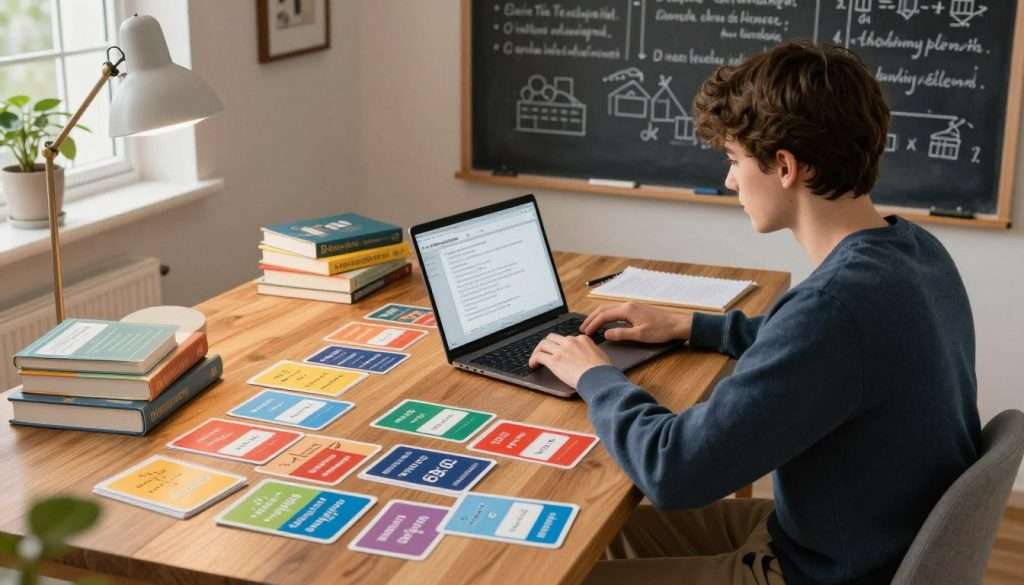
After you know what to learn, break it down into smaller parts. Turn big topics into smaller ones or make flashcards. Flashcards have key terms on one side and their meanings on the other.
This approach makes studying easier and less stressful.
Step 3: Create Your Initial Study Schedule
Now, plan out your study schedule. Choose how often to review your material based on the spaced repetition method. Start with daily reviews, then increase the time between them as you get better.
Use a planner, app, or digital tool to keep track of your reviews. This will help you stay on schedule.
By following these steps, you’ll be ready to use spaced repetition to improve your learning.
Creating Effective Study Materials for Spaced Repetition
To get the most out of spaced repetition, you need a smart plan for making your study materials. The quality of your flashcards, notes, and other study tools is key to keeping information in your memory.
Designing High-Quality Flashcards
Flashcards are a key part of spaced repetition. Here are some tips to make them work best:
- Keep it simple: Make sure each card has a clear question or prompt on one side and a precise answer on the other.
- Use images and mnemonics: Adding pictures and mnemonics can help you remember better.
- Avoid clutter: Don’t put too much on one card. Focus on one idea per card.
Using Active Recall Questions
Active recall is a strong method that makes you think hard about what you’ve learned. When making flashcards, aim to create questions that make you recall information.
For instance, instead of a card saying “The capital of France is Paris,” make one that asks “What is the capital of France?” This makes your brain work harder to remember.
Adding Context and Examples
Flashcards are great for memorizing, but adding context and examples can make you understand better. Think about including:
- Examples that show the concept.
- Mnemonics or memory tricks to help recall.
- Links to other related info.
| Study Material | Purpose | Example |
|---|---|---|
| Flashcards | Memorization | Vocabulary words, historical dates |
| Active Recall Questions | Deepens understanding | Practice quizzes, self-tests |
| Context and Examples | Enhances retention | Case studies, illustrative anecdotes |
By making top-notch study materials for spaced repetition, you can really boost your learning. The secret is to be smart and careful in how you create your study tools.
Setting Up Your Spaced Repetition Schedule
Let’s explore how to set up a spaced repetition schedule that suits you. An effective schedule is key to retaining information and making the most of your study time.
The 1-3-7-21 Day Review Pattern
The 1-3-7-21 day pattern is a popular method for spacing out reviews. You review a piece of information one day, then again three days later. After that, you review it seven days, and then 21 days after that. This pattern helps solidify information in your long-term memory.
For example, when learning a new vocabulary word, you review it on day one. Then, you review it again on day four, day 11, and day 32. These intervals are a good starting point, but you can adjust them as needed.

Adjusting Intervals Based on Difficulty
Not all information is the same. Some concepts or facts might be harder to remember than others. It’s important to adjust your review intervals based on how difficult the material is for you.
- If something is easy to recall, you can lengthen the interval until your next review.
- If you’re struggling to remember something, shorten the interval and review it more often.
This approach helps you focus on what you need to work on. It saves time on material you already know well and gives extra attention to challenging topics.
Tracking Your Progress and Performance
Tracking your progress is crucial when using spaced repetition. You need to see what’s working and what’s not. Many spaced repetition software programs have tracking features to help you monitor your performance.
| Material | Last Review | Next Review | Difficulty |
|---|---|---|---|
| Vocabulary Word 1 | 2023-04-01 | 2023-04-15 | Easy |
| Historical Date | 2023-04-05 | 2023-04-12 | Hard |
| Formula | 2023-04-10 | 2023-05-01 | Medium |
“The key to effective learning is not just repetition, but spaced repetition. By reviewing material at increasingly longer intervals, you’re not just memorizing; you’re learning.” –
By setting up a spaced repetition schedule and adjusting it based on your performance, you can optimize your study sessions. This will help you retain information better.
Best Spaced Repetition Software and Tools
Let’s explore the top spaced repetition software to help you study better. These tools automate scheduling, track your progress, and make learning more efficient.
Anki: The Customizable Powerhouse
Anki is a top choice for spaced repetition software. It’s very customizable, letting you create digital flashcards that meet your needs. You can add images, audio, and videos to your cards, making it great for many subjects.
Anki uses a smart algorithm based on spaced repetition. This shows you cards at the best times to help you remember information. It also has a big community, so you can find decks for lots of subjects.
Quizlet: User-Friendly and Social
Quizlet is another well-liked study tool that uses spaced repetition. It’s easy to use, making digital flashcards simple to create and study. Quizlet also has a social side, letting you share and find study sets from others.
Quizlet makes studying fun. You can use different study modes, like “Learn” and “Test,” to help you remember. Plus, it has a mobile app for studying anywhere.
RemNote: Note-Taking Meets Spaced Repetition
RemNote is a newer but popular spaced repetition software. It combines note-taking with spaced repetition, helping you organize and review your notes at the right times.
RemNote’s design is clean and easy to use. It also has features like bidirectional linking, which helps you connect different notes and ideas. This makes learning and remembering easier.
Paper-Based Systems for Traditional Learners
Some people prefer not to use digital tools. Paper-based systems can work well for spaced repetition too. You can make physical flashcards or use a planner to keep track of your reviews.
Paper-based systems offer a tactile and engaging way to study. You can use colors, highlighters, and layouts to make your study materials more interesting. Plus, you don’t have to worry about screens or batteries.
When picking a spaced repetition tool, think about what suits your learning style best. Whether you like digital or paper methods, the most important thing is to find a system you can stick to.
- Anki: Highly customizable, great for complex subjects.
- Quizlet: User-friendly, social features, and engaging study modes.
- RemNote: Combines note-taking with spaced repetition, intuitive interface.
- Paper-Based Systems: Tactile, no screen time, customizable with colors and layouts.
Spaced Repetition for Studying Different Subjects
Spaced repetition is not just for memorizing facts. It’s a powerful technique for learning many subjects. It works for language learners, medical students, and math experts alike.
Language Learning and Vocabulary
Learning a new language starts with vocabulary. Make flashcards with words on one side and meanings on the other. Add a sentence or phrase to give context. For example, “Mi gato se llama Max” for “gato” (cat) in Spanish.
Use mnemonics or memories to remember words. For French “librairie” (library), think of “liberate” and imagine a library as a place to free your mind.
Medical and Technical Terminology
Medical students must memorize complex terms. Spaced repetition helps. Break down terms into root words, prefixes, and suffixes. This aids in memorization and understanding.
For “hypertension,” break it down into “hyper-” (excessive) and “tension” (blood pressure). Flashcards with term, breakdown, and definition are effective.
Mathematics and Problem-Solving
Math goes beyond memorization; it needs understanding and application. Memorizing key formulas and theorems helps with problem-solving. Review important formulas and concepts regularly with spaced repetition.
Create flashcards with formulas on one side and their use or derivation on the other. This way, you’ll remember and understand the formula. Practice problems related to the formula also solidify your learning.
Common Mistakes When Using Spaced Repetition
Using spaced repetition can be tricky. It’s easy to make mistakes that lower its effectiveness. Knowing these common errors can help you use spaced repetition better.
Overloading Your Daily Review Sessions
One big mistake is trying to cram too much into your daily reviews. It might seem like a good idea, but it can cause burnout and make you less productive. Instead, spread out your reviews to keep a steady pace.
| Daily Review Limit | Recommended Frequency | Benefits |
|---|---|---|
| 20-30 items | Daily | Maintains consistent progress without overwhelming the learner |
| 50+ items | Daily | High risk of burnout, decreased retention |
Creating Poor-Quality Study Materials
The quality of your study materials is very important. Poorly designed flashcards or unclear questions can confuse you more than help. Make sure your materials are clear, simple, and relevant to what you’re studying.
Skipping Reviews and Breaking the System
Being consistent is crucial with spaced repetition. Skipping reviews or not sticking to your schedule can mess up the whole system. This can lead to poor memory retention. To stay on track, set reminders and make spaced repetition a part of your daily routine.
- Set specific review times
- Use a planner or app to track your progress
- Adjust your schedule as needed based on your performance
By avoiding these common mistakes, you can improve your learning with spaced repetition. The goal is to make studying easier and more effective, not stressful.
Advanced Tips to Maximize Memory Retention with Spaced Repetition
Now that you know the basics of spaced repetition, let’s explore advanced tips to boost your memory. By mixing spaced repetition with other learning methods, you can remember more easily.
Combining Spaced Repetition with Other Study Techniques
One great way to improve memory is to use active recall with spaced repetition. Active recall means you actively try to remember information, not just read it. This combo strengthens your memory and makes recalling easier.
For example, when using flashcards, try to recall the answer before looking at it. This mix can greatly improve your memory. Another method is to use interleaving, switching between different materials to deepen your understanding.
Using Mnemonics and Memory Palaces
Mnemonics and memory palaces help encode information in memorable ways. They link new info to familiar things, making it easier to recall. These methods work well with spaced repetition.
For instance, create a mnemonic for a complex formula or date. Then, review it regularly with spaced repetition. Memory palaces work by visualizing a place and linking info to it, making recall easier.
Optimizing Review Times for Your Schedule
The spaced repetition algorithm tells you when to review, but adjust times to fit your schedule. Some prefer reviewing in the morning, others at night. Find what works for you.
Try reviewing during your commute or breaks. The goal is to make spaced repetition a daily habit. This way, you’ll retain more information.
Conclusion
You now know how to make studying better with spaced repetition. This method helps you learn more efficiently. It uses your brain’s natural way to remember things.
Spaced repetition is not just a study trick. It’s a big change. It makes your memory better, saves time, and boosts your confidence.
It’s time to use spaced repetition in your studies. It works for students, professionals, and anyone who wants to learn. Start now and see how it changes your studying.