
Have ever wondered why some study sessions feel easy while others are tough? You’ve probably seen colorful charts online. They claim to unlock secrets for remembering things instantly.
Many people believe in these charts, but we want to look closer. It’s time to leave myths behind and find evidence-based strategies that really work. Understanding The learning pyramid: what actually helps you remember more helps us switch to better habits.
We think studying should be fun, not a chore. By being active, your brain turns info into lasting knowledge. Let’s find ways to make every study minute count.
Key Takeaways
- Passive reading often leads to poor information retention.
- Active engagement creates stronger neural pathways for knowledge.
- Evidence-based methods outperform traditional rote memorization.
- Personalizing study habits improves overall academic performance.
- Shifting mindsets turns tedious tasks into effective growth opportunities.
The Origins and Evolution of the Learning Pyramid
The Learning Pyramid’s story shows how a simple idea can grow. It began in the 1960s at the NTL Institute in Bethel, Maine. Back then, teachers were looking for ways to help students understand complex topics better.
This model became a key part of teaching in many places. It said that teaching others could lead to better retention than just reading. It sounds perfect, right? Who wouldn’t want to learn faster?
But, let’s talk about the evidence. The pyramid looks great, but it’s not as scientifically proven as we’d like. Today, many see it as a useful idea, not a strict rule for learning.
“The most effective way to learn is not necessarily the one that looks best on a colorful infographic, but the one that challenges your brain to work harder.”
It’s easy to get excited about catchy diagrams. But, let’s focus on what really works. Knowing the Learning Pyramid’s history helps us see which learning strategies are worth it and which are just marketing tricks.
- Historical Context: Developed in the 1960s at the NTL Institute.
- The Appeal: Simple, visual, and easy to understand.
- The Reality: Lacks robust empirical data to support specific percentage claims.
The Learning Pyramid: What Actually Helps You Remember More?
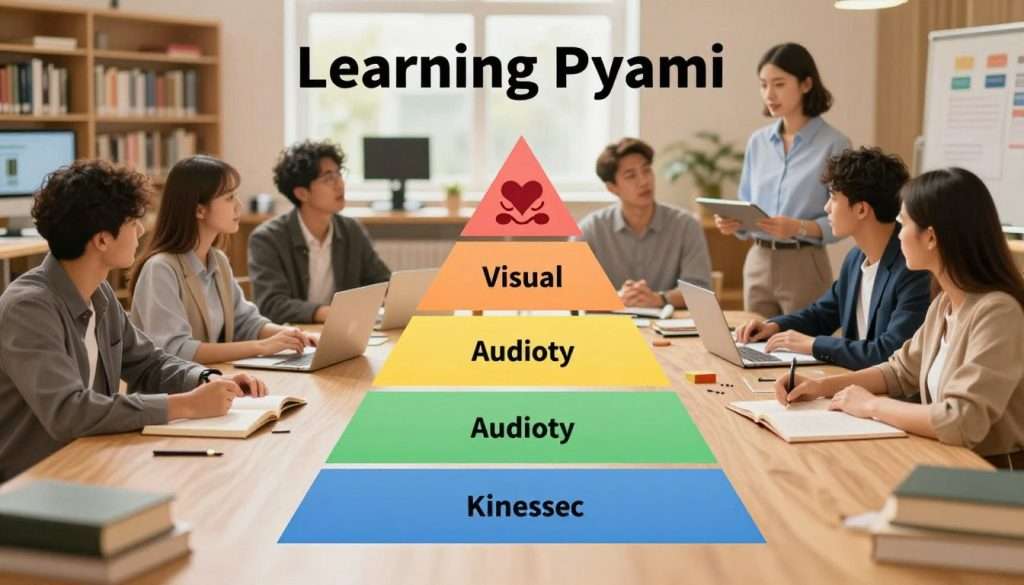
We’re exploring the Learning Pyramid to find out the learning pyramid: what actually helps you remember more. You’ve probably seen those colorful charts online. They say you only remember 10% of what you read, but a huge 90% of what you teach others.
It sounds like a study magic trick, right? But, we should be careful. Scientific research doesn’t fully support these exact numbers. They’re more like guidelines than strict rules.
Even if the numbers are a bit off, the main idea is very valuable. The pyramid shows a key truth: just sitting back and listening doesn’t help much. When you actively participate, your brain makes stronger connections.
Don’t worry too much about the exact percentages. Focus on the action itself. Teaching or applying what you learn makes your brain work harder. That’s the real secret of the learning pyramid: what actually helps you remember more. By being active, studying becomes a powerful tool for success.
Why Passive Learning Often Leads to Poor Retention
We often think reading our notes is the same as learning. Highlighting lines and scanning pages seems productive. But this passive approach rarely lasts. Your brain needs more than just input to remember new concepts.
Passive learning asks your brain to work hard without your help. This is why many traditional methods don’t work well in exams.
The Limitations of Reading and Listening
Reading textbooks or listening to lectures might seem like the best way to study. But research shows they’re not enough on their own. For example, studies found museum visits had no measurable effect on student exam results. These experiences are enriching but don’t help your brain remember information.
When you only read or listen, you’re just watching your own education. You might understand something in the moment. But that temporary understanding fades quickly. Without a challenge, your brain sees the information as unimportant.
The Illusion of Competence in Re-reading Notes
Ever read something and felt you got it, only to forget it later? This is the illusion of competence. Familiar text makes your brain think you know it well.
Re-reading notes is a common trap. The words look familiar, making you think you know it. But recognition isn’t the same as remembering. True learning comes from recalling information from memory, not just looking at it.
The Science of Active Recall and Memory Consolidation
Deep learning happens when you struggle to remember things. When you try to recall facts without notes, you’re not just testing yourself. You’re building a stronger brain.
Many students just passively review their notes. But that’s not enough. By using cognitive learning methods, you become an active learner. This is how you turn short-term thoughts into lasting knowledge.
How Neural Pathways Strengthen Through Retrieval
Your brain is like a hiking trail. The more you walk it, the clearer it gets. Every time you struggle to remember something, you’re making the path easier.
Making mistakes is key to this process. When you get something wrong, your brain finds the gap in your knowledge. This direct correction is more effective than just reading the right answer.
“The brain is not a vessel to be filled, but a fire to be kindled.”
Here are some benefits of active retrieval:
- It shows you what you don’t know yet.
- It strengthens neural connections through effort.
- It stops the illusion of knowing from just re-reading.
The Role of Cognitive Load in Deep Learning
Learning complex topics can feel overwhelming. But managing your cognitive load can change the game. You don’t need to learn everything at once to see progress.
Breaking information into smaller chunks helps your brain process it better. These cognitive learning methods keep you focused and ensure your efforts pay off. It’s not about how much you study, but how well you challenge your brain.
Focus on quality over quantity. Your memory retention techniques will become natural. Keep pushing yourself to recall, even when it’s hard. That’s where the real growth is!
The Power of Teaching Others to Solidify Knowledge
Ever felt like you know something until you try to explain it? Then, those unclear spots in your mind become very clear. This isn’t a sign of failure; it’s actually the most effective way to learn.
When you teach someone else, your brain works harder. You organize information better and fill in missing pieces. It’s proven that teaching someone else helps you master a subject better.
The Protégé Effect Explained
The Protégé Effect shows how teaching others boosts your own learning. By preparing to teach, you think more deeply about the material. You focus on the core essence of the topic, not just memorizing facts.
“To teach is to learn twice.”
Teaching forces you to simplify complex ideas. Breaking down concepts into simple parts strengthens your brain’s connections. You’re not just repeating words; you’re building a mental map that makes the information stick.
Structuring Peer-to-Peer Explanations
For the best results, plan your teaching. Don’t just go through your notes randomly. Instead, guide your study partner through the subject step-by-step. This way, both of you will understand it better.
Here’s a table to help you organize your study sessions:
| Strategy | Action Step | Goal |
|---|---|---|
| The Analogy Method | Use a real-world comparison | Simplify complex logic |
| The “Why” Drill | Ask why it matters | Connect to core concepts |
| The Gap Check | Identify missing links | Strengthen weak areas |
| The Summary Loop | Recap in one sentence | Solidify main takeaways |
By using this method, you turn a simple chat into a powerful learning tool. Your confidence will grow as you find you can explain tough topics easily. Keep at it, and you’ll become the top expert in your study group.
Implementing Practice-by-Doing Strategies
Feeling stuck while studying? It might be because you’re missing the key to action. We often think reading a chapter means we’ve learned, but that’s not true. You’re wasting 90% of your time because you don’t see the value of active implementation.
Changing from theory to practice is where the magic happens. Instead of just reading, you need to make your brain work. This turns ideas into practical skills that you can use.

Simulating Real-World Application
One great way to avoid getting stuck is to practice in real-life situations. If you’re learning a new language, don’t just memorize words. Try writing a story or talking with a native speaker about your day.
When you tackle problems that feel like real life, your brain gets a workout. You’re not just watching; you’re actively learning. This direct action helps your memory last longer.
“Tell me and I forget, teach me and I may remember, involve me and I learn.”
Building Projects to Bridge Theory and Practice
The best way to prove you know something is to make something with it. Whether it’s coding, writing, or planning, projects let you apply what you’ve learned. This closes the gap between theoretical knowledge and practical use.
When you work on a project, you’ll face obstacles. But these are chances to grow because they make you think and learn. By the end, you’ll know the material much better than any book.
The Role of Discussion and Collaborative Learning
Studying doesn’t have to be lonely. By sharing your learning with others, you can improve your memory. Studies show that up to 50% of what you learn can stick with you through group discussions.
Talking about what you’ve learned helps you organize your thoughts. You can’t just gloss over a topic when explaining it to someone else. This dynamic exchange turns reading into a lively debate that strengthens your memory.
Engaging in Socratic Questioning
Using Socratic questioning in your study group can be very helpful. Instead of just listening when someone explains a concept, ask them why they think that way. This method helps everyone dive deeper into the subject’s core.
By asking tough questions, you move beyond just memorizing facts. You start to see how different ideas are connected. This way, you:
- Find out what you don’t know yet.
- Practice explaining your thoughts under pressure.
- Gain confidence in sharing complex ideas.
The Benefits of Diverse Perspectives in Study Groups
Working with others brings different viewpoints to the table. Everyone sees things from their own unique perspective. Hearing how someone else views a theory can challenge your own views.
This challenge is good for your brain. It makes you question your own logic and consider other ways of thinking. By embracing these different views, you build a stronger understanding of the material.
| Study Method | Primary Benefit | Retention Level |
|---|---|---|
| Solitary Reading | Focus and Speed | Low to Moderate |
| Group Discussion | Critical Thinking | High |
| Teaching Others | Mastery | Very High |
Visualizing Information for Better Recall
Your brain loves pictures as much as words. Using both can make learning easier. Turning text into visuals helps organize complex ideas.
Using Mind Maps to Connect Concepts
Mind maps are great for handling lots of information. They start with a main topic in the center and branch out. This way, you can see how ideas connect.
Using mind maps makes learning active, not just reading. It’s like making a map of your thoughts. This helps you remember information better.
The Dual Coding Theory in Practice
Dual coding theory is key to this success. It says your brain handles pictures and words differently. Combining them creates more ways for your brain to remember.
It’s like having a backup for your brain. If you forget a word, a picture might help you remember. These tips help you understand better, not just memorize.
| Feature | Traditional Notes | Visual Mind Maps |
|---|---|---|
| Information Flow | Linear and rigid | Organic and flexible |
| Brain Engagement | Low (Passive) | High (Active) |
| Recall Speed | Slower | Faster |
| Complexity Handling | Difficult | Excellent |
Effective Study Habits for Long-Term Retention
Mastering your memory is not about working harder, but about working with your brain’s natural rhythm. To keep information for a long time, avoid last-minute cramming. By adopting effective study habits, your hard work will pay off long after exams are over.

Spaced Repetition Systems
Your brain is like a garden that needs regular watering to stay green. Spaced repetition means reviewing material at increasing intervals over time. Instead of reading a chapter five times in one day, review it today, again in three days, and then once more next week.
This method makes your brain work harder to remember information, strengthening neural connections. It’s a powerful learning strategy for mastering complex topics. Spacing out your practice prevents memory decay from ignoring new information.
Interleaving Subjects to Improve Discrimination
Many students study only one topic for hours, leading to a false sense of mastery. Interleaving mixes different subjects or problems in one study session.
Switching between topics helps your brain better distinguish between similar concepts. You learn to choose the right strategy for each problem, not just repeat the same pattern. This mental agility is key for success in real-world scenarios.
| Study Method | Primary Benefit | Best For |
|---|---|---|
| Cramming | Short-term recall | Last-minute review |
| Spaced Repetition | Long-term retention | Core concepts |
| Interleaving | Concept discrimination | Complex problem solving |
Common Pitfalls in Modern Educational Psychology
Ever spent hours highlighting a textbook but remember nothing? It’s a common problem many face. We want to learn but often get caught in traps that make us feel busy without learning.
Learning about educational psychology can help you avoid these mistakes. It lets you adopt effective study habits that really work.
Over-reliance on Highlighting and Underlining
We love our neon markers, but highlighting is mostly passive busy work. When you highlight, your brain isn’t really learning. You’re just marking words, not connecting ideas.
This habit makes us think we’ve learned when we haven’t. A colorful page doesn’t mean you’ve mastered the material. True learning means engaging with the content, not just decorating it.
Ignoring the Importance of Metacognition
Metacognition is the key you’ve been missing. It’s thinking about your own thinking. It’s asking if you really get a concept or just recognize the words.
When studying, stop often to check your progress. Ask if you can explain the idea in your own words. If not, you know where to focus.
Mastering this skill helps you avoid mindless repetition. Modern educational psychology shows being aware of your gaps is the best way to fill them. Stop highlighting and start questioning your understanding today!
Mastering Your Personal Learning System
Ready to stop guessing and start mastering your study habits for good? You’ve learned about how we learn. Now, it’s time to create a consistent, personal system that works for you.
How to Become the Smartest Student in the Classroom
Becoming a top student isn’t about having a great memory. It’s about using the right memory retention techniques to keep information in your mind. Using active retrieval instead of just reading makes a big difference.
Accessing Your Free Resource for Academic Success
Want to learn more? My free book, How to Become the Smartest Student in the Classroom, offers memory enhancement tips and study routines. It’s free and no strings attached. Get your copy here at https://www.studyingmachine.com/free-books/ to start your academic journey today.
Integrating Memory Techniques into Daily Routines
Consistency is key to success. Try to make these memory enhancement tips part of your daily life, not just before exams. Small, frequent practice sessions strengthen your brain and make learning easy.
Here’s a comparison of your new approach with old methods:
| Study Method | Retention Level | Effort Required |
|---|---|---|
| Passive Re-reading | Low | Low |
| Highlighting Text | Low | Low |
| Active Recall | High | High |
| Teaching Others | Very High | High |
Choosing the right memory retention techniques turns studying into something enjoyable and effective. Start small, stay consistent, and watch your grades improve as you learn your own way.
Conclusion
You now have a smarter way to study. We debunked the learning pyramid myth. It’s time to move from passive to active learning.
Modern educational psychology shows your brain loves a challenge. Struggling with a concept strengthens your brain more than just reading. This mindset makes every study session a chance to grow.
Don’t be afraid of mistakes. Each one helps you learn and improve. By using these educational psychology tips, you create a study system that’s just right for you.
We want you to feel confident in your next project. Use these tools to make learning fun and effective. Your journey to mastery begins with the next page you turn.