

Productive Struggle can make learning more effective when a challenging task is within reach and you have room to try, get feedback, and try again. A worked example is a step-by-step solved problem that learners study before trying one themselves. When a study session feels hard, rereading or grabbing the answer can seem like the quickest escape. But students can learn from effort when a task leaves room for real thinking.
The right challenge pairs effort with support. You need time to make an attempt, notice what happened, and use feedback to improve your understanding. Motivation can dip when you meet a mistake, but that mistake can point to what you need to learn. We’ll look at how challenge, instruction, and support work together, so you can choose a useful next step. A hard moment is useful when it helps you build understanding, not when it leaves you stranded.
Key Takeaways
- Choose challenges you can meaningfully explore.
- Use mistakes to guide your next attempt.
- Study an example when a new procedure feels unfamiliar.
- Return to material later to strengthen memory.
- Ask for feedback that helps you move forward.
What Productive Struggle Adds to Learning
Productive Struggle gives students a chance to test what they know before instruction helps them refine it. Learners try unfamiliar problems, share approximate ideas, then study explanations that make those ideas easier to understand. The key is what happens next: instruction must help students make sense of their attempts.
Effort supports learning when students can connect their attempts to useful instruction. A 2021 meta-analysis of 53 studies and 166 comparisons found a moderate advantage for problem solving followed by instruction over instruction followed by problem solving. The result was Hedges’ g = 0.36, with a 95% confidence interval of 0.20–0.51, in the 2021 meta-analysis.
What makes an attempt useful rather than overwhelming
Productive Failure is one specific form of problem solving followed by instruction, not a name for every lesson that asks students to solve problems first. It starts with exploration of a challenging problem and approximate solutions. Then instruction builds on those attempts.
Unproductive struggle begins when students have no useful path from an attempt to feedback.
That distinction matters because failure alone does not teach. Students need a chance to compare their thinking with an explanation, ask questions, and revise an idea. A teacher can offer a hint or a visual without giving away every step.
How effort can build connected understanding
A 2026 theoretical analysis proposes three possible mechanisms for Productive Failure: cognitive conflict, delayed instruction, and knowledge reconstruction. These are explanations researchers propose, not guaranteed effects. The three proposed mechanisms describe how students may notice gaps, revisit ideas, and connect new information.
A Productive Struggle essay can describe a challenge, the attempts made, and the feedback that helped the learner understand. It works best when the writer explains how an idea changed, not just how long the task took. Students can then show what their mistakes revealed and how instruction helped them make sense of the problem.
The goal is a clearer understanding, not a story about having tried hard.
When Should You Try First, and When Should You Study an Example?
A useful first check is whether the learner already has enough component knowledge to make a meaningful attempt. An attempt-first lesson can fit when students can explore a problem in several ways; a worked example can help novices learn a new procedure with less strain. Start with what the task assumes, not with a fixed rule about struggle.
Use an example first when learners lack the basic steps needed to explore a new procedure. Evidence varies by learner and task:
| Approach | Learner or lesson context | Evidence and result |
|---|---|---|
| Problem solving, then instruction | Overall comparison | 53 studies; moderate advantage, g = 0.36 |
| High-fidelity Productive Failure | Careful implementation | Hedges’ g values: 0.37–0.58 |
| Instruction, then problem solving | Grades 2–5; domain-general skills | Results favored instruction first |
| Worked examples | Novices learning new procedures | Can reduce cognitive load |
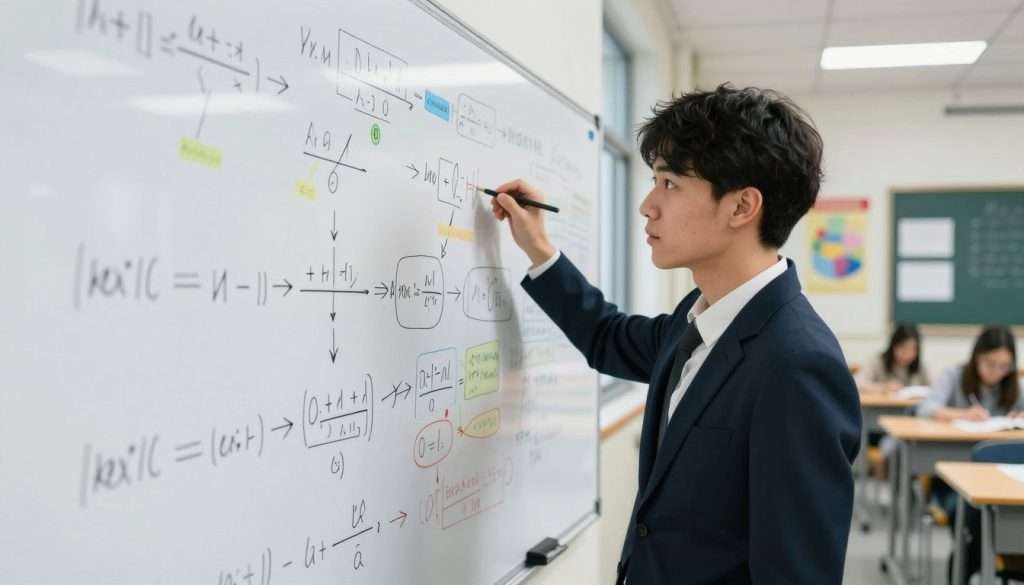
When an attempt-first lesson fits
Students can try first when they have enough prior knowledge to test a strategy and make sense of mistakes. In a multistep math problem, a learner might try a number sentence, then compare it with an explanation. A 2021 meta-analysis found that high-fidelity Productive Failure had Hedges’ g values from 0.37 to 0.58.
The same meta-analysis found results favoring instruction followed by problem solving for learners in grades 2–5 and for domain-general skills. That exception matters: a task’s subject and students’ current skills can change which approach helps most.
When a worked example should come first
A 2023 experiment with multistep mathematics problems found that learners who studied worked examples did better on retention and transfer tests than learners who solved problems during initial learning. The 2023 mathematics experiment also found lower cognitive load for learners studying examples.
In a 1985 algebra study, learners who practiced with worked examples took almost six times longer to finish the learning sequence and made more errors than learners who studied worked examples. Examples can give novices a clear view of new steps before independent practice. Before choosing a method, check what knowledge the task assumes learners already have.
A Four-Step Routine for Classroom and Solo Study
For a quick math warm-up, ask students to find the total of 13 animal books, 9 space books, and 16 sports books before discussing a solution. The total is 38, but the explanation shows how students used addition and tracked each category. Make room for more than one approach.
The NCTM mathematics teaching practices call for demanding tasks with multiple entry points and varied strategies. Students can use prior understanding, tools, and drawings to explain their thinking. Harder for its own sake does not guarantee learning.

- Choose a task with several entry points and a clear goal.
- Invite a first attempt using prior knowledge, a drawing, or another representation.
- Ask learners to explain their reasoning before offering targeted feedback.
- Revisit the material later with a short retrieval check that mixes in earlier learning.
Stepping back is not the same as leaving students without support. Retrieval practice helps long-term retention more than passive rereading, and spaced practice often beats one massed session. A 2026 review of learning strategies names retrieval and spacing as useful approaches. Our free book, How to Become the Smartest Student in the Classroom, offers memory techniques, study routines, and strategies that support learning. Ask learners to defend why their model includes all three book categories.
Making a task harder for its own sake does not guarantee that students will learn more.
Conclusion
A good challenge gives you room to think, plus enough support to keep moving. Choose a task that lets you use what you know, then give yourself a chance to compare your ideas with helpful feedback. That balance can make study feel less like a wall and more like a path you can follow.
Small routines also help you remember what you learn. If you want a full system of memory techniques, study routines, and strategies that stick, get our free copy of How to Become the Smartest Student in the Classroom. It comes at no cost and with no catch. You can start with one new idea and build from there.
Get your free copy here: https://www.studyingmachine.com/free-books/