

Ever feel like your textbooks are just a mess of confusing symbols? We’ve all been there. Sometimes, the key to mastering a tough subject isn’t about working harder. It’s about thinking smarter.
Remember Paul Morphy’s legendary “opera game”? It opened a magical world of logic and beauty. We think your academic path deserves that same spark of brilliance.
Learning isn’t just about memorizing dry facts. It’s about unlocking the deep, strategic patterns in your material. By thinking like a pro, you make every study session a winning move.
Let’s dive into how these elite thinkers tackle challenges. We’ll show you how to turn your daily studies into an engaging and effective journey to success.
Key Takeaways
- See academic challenges as strategic puzzles, not chores.
- Focus on deep understanding, not just memorizing.
- Use logical patterns to make complex info simpler.
- Make every study session a deliberate, winning move.
- Find the hidden beauty and magic in your subjects.
The Mindset of a Grandmaster
Thinking like a grandmaster is not just for board games; it’s a way to upgrade your brain. When you use chess strategies in your studies, obstacles become puzzles to solve. This changes how you see challenges.
Even complex subjects become easier when you have the right mindset. By changing how you view things, every study session becomes a chance to improve your thinking.
Cultivating a Growth Mindset
A growth mindset is key for high-level learning. It means you believe you can get better with effort and expert guidance. When faced with a challenge, you don’t give up. Instead, you look for a new way to tackle it.
This mindset keeps you curious and eager to learn. You don’t fear mistakes anymore. Instead, you see them as chances to learn and grow. Here’s how this mindset changes your study habits:
| Feature | Fixed Mindset | Growth Mindset |
|---|---|---|
| Challenges | Avoided | Embraced |
| Obstacles | Give up easily | Persist |
| Effort | Seen as fruitless | Path to mastery |
| Feedback | Ignored | Learned from |
The Importance of Deep Focus
Deep focus is a key skill for top performers. It helps you ignore distractions and focus on tough material for longer. Just like a chess player ignores the crowd, you must protect your focus.
Getting expert guidance can help you improve your focus faster. A mentor or a proven study system can save you from wasting time on bad methods. By mastering focus, you turn study time into a game where you’re always in control.
What Chess Grandmasters Can Teach You About Studying
Studying like a grandmaster is not just about memorizing moves. It’s about changing how you see the world. When you look at the board, you see more than just pieces. You see a complex web of possibilities.
This is what chess grandmasters can teach you about studying in your life.
Treating Knowledge as a Dynamic System
We often treat textbooks as static lists of facts. But true masters see every subject as a living, breathing system. Every piece of information connects to another.
Think of it like a puzzle where the edges define the center.
Take Rudolf Charousek, a brilliant player who died at 26. His games are a treasure trove for those learning from experts. He showed that deep wisdom can be found in any situation.
The Role of Curiosity in Skill Acquisition
Curiosity keeps your brain engaged during long study sessions. Instead of just reading, ask yourself why a concept works. This turns a dull task into a detective mission.
When you stay curious, you become an active learner. This dynamic approach keeps your skills sharp and motivation high, even when the material gets tough.
Pattern Recognition and Chunking Information
Your brain is like a chessboard, with each piece having its place. Instead of seeing thirty-two pieces, you see patterns and strategies. This helps you process information faster in your studies.
Breaking Down Complex Subjects
Just as a chess player spots a bishop’s move, you can identify key moves in your studies. When a big topic seems too much, break it down into smaller parts. This makes it easier for your brain to handle.
By focusing on smaller parts, you feel less overwhelmed. You see how each piece fits into the bigger picture. This is a key effective study technique for clarity.
Building Mental Libraries for Faster Recall
After breaking down your subject, organize the parts in your mind. Imagine a mental library where everything is labeled and easy to find. This way, you can quickly find what you need during exams.
With this organized approach, you study faster and with more confidence. It turns studying into a strategic game, not a chore.
Techniques for Effective Information Categorization
To keep your mental library organized, use active categorization. Group related ideas with mind maps or color-coded notes. This sharpens your critical thinking skills as you decide where each piece goes.
Good categorization builds strong neural paths for easy recall. You’re not just memorizing; you’re creating a structured system of knowledge. This shifts you from a passive learner to a master of your studies.
The Power of Deliberate Practice
Most students just read their notes over and over. But there’s a better way. Reading the same notes repeatedly keeps your brain in an easy, low-effort state. To really master a subject, you need to use effective study techniques that challenge your mind.
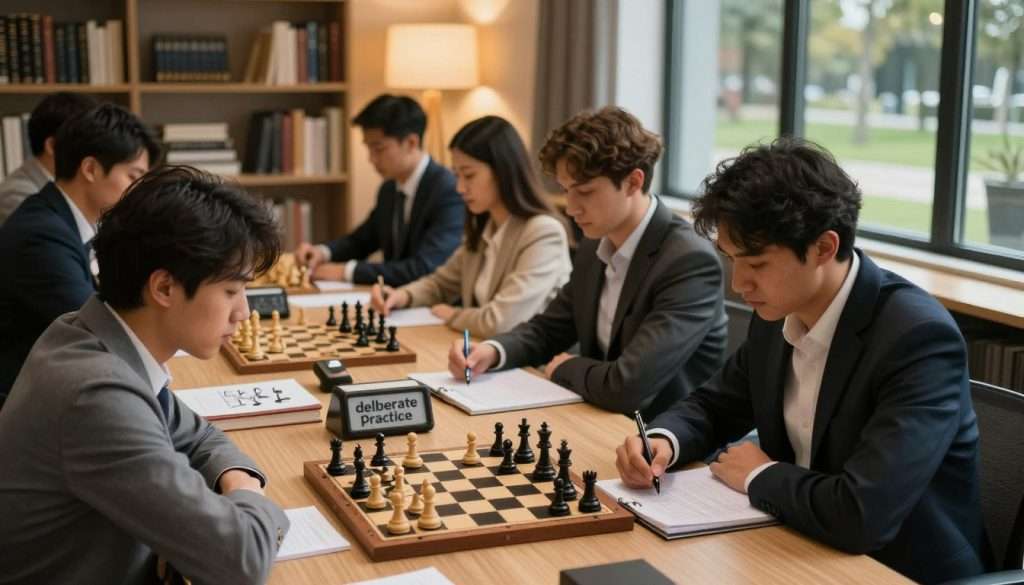
Moving Beyond Passive Reading
Passive reading is like watching a movie without paying attention. You might think you’re learning, but the info doesn’t stick. Instead, watch a lecture or demo once to get the main idea.
Then, watch it again and pause at the key turning point to think about why the expert made that choice. This makes you actively think and turns a dull review into a mental challenge.
Focusing on Weaknesses Rather Than Strengths
It’s tempting to review what you already know because it feels good. But real growth comes from areas where you struggle. To improve, focus on topics that make you feel a bit uncomfortable.
Think of it as your own personal training program. With the right expert guidance, you can find and improve your weak spots. Ignoring them only slows you down, so tackle the tough stuff head-on.
Designing Targeted Exercises for Improvement
You don’t need a coach to plan your study. You can make your own exercises by breaking down big concepts into smaller tasks. Focus on one skill at a time until you’re confident, then move on to the next challenge.
| Study Habit | Passive Approach | Deliberate Practice |
|---|---|---|
| Reading Material | Re-reading chapters | Summarizing from memory |
| Problem Solving | Looking at solutions | Testing without hints |
| Goal Setting | General review | Targeting specific gaps |
Using these effective study techniques lets you take charge of your learning. Remember, consistent effort in weak areas is more valuable than endless repetition. With some expert guidance and a plan, your skills will grow faster than you think.
Analyzing Mistakes Through Post-Game Review
Mistakes are often the key to getting better. Instead of ignoring a bad study session, treat it like a chess player reviews a lost game. By examining where things went wrong, you learn to avoid those mistakes next time.
The Value of Self-Reflection
After a study session, take a moment to reflect. Ask yourself what you learned. This habit turns a passive experience into an active learning opportunity. You’re not just memorizing; you’re refining your skills.
Learning from Failure Without Emotional Bias
It’s easy to feel frustrated when you hit a wall. But see every mistake as a neutral clue. Your errors don’t show your intelligence; they point to what you need to study next. By removing emotions, you can analyze your work with a clear mind.
Creating a Feedback Loop for Academic Success
To keep growing, create a feedback loop. After each session, note what worked and what didn’t. This sharpens your critical thinking and keeps you moving forward. Over time, this cycle becomes the engine for mastering new skills, turning every stumble into a step forward.
Managing Cognitive Load and Mental Stamina
Your brain is like a high-performance engine. It needs the right fuel and care to keep running well. Just like a chess grandmaster, you must learn to manage your mental energy. Pushing yourself too hard rarely leads to better results.
Instead, work smarter by respecting your natural limits. Treating your brain with care helps avoid burnout. We have some educational insights to change how you study.
The Science of Rest and Recovery
Many think constant grinding is the only way to succeed. But science shows your brain processes information and builds connections while resting. This downtime is key for cognitive development, helping your mind solidify what you’ve learned.
Rest is like organizing your brain’s library. Without it, finding information later becomes hard. Short, intentional breaks are a strategic move for mastering material.
Optimizing Study Sessions for Peak Performance
To perform at your best, structure your time wisely. Use short, intense focus bursts followed by brief recovery. This keeps your mind sharp and prevents mistakes.
The table below shows how to balance study intensity with recovery for peak performance.
| Session Type | Duration | Goal | Recovery Time |
|---|---|---|---|
| Deep Focus | 45 Minutes | Mastering Concepts | 10 Minutes |
| Review Phase | 20 Minutes | Pattern Recognition | 5 Minutes |
| Active Recall | 30 Minutes | Testing Knowledge | 15 Minutes |
By following this rhythm, your brain stays fresh for challenges. Remember, stamina is built through smart recovery, not just willpower. Stay consistent, take breaks, and watch your learning efficiency soar.
Developing Long-Term Strategic Planning
Ever felt lost in your studies without a map? Without a clear plan, learning can feel aimless. We see long-term planning as key to your cognitive development, helping you grasp the big picture in any subject.
Setting Milestones for Complex Learning
Breaking big goals into smaller steps keeps you motivated. Think of these steps as milestones that guide you. When you reach these points, you gain the confidence to move forward.
- Define your ultimate objective clearly.
- Create small, actionable steps for each week.
- Review your progress regularly to ensure you are moving forward.
Adapting Strategies When Progress Stalls
Sometimes, even the best plans hit a wall. If your progress stalls, don’t panic! Look at how greats like Botvinnik, Karpov, and Rubinstein adapted. They knew rigid thinking can fail.
You need to be flexible and change your chess strategies when needed. By studying these masters, you learn to adapt. This skill is crucial for lifelong learning and ongoing cognitive development. Adjusting your approach shows you’re refining your strategy, not failing.
Leveraging Tools and Technology for Mastery
Mastering new skills needs a mix of modern tools and old-school focus. The right tech can boost your growth a lot. Using these tools wisely helps you learn faster and better.

Using Digital Resources to Simulate Challenges
Watching experts tackle tough situations is a great way to learn. We suggest using the Replay Lab to see how they make decisions. It lets you pause, analyze, and guess the outcome before it’s shown.
This method helps you apply what you learn in real situations. Here are some benefits of digital simulation:
- Immediate feedback loops that show you where you went wrong.
- The chance to replay complex scenarios until you get it right.
- Access to a huge library of expert decisions to study at your own pace.
“Technology is best when it brings people together and helps them learn faster than they ever could alone.”
Balancing Analog Study with Modern Software
Don’t rely only on software. Mixing analog study with modern tools keeps your mind sharp. Writing notes by hand or using a physical board helps you remember better.
Think of software as your training partner and analog study as your reflection time. This mix creates a strong learning environment. It helps you understand the logic behind what you’re learning, not just memorize it.
Conclusion
We hope this deep dive into the grandmaster playbook shows you that studying is a strategic adventure. You now hold the keys to turn any subject into a personal masterpiece.
Learning from experts allows you to bypass common pitfalls and reach your goals faster. You can apply these educational insights to your daily routine starting right now.
Pick one small habit from our guide and test it today. You might try breaking a complex topic into smaller chunks or reviewing your mistakes with a fresh perspective.
Building a library of knowledge takes time and patience. Stay curious about the process and keep refining your approach as you grow.
We want to hear about your progress as you implement these strategies. Share your favorite study hacks with us on social media or drop a note to let us know what worked best for you.
Your path to mastery is unique. Keep pushing boundaries and enjoy the thrill of becoming a lifelong learner.