

Ever wondered why your brain tricks you when making simple choices? We all have those moments where logic seems to fade away. These mental shortcuts are called cognitive biases. They act like hidden filters, shaping how we see reality.
In the 1970s, researchers Kahneman and Tversky started a big study. They wanted to know why our decisions often stray from logic. They found out our minds use clever shortcuts to quickly process information. While these shortcuts help us survive, they can also mislead us.
By recognizing these patterns, you can clear the mental fog. Understanding cognitive biases helps you make choices that really match your goals. Whether it’s a tough study session or a big life change, you now have the power to control your thinking!
Key Takeaways
- Our brains use mental shortcuts to process information quickly.
- Kahneman and Tversky pioneered the study of how we deviate from logic.
- These hidden filters influence your daily choices and study habits.
- Awareness is the first step toward making better, more intentional decisions.
- You can learn to navigate these patterns to reach your personal goals.
The Evolutionary Roots of Human Judgment
You might think you’re always in control, but your brain has secret shortcuts. These cognitive biases aren’t just random errors. They’re leftovers from when your ancestors had to make crucial decisions fast.
Survival Mechanisms and Mental Shortcuts
In the past, our ancestors faced life-or-death situations often. To survive, their brains developed mental shortcuts for quick decisions. These early cognitive biases were smart survival tools.
Consider these scenarios where fast thinking was key:
- Identifying a rustle in the grass as a potential predator.
- Deciding whether to trust a stranger based on a quick glance.
- Choosing to flee from a dangerous situation before fully analyzing the risk.
The Transition from Ancient Environments to Modern Complexity
Today, our world is much different from our ancestors’. We face complex data, social media, and endless choices. Yet, our brains still run on ancient software designed for the savanna.
This mismatch poses a challenge for modern learners. While these cognitive biases helped our ancestors, they can mislead us today. Understanding that your brain is wired for survival is the first step to smarter thinking.
Defining Cognitive Biases in Behavioral Economics
Our minds are always processing information, often using shortcuts that lead us astray. In behavioral economics, we explore how these patterns affect our spending, career choices, and even lunch decisions. It’s not just about numbers; it’s about the human side of logic.
Usually, your brain saves energy by using automatic processes. While these shortcuts are helpful, they can sometimes cause predictable errors in judgment. Knowing these patterns can help you take control of your life.
Distinguishing Between Heuristics and Biases
Heuristics are your brain’s “mental rules of thumb.” They are quick strategies for processing information without analyzing every detail. For instance, you might pick a restaurant because it’s crowded, thinking a crowd means quality.
But when these shortcuts consistently mislead you, they become cognitive biases. These are systematic errors in your thinking. A heuristic is a tool, but a bias is the miscalculation that happens when you use it wrongly.
The Role of Cognitive Psychology in Decision Making
Cognitive psychology shows us our brains work in two modes. The first is fast, intuitive, and emotional, while the second is slow, deliberate, and logical. Most decision making biases happen when we rely too much on the fast, automatic mode for complex tasks.
By understanding these modes, you can pause for big decisions. Instead of autopilot, engage your analytical side to check your instincts. This simple change in behavioral economics can help you avoid common traps and make choices that match your long-term goals.
The Mechanics of Confirmation Bias
It feels great when someone confirms our deepest beliefs. But this comfort comes at a hidden cost. We often fall into the trap of confirmation bias, which is our natural tendency to hunt for information that supports what we already think. It is like having a filter that only lets in the news that makes us feel good about our existing opinions.
Why We Seek Information That Validates Our Beliefs
Our brains are like efficiency machines that prefer the path of least resistance. Processing new, conflicting information takes a lot of mental energy. It can even feel uncomfortable or threatening to our identity. By sticking to what we already know, we save time and keep our ego intact.
This habit is not just about being stubborn; it is a deep-seated psychological preference. We want to feel consistent in our views, so we subconsciously ignore evidence that suggests we might be wrong. This is a primary driver of many decision making biases that cloud our judgment every single day.
The Impact of Echo Chambers on Critical Thinking
Modern technology has made it easier than ever to surround ourselves with like-minded voices. Social media algorithms are designed to show us content that mirrors our interests, effectively building an echo chamber around us. When we only hear our own opinions reflected back, our ability to think critically begins to fade.
This isolation prevents us from seeing the full picture of complex issues. Without exposure to different viewpoints, our beliefs become rigid and untested. Breaking out of this loop is essential if you want to become a more well-rounded and thoughtful learner.
Strategies to Actively Seek Disconfirming Evidence
You can start by making a conscious effort to look for sources that challenge your perspective. If you hold a strong opinion on a topic, try to find the most intelligent argument against it. This simple act forces your brain to slow down and process information more deeply.
- Follow experts who hold views different from your own.
- Ask yourself, “What if I am wrong about this?” before making a choice.
- Seek out diverse perspectives in your daily reading.
By actively hunting for evidence that contradicts your current stance, you sharpen your mind. It is a tough habit to build, but it is the best way to ensure your decisions are based on reality rather than just comfort.
Navigating the Anchoring Bias
Ever feel like a discounted item is a steal just because the original price was sky-high? This is the anchoring bias. It’s when your brain uses the first piece of info as a reference for all future judgments.
Once that anchor is set, it’s hard to change your view. You might think you’re making a smart choice, but you’re really just reacting to that first number.
How First Impressions Set the Stage for Negotiation
In business and salary talks, who speaks first has the upper hand. By sharing an initial number, they set a psychological anchor for the whole conversation. Even if that number is extreme, it pulls the final agreement towards it.
If you’re on the receiving end, you might feel pressured to accept a deal that seems fair. To avoid this, do your homework first. Knowing the market value helps you not get stuck on the artificial anchor set by the other side.
The Psychological Weight of Initial Numerical Values
Our brains are not calculators; they seek patterns. Seeing a high number makes it hard to move away from it, even with better data. This anchoring bias affects how we see study costs and project timelines.
The following table shows how this bias shows up in daily life:
| Scenario | The Anchor | The Resulting Bias |
|---|---|---|
| Retail Shopping | Original “Suggested” Price | Seeing a sale price as a bargain. |
| Salary Negotiation | First Offer Mentioned | Using that initial figure for counter-offers. |
| Academic Planning | Initial Time Estimate | Underestimating the actual effort needed. |
By spotting these patterns, you can step back and see the true value of a situation. Don’t let the first number you hear decide your choice. Stay curious and seek the full story.
The Availability Heuristic and Risk Perception
Why do we worry more about plane crashes than car accidents, even though car accidents are more common? It’s because of how our brains work. We use heuristics, or mental shortcuts, to quickly judge the world.
The availability heuristic is a big mental trap. It makes us think an event is likely if we can easily remember examples of it. If something comes to mind quickly, we think it must happen a lot.
Judging Probability Based on Recent Memories
When we try to guess the chance of something happening, we don’t always look at facts. We use recent or vivid memories instead. If you saw a news report about a rare event, that memory feels important.
This makes you think the event is more likely to happen to you. This is the availability heuristic at work. We confuse ease of recall with how often something happens.
“The human mind is not a calculator; it is a storyteller that prioritizes the most dramatic chapters.”
Media Influence and the Distortion of Reality
The media greatly influences our mental shortcuts. News focuses on rare, dramatic, and scary stories to grab our attention. These stories stay in our minds longer than everyday facts.
This makes us think the world is more dangerous than it is. We’re constantly exposed to negative headlines. To make better choices, we need to look beyond the latest shocking stories and seek the full truth.
Overcoming the Overconfidence Bias
Have you ever felt like you knew everything about a topic, only to find out you didn’t? This feeling is common and often comes from the overconfidence bias. Feeling sure of yourself is usually good, but it can hide the gaps in your knowledge.

The Dunning-Kruger Effect and Self-Assessment
The Dunning-Kruger effect is a mind trick. It makes people with little knowledge think they’re experts. They feel incredibly certain about their skills because they don’t know what they don’t know.
To better understand yourself, look at your work critically. Don’t assume you know everything. Try explaining what you think you know to someone else. If you find it hard, you’ve found a knowledge gap that needs more work.
Why We Overestimate Our Knowledge and Abilities
We often overestimate our abilities because our brains like simple answers. It’s easier to think we’re good enough than to admit we’re beginners. This comfort can stop us from learning more.
Being humble about what you know helps you grow. Accepting that you’re always learning opens the door to deeper understanding. Check out the table below to see how confidence changes as you learn more.
| Stage of Learning | Confidence Level | Actual Competence |
|---|---|---|
| Novice | Very High | Low |
| Intermediate | Low (The “Valley of Despair”) | Moderate |
| Expert | High and Stable | High |
By understanding these patterns, you can avoid the overconfidence bias. Always question your assumptions and stay curious. True wisdom begins with admitting there’s always more to learn.
The Sunk Cost Fallacy and Rational Persistence
Ever sat through a bad movie because you paid for it? We often feel we must finish what we start, even if it hurts or doesn’t work.
This is the sunk cost fallacy at work. It’s when we keep investing time, money, or effort into something because we’ve already spent it. We think quitting would be a waste, but the truth is, the money is gone, no matter what.
At times, we confuse this with rational persistence. We fear being seen as a quitter, so we keep going, even when it’s not working. But true wisdom is knowing when to stop.
Escalation of Commitment in Personal and Professional Life
This trap affects us in many ways, from school to work. You might keep studying a subject you dislike because you’ve already spent so much time on it. This is called an escalation of commitment.
In work, it might mean a team keeps funding a failing project because they’ve already spent a lot. Instead of trying something new, they keep throwing money at it. It feels safe but often leads to bigger losses.
Learning When to Cut Your Losses
The key skill is knowing when to walk away. If you’re feeling forced to keep going, ask yourself: “Would I start this project today?”
If the answer is no, it’s time to cut your losses. Quitting a bad investment is not failure; it’s smart. By stopping, you free up time and energy for something better.
Social Influence and the Bandwagon Effect
Have you ever agreed with a group just to fit in? We all want to belong and be accepted. Sometimes, we follow the crowd even when it doesn’t feel right.
This is called the bandwagon effect. It affects our choices in many areas, from clothes to business decisions. Seeing everyone else do something makes us want to do it too, to fit in.
The Pressure to Conform in Group Decision Making
In work or school, the urge to agree can be strong. We might not speak up in meetings to avoid being seen as out of place. This groupthink can lead to bad decisions because it stops healthy debate.
When a group agrees too fast, it often means they value being in sync more than being right. Seeing a few people agree can make others follow without questioning. This stops the idea from being fully explored.
Maintaining Individual Autonomy in Social Settings
Being true to yourself doesn’t mean you’re hard to work with. You can be a great collaborator and still think for yourself. The trick is to listen well while keeping your own thoughts sharp.
Ask questions that make others explain their views, not just state them. If you’re nervous, say you’re curious about something. This way, you can share your thoughts without seeming to go against the group.
Being truly independent is about being a team player and thinking for yourself. By recognizing the bandwagon effect, you can add value to any group. Your unique view is often what keeps the team from making big mistakes.
The Framing Effect and Choice Architecture
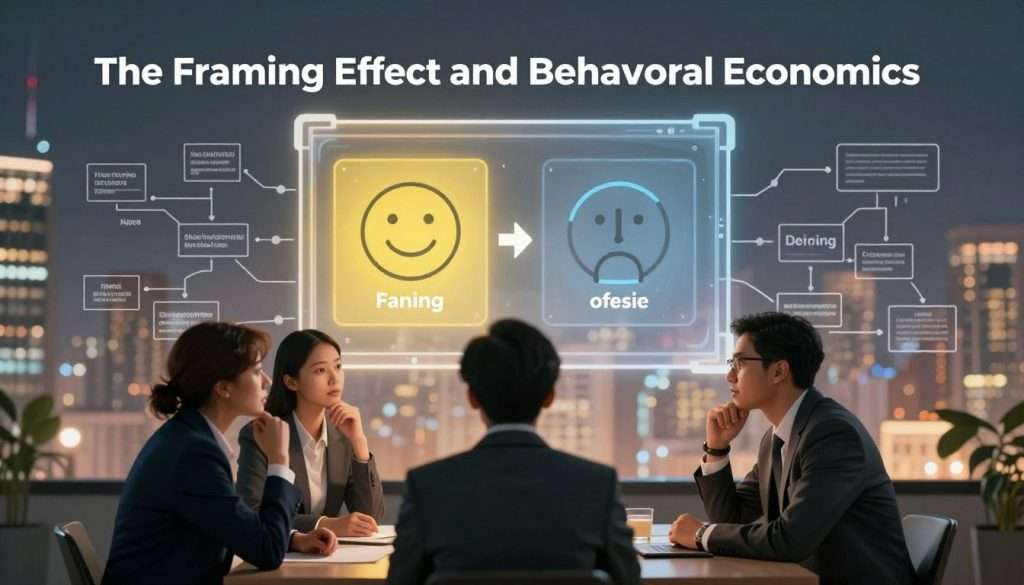
Ever noticed why “90% fat-free” sounds better than “10% fat”? It’s not just the math. Our brains process these differently. This is the framing effect, a key idea in behavioral economics. It shows how our choices change based on how information is presented.
We think we make choices based on logic. But, choice architecture around us influences us. It’s how options are set up to guide us toward certain outcomes.
How Presentation Influences Perception
The framing effect happens when our choices change based on gain or loss framing. We dislike losing more than we like gaining. This makes us loss-averse.
When a doctor says a surgery has a 90% success rate, you feel hopeful. But, a 10% chance of failure makes you think twice. The facts are the same, but the framing changes how we feel.
Marketing Tactics That Leverage Cognitive Biases
Marketers use these tricks to shape our shopping. They highlight benefits and frame prices in ways that influence us. We make choices without realizing it.
For instance, a service might say “only $1 a day” instead of “$365 a year.” This makes the cost seem smaller. Knowing these tricks helps us see beyond the marketing to the real value.
Next time you see an ad, pause and think. Are you reacting to the product’s true value or its framing? Being aware helps us avoid being steered in unintended ways.
The Hindsight Bias and the Illusion of Predictability
Have you ever said, “I knew that was going to happen,” after something happened? This is called hindsight bias. It’s when we think we could have predicted the past better than we actually could.
Looking back, our brains make the past seem clearer than it was. We change our history to make it seem obvious. This illusion of predictability feels good but can also be misleading.
Revising History to Fit Current Outcomes
Our memories aren’t perfect. They’re more like a creative editor, updating our past based on today’s knowledge. After learning the outcome of a situation, we forget the uncertainty.
We focus on facts that support the outcome and ignore other signs. This happens automatically, making it hard to notice without effort. Here are ways we change our history:
- Selective Memory: Remembering only facts that match the final result.
- Outcome Bias: Judging decisions based on success, not the process.
- False Certainty: Thinking we had a “gut feeling” when it was just a guess.
The Danger of Assuming Events Were Inevitable
The biggest problem with this bias is feeling overconfident in hindsight. Believing events were inevitable can lead to poor decisions. This affects both our personal and professional lives.
If you think you could have predicted a market crash or a project failure, you might overlook the real causes. It’s safer to accept that surprises are part of life. See how this bias changes our view in the table below:
| Scenario | Initial Feeling | Hindsight View |
|---|---|---|
| Stock Market Shift | Total Uncertainty | “It was so obvious!” |
| Exam Results | Nervous Guessing | “I knew I would pass.” |
| Relationship Breakup | Complete Shock | “I saw the signs early.” |
By recognizing these cognitive traps, we can stay grounded in reality. Just because something happened doesn’t mean it was destined. Being humble about our predictions helps us keep learning.
Practical Strategies to Mitigate Cognitive Biases
Let’s look at ways to beat the mental shortcuts that mislead us. Our brains are quick, but we can slow down to make better choices. By doing this, we turn mental traps into chances for clearer thinking.
Implementing Decision Journals and Checklists
Keeping a decision journal helps you stay objective. Writing down your reasons before making a choice creates a record. This habit helps you see when you’re ignoring evidence that goes against your first thoughts.
Checklists are also useful. They break down big choices into smaller steps. This stops you from being too influenced by the first piece of information you get. Checklists help you see the whole picture, not just the latest details.
The Value of Seeking Diverse Perspectives
We often rely on easy-to-remember information instead of accurate data. To avoid this, seek out people who think differently. Their fresh views can challenge your own and reveal blind spots.
Cultivating Intellectual Humility
Practicing intellectual humility is key to avoiding overconfidence. It means being open to being wrong and considering new evidence. When you approach problems with humility, you’re better at handling today’s complex issues.
| Strategy | Primary Benefit | Bias Addressed |
|---|---|---|
| Decision Journaling | Increases self-awareness | Confirmation Bias |
| Using Checklists | Ensures consistency | Anchoring Bias |
| Seeking Feedback | Broadens perspective | Availability Heuristic |
| Intellectual Humility | Reduces ego-driven errors | Overconfidence Bias |
Conclusion
You now understand how your brain sees the world. Learning cognitive psychology isn’t about being emotionless. It’s about being more thoughtful and aware.
Knowing common heuristics boosts your study confidence. You might catch yourself biased when reading news or negotiating salaries. These moments are key for growth.
Our brains often rely on recent, vivid memories, leading to the availability heuristic. We might also feel too sure about our skills, showing overconfidence bias. Recognizing these biases helps you think before acting.
Every day, you can challenge your own beliefs. We encourage you to keep learning and questioning. Aim for progress, not perfection. Stay curious about how your mind works!