
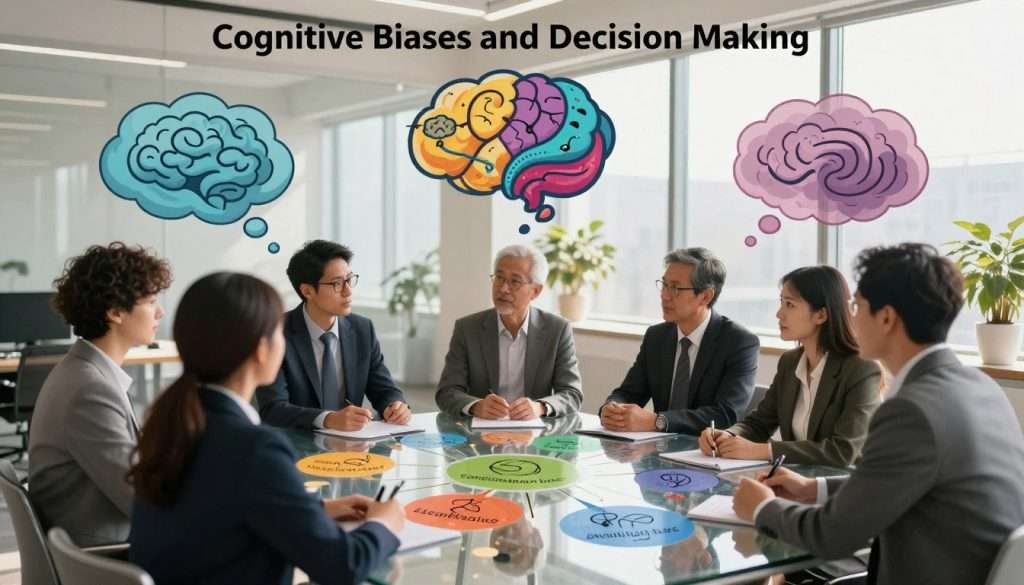
Ever feel like your brain is playing tricks on you? We all use mental shortcuts to get through our busy lives. But sometimes, these shortcuts can lead us astray.
Cognitive Biases are these hidden patterns that shape how we see the world. They affect our daily choices more than we think, often without us noticing.
The good news is you can change your study habits and life by understanding these mental traps. When you spot these patterns, you make decisions with clearer purpose.
We’re here to help you take control of your mind. Let’s dive into how you can use these insights to make smarter choices today!
Key Takeaways
- Understand how your brain uses mental shortcuts to process information.
- Identify common patterns that impact your daily choices.
- Learn how to improve your Decision Making process for better results.
- Apply these insights to boost your study efficiency and focus.
- Take control of your habits by recognizing Cognitive Biases in action.
The Psychology Behind Cognitive Biases
Your brain works fast to keep you moving. It uses heuristics, or mental shortcuts, to make quick decisions. These shortcuts help you avoid detailed analysis.
While helpful, these shortcuts can lead to predictable errors. We call these errors cognitive biases. These biases can affect how you study and interpret new information, often without you noticing.
In the 1970s, Daniel Kahneman and Amos Tversky changed how we see decision-making. They found that our choices often don’t follow logic. This shows we’re not always rational, mainly when we’re stressed or tired.
Knowing these patterns helps you learn better. Recognizing your brain’s preference for shortcuts lets you challenge them. By slowing down, you can avoid cognitive biases and make choices that support your goals.
| Feature | Rational Thinking | Heuristic Thinking |
|---|---|---|
| Speed | Slow and deliberate | Fast and automatic |
| Energy Use | High mental effort | Low mental effort |
| Accuracy | High precision | Prone to errors |
| Goal | Logical conclusion | Quick efficiency |
Understanding these differences helps you manage your study time better. Remember, awareness is key to overcoming your brain’s limitations.
How Behavioral Economics Shapes Our Choices
We often think we’re perfectly rational, but it’s not that simple. Our brains have Cognitive Biases that steer us away from pure logic. Behavioral Economics helps us understand why we make the choices we do.
This field looks at how we really behave, not just what we think we should do. It combines psychology and management to give us a clearer picture of our decision-making. This way, we can see how our feelings and social habits shape our daily actions.
Recognizing we’re not always rational helps us spot patterns that lead us astray. It’s not about being perfect; it’s about being aware of our mental shortcuts. By studying these patterns, you can dodge common traps and make choices that really match your goals.
| Feature | Traditional Rational Model | Behavioral Economics Reality |
|---|---|---|
| Decision Driver | Pure Logic | Emotions and Context |
| Information Use | Perfectly Processed | Subject to Cognitive Biases |
| Goal Setting | Maximizing Utility | Satisficing and Social Influence |
| Predictability | Highly Predictable | Complex and Variable |
Grasping these dynamics can change your life. You won’t get frustrated when your brain takes the easy way. Instead, you can use these insights to create better systems for your life and work.
Understanding the Confirmation Bias
It feels great to be right, but this feeling can trap us. We’re talking about the Confirmation Bias. It’s when our brains act like personal filters.
We look for information that confirms what we think. It’s our brain’s easy way out. But, it can mess with our judgment when learning something new.
Why We Seek Information That Validates Our Beliefs
Why do we do this? It’s because of cognitive ease. When info matches our views, our brains process it fast and easy.
But, info that goes against our beliefs causes cognitive dissonance. This feels bad, so we avoid it. By sticking to agreeing sources, we keep our minds at ease, even if we miss the full story.
Strategies to Challenge Your Own Assumptions
To break free from Confirmation Bias, seek out opposing views. Start by looking for sources that challenge your views.
When researching, find at least two articles that disagree with you. You can also play the devil’s advocate in study sessions. This tests your arguments.
| Thinking Style | Primary Goal | Outcome |
|---|---|---|
| Biased Thinking | Seeking Validation | Reinforces existing errors |
| Objective Thinking | Seeking Truth | Expands knowledge base |
| Critical Analysis | Challenging Assumptions | Reduces Confirmation Bias |
The Anchoring Effect in Negotiations and Pricing
Our brains tend to stick to the first piece of information we get. This is called the Anchoring Effect. It greatly influences how we see value.
When buying a car or negotiating a salary, the first number is very important. It sets the tone, making it hard to see things clearly.
How First Impressions Set the Baseline
Ever seen a “sale” price? The original price is there to anchor, making the discount look great.
Your brain uses that first number as a reference for all decisions. Even if something is still too expensive, you feel good because it’s compared to that first, high price.
Mitigating the Impact of Initial Data Points
To avoid this, pause before making a choice. Ignore the first number and look up the real market value.
Also, set your own anchor before negotiating. Knowing the real value helps you make a fair deal, not one based on someone else’s offer.
| Feature | Anchored Choice | Objective Choice |
|---|---|---|
| Reference Point | First number heard | Market research |
| Emotional State | Reactive | Proactive |
| Outcome | Often biased | Value-based |
Being aware of these traps can make you a better decision maker. Remember, the Anchoring Effect only works if you let that first number define your reality!
Availability Heuristic and the Illusion of Frequency
Our brains can trick us into thinking what we remember most happens a lot. This is called the availability heuristic. It means we think an event is common if we can remember it easily.
Remembering something quickly makes us think it’s common. But, this is often wrong. It’s like the Anchoring Effect, which makes us stick to what we first think.
Why Recent Events Influence Our Judgment
We value new information more than old. If you saw a news report about a rare accident, you might think traveling is risky. Your brain focuses on this recent memory over long-term facts.
Our brains prefer quick decisions over deep thinking. We use the availability heuristic to make fast choices. While it helped our ancestors, it can mislead us today.
Distinguishing Between Probability and Vividness
Being vivid doesn’t mean something is likely to happen. A scary story doesn’t mean it will happen to you. We mix up how intense an experience is with how often it happens.
To make better choices, look at the bigger picture. Ask if your fear is based on hard evidence or just a story. By separating feelings from facts, you can avoid the availability heuristic mistake.
The Framing Effect and How Context Changes Decisions
Ever noticed how changing a few words can make a deal seem amazing or terrible? This is called the Framing Effect. It shows how our brains see the same choice differently, depending on if it’s a gain or a loss.
Our emotions often control us, not logic. When information is presented in a certain way, it makes us react quickly. This can cloud our judgment. Knowing this bias helps us make choices that really fit our goals.

The Power of Positive Versus Negative Presentation
Think about this: a yogurt is “80% fat-free” or “20% fat.” Both are the same, but the first sounds better. We like positive frames because they show what we gain.
Negative frames, on the other hand, make us fear loss. Hearing a surgery has a 90% success rate makes us hopeful. But a 10% failure rate makes us anxious and hesitant. The Framing Effect shows that how we present information matters a lot.
Reframing Problems to Gain Clarity
You can improve your decision-making by reframing problems. When stuck, try seeing things differently. Ask yourself, “Would my choice change if I saw this as a gain?”
By changing how you think, you can avoid emotional mistakes. This simple trick helps you see things clearly. With practice, you’ll make better, more confident choices every day.
Overconfidence Bias and the Risk of Certainty
Ever felt like you knew everything about a topic, only to find out you were wrong? This feeling is common. It’s called Overconfidence Bias and it can block our learning. When we think we know it all, we stop looking for more info.
The Dangers of Overestimating Our Knowledge
Being too sure of ourselves can be dangerous. We might not ask questions. We might think we know everything, but then struggle when it gets tough. This false sense of security stops us from really learning.
When we think we can do it all, we ignore what we don’t know. We might skip hard parts because they seem easy. This weakens our knowledge base, making it hard to tackle tough problems later.
Cultivating Intellectual Humility
The best way to fight this is to be humble. This means knowing you don’t know everything and being open to new ideas. By embracing what you don’t know, you can study better.
See every challenge as a beginner’s task, even if you’re experienced. This helps you avoid the Overconfidence Bias. It also lets you see problems from different angles, thanks to the Framing Effect.
Being smart is not about knowing everything right away. It’s about being brave to keep learning and honest when you need more study. Stay curious, stay humble, and your knowledge will grow.
Loss Aversion and the Fear of Missing Out
Why does losing hurt more than winning feels good? Our brains are wired to value safety over rewards. This is called Loss Aversion. It means losing something is twice as painful as gaining something of the same value.
Why We Value Losses More Than Gains
We often stay in bad situations because we fear losing. This fear can stop us from letting go of bad investments or habits. The emotional weight of giving up feels like a defeat.
This bias makes us cling to things we no longer need or use. Our brains see losing as a threat. So, we make irrational choices to avoid that feeling of “losing out.”
Making Rational Choices Despite Emotional Attachment
Breaking free from this cycle takes practice and a new perspective. You can learn to separate your emotions from facts for better decisions. While Overconfidence Bias makes us think we can predict the future, recognizing our fear of loss keeps us grounded.
Here are ways to make rational decisions:
- View the situation from the outside: Ask yourself what advice you would give a friend in the same position.
- Focus on the future: Look at the potential for future gains instead of what you’ve already spent or invested.
- Set clear exit criteria: Define exactly when you will walk away from a project before you even start.
By focusing on what you could gain, you take back control of your choices. It is not always easy, but recognizing these patterns is the first step to smarter living.
Practical Frameworks for Better Decision Making
If your brain seems to play tricks on you, it’s time to improve your decision making skills. We often fall into mental traps without knowing it. But, you can take control by using structured approaches.
One effective way is the WRAP framework. It helps you widen your options, reality-check your assumptions, attain distance, and plan to be wrong.

Implementing Pre-Mortems in Your Planning
A pre-mortem is a great way to predict potential disasters before they happen. Instead of thinking about what could go right, imagine your project has failed. By working backward, you can find the reasons for that failure.
This method helps you avoid confirmation bias during planning. It turns your skepticism into a powerful tool. Anticipating problems early builds a strong foundation for success.
Using Decision Journals to Track Your Logic
Keeping a decision journal is like having a personal coach for your brain. Write down what you expect to happen and why you’re making that choice. This simple habit creates a record of your thought process.
Over time, you’ll notice patterns in your decision making that you never saw before. You might find you’re too optimistic in some situations or rush when stressed. Reviewing your past choices helps you learn from mistakes and improve your judgment.
The Role of Cognitive Biases in Professional Environments
Cognitive biases don’t just hide in our personal lives; they often show up at the office to disrupt our best-laid plans. Whether you work in finance, medicine, or creative management, these mental shortcuts can silently steer your decision making in the wrong direction. When we fail to recognize these patterns, we risk repeating the same mistakes that have tripped up professionals for decades.
Improving Team Dynamics and Groupthink
Have you ever sat in a meeting where everyone seemed to agree, even though the idea felt a bit shaky? This is the classic trap of groupthink. It happens when the desire for harmony overrides the need for a realistic appraisal of alternatives. When a team values comfort over truth, the quality of their collective output suffers significantly.
“The greatest enemy of knowledge is not ignorance, it is the illusion of knowledge.”
To break this cycle, you must encourage healthy friction. Cognitive biases thrive in environments where dissent is discouraged or viewed as a personal attack. By shifting the culture to reward curiosity rather than conformity, you can stop groupthink before it takes root.
Creating Systems That Encourage Diverse Perspectives
Building a better workplace requires more than just good intentions; it requires robust systems. You need to design processes that force the team to look at problems from multiple angles. For instance, assigning a “devil’s advocate” in every meeting can help surface hidden risks that others might be afraid to mention.
The following table highlights how shifting your approach can lead to more objective outcomes:
| Feature | Biased Team Behavior | Objective Team Behavior |
|---|---|---|
| Conflict | Avoided to keep peace | Welcomed as a tool for growth |
| Data Usage | Cherry-picked to fit a narrative | Analyzed from all available sources |
| Decision Making | Driven by the loudest voice | Driven by evidence and debate |
Ultimately, effective leadership is about creating a safe space where diverse viewpoints are not just tolerated but actively sought out. When you build these guardrails into your daily workflow, you protect your team from the most common pitfalls of human judgment. By staying vigilant, you turn your organization into a powerhouse of clear, rational thought.
Developing a Mindset for Critical Thinking
To make better choices, learn to pause before acting. Our brains save energy by acting quickly, but this isn’t always right. By thinking more, you can control your decisions better.
The Importance of Slowing Down Your Thought Process
Rushing decisions leads to mistakes. Behavioral Economics shows our brains like easy paths, even if they’re wrong. Slowing down lets you think more clearly.
“The intelligence of a person is measured by the quality of their questions, not just the speed of their answers.”
Before big choices, ask yourself a few questions:
- What evidence am I ignoring right now?
- Am I reacting to the situation or responding to it?
- How would I feel about this decision in a month?
Continuous Learning as a Defense Against Bias
Staying curious fights against fixed thinking. Continuous learning keeps your mind open. This stops you from judging things based on how easily they come to mind.
Think of your brain as a muscle that needs work. Exposing yourself to new ideas and questioning your beliefs makes your mind stronger. Strategic management of your thoughts keeps you from just following the crowd.
The aim is not to be perfect but to be aware. Every pause to reflect sharpens your ability to see the world clearly and confidently.
Conclusion
You’ve explored the hidden ways of the human mind. We learned how your brain creates shortcuts and how these habits affect your choices. Now, it’s time to use this knowledge to your advantage.
Don’t aim for perfect logic. Just become aware of your thought patterns. When you see Loss Aversion, pause and think again. This simple step can change everything.
See your studies as an adventure, not a task. Questioning assumptions sharpens your critical thinking. You grow by understanding your mind is always changing.
Keep a journal to track your decisions and see how you improve. Share your insights with your study group. Your smarter thinking begins with your next choice.
What bias will you watch out for this week? Share how you apply these ideas to your learning. We’re excited to see you master your mindset and reach your goals!