
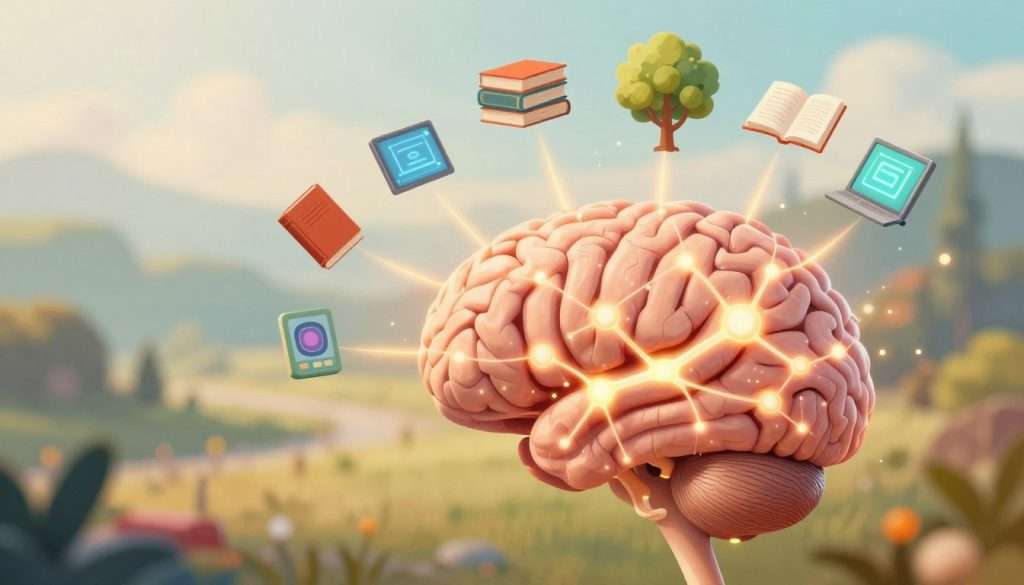
Ever curious about how you learn new things? It’s a cool process where your neural circuitry changes to hold new ideas. By focusing, practicing, and connecting new info to what you know, you’re basically rewiring your brain.
Your brain talks through trillions of synapses, making paths that get stronger with each try. We aim to help you grasp this amazing process. This guide is your step-by-step to better study habits.
By getting these hidden workings, studying can become a thrilling journey. Let’s explore how to unlock your mental potential right now!
Key Takeaways
- Your mind physically changes its structure when you acquire new information.
- Focus and consistent practice are vital for building stronger neural pathways.
- Connecting new data to existing knowledge helps memory retention significantly.
- Trillions of tiny connections work together to process everything you encounter.
- You can actively improve your study efficiency by working with your biology.
How Does the Brain Learn? The Science of Learning Explained
Let’s explore the amazing world of brain learning science. Many of us thought studying meant reading the same thing over and over. But, this method often hides a lack of true understanding.
Define learning as a lasting change in knowledge, skills, or behavior
True learning is more than just a temporary feeling. It’s a lasting change in your brain that lets you do new things. If you can’t remember or use what you learned later, you haven’t really learned it.
“Learning is the process of acquiring new understanding, knowledge, behaviors, skills, values, attitudes, and preferences.”
Trace the learning process in the brain from attention to long-term memory
The journey of learning starts with your attention. If you’re not focused, your brain won’t store the information. When you do focus, your brain moves the info from short-term memory to long-term memory.
This process needs effort, not just sitting there. By actively recalling what you learned, you strengthen your brain’s connections. This makes it easier to access that knowledge when you need it.
Explain how cognitive science and neuroscience complement each other
To grasp brain learning science, we look at cognitive science and neuroscience. Cognitive science studies how we think and process information. Neuroscience looks at the brain’s biology, like neurons and synapses, that makes thinking possible.
Together, these fields give us a full picture. Cognitive science offers strategies for better studying. Neuroscience explains why those strategies work at a brain level.
Separate useful learning science from common study myths
There’s a lot of bad advice out there about studying. Many believe that highlighting everything or listening to classical music boosts intelligence. But, these methods don’t really help and can be misleading.
Good brain learning science teaches us to use active methods like testing ourselves. Stop just re-reading and start really engaging with the material. Your brain learns best through challenges, not comfort.
How Neuroplasticity Changes the Brain Through Practice
Your brain is always changing, thanks to everything you do. This amazing ability to change itself is called neuroplasticity. It’s what lets you learn new skills and get better at old ones, all your life.
Understand how repeated experience reshapes neural pathways
Every time you practice something new, your brain makes tiny changes. It’s like carving a path through a forest. At first, it’s hard to see the way. But with repeated experience, the path gets clearer and easier to follow.
Explain the role of brain synapses and learning
At a tiny level, your brain uses synapses to talk to itself. When you focus on learning, these connections get stronger. Studies show that these changes are unique to you, helping your brain adapt to your efforts.
Compare focused practice, passive exposure, and deliberate practice
There’s a big difference between just being around information and really learning it. Just watching a video or reading a book is a start, but it’s not enough for true mastery. Deliberate practice requires your full attention and effort to really change your brain.
Use manageable challenges to strengthen developing skills
To keep your brain growing, you need to challenge yourself. If something is too easy, your brain won’t be working hard to learn.
Increase difficulty gradually instead of repeating only what feels easy
Find a task that’s just right, challenging but doable. By gradually increasing the difficulty, your brain stays active and keeps growing. This keeps you from getting stuck in a learning rut.
Recognize why mistakes provide information for the next attempt
Don’t worry about making mistakes! They’re actually valuable data points for your brain. When you make a mistake, your brain knows it needs to try something different. Use these moments to improve your next try.
How Attention and Working Memory Control What You Learn
Think of your attention as a high-powered spotlight in a dark room. You can only illuminate one small area at a time, which means you must choose your targets wisely. The cognitive science of learning teaches us that where you point that light determines what actually sticks in your brain.
Direct attention toward one meaningful learning target
Trying to learn everything at once means you learn nothing well. Choose one specific goal for your study session, like mastering a single math formula or understanding a historical event. By narrowing your focus, you give your brain the best chance to process information deeply.
Manage the limited capacity of working memory
Your working memory is like a small desk where you hold information while you work on it. It has a very limited capacity, and it fills up fast. If you pile too many tasks onto that desk, everything starts to slide off and get lost.
Reduce distractions, task switching, and unnecessary mental load
Every time you check your phone or switch between subjects, your brain pays a heavy price. This constant task switching creates a massive mental load that drains your energy. To protect your focus, clear your workspace of clutter and silence those notifications.
Break complex lessons into connected chunks
Large, intimidating topics are much easier to digest when you slice them into smaller pieces. Think of it like eating a giant meal; you take one bite at a time rather than trying to swallow the whole plate. This method keeps your brain from feeling overwhelmed.
Use examples, diagrams, and explanations without overwhelming the learner
Visual aids and clear examples act as bridges for your brain. They help translate abstract ideas into something concrete and relatable. Keep these tools simple so they support your understanding instead of adding more noise to your study session.
Connect new information to knowledge already stored in memory
Your brain loves to build on what it already knows. When you encounter a new concept, try to link it to a story or fact you have already mastered. This creates a stronger neural anchor, making the information much easier to recall later.
| Strategy | Impact on Brain | Result |
|---|---|---|
| Single-tasking | High focus | Deep retention |
| Chunking | Reduced load | Better clarity |
| Prior Knowledge | Stronger links | Faster recall |
By applying these principles from the cognitive science of learning, you turn your study time into a high-efficiency zone. Remember, it is not about how long you study, but how well you manage your mental resources.
How the Brain Forms, Stores, and Strengthens Memories
Your brain is amazing at making short moments last forever. This process of brain memory formation goes through several steps. It starts with a spark and ends with a lasting memory in your mind.
Follow information from encoding to consolidation and retrieval
First, your brain encodes information by turning sensory input into neural signals. It’s like writing a note on a digital pad. Then, it works to consolidate that information, making sure it doesn’t disappear.
Lastly, you have retrieval, which is when you pull that information back out. Whether it’s solving a math problem or remembering a word, your brain goes through these steps over and over.

Distinguish short-term memory, working memory, and long-term memory
Think of your memory in three main areas. Short-term memory is for quick info that lasts a few seconds. Working memory is where you work with information to solve problems.
Long-term memory is where info stays for a long time. Studies on sea slugs like Aplysia show that this process changes your brain physically, creating new connections and proteins.
Explain how the hippocampus supports new memory formation
The hippocampus is like the brain’s “save button.” It’s key for brain memory formation, deciding what experiences to keep. Without it, your brain can’t turn daily events into lasting memories.
Use sleep to support memory consolidation
Sleep is not just rest; it’s when your brain does its best work. During deep sleep, it replays the day’s events, making your memories stronger.
Plan study sessions so important material is reviewed before sleep
Review your toughest material right before bed. This helps your brain focus on what’s important while you sleep.
Protect sleep instead of replacing it with late-night cramming
“Sleep is the best meditation.” — Dalai Lama
Staying up late to cram might seem helpful, but it actually hinders memory consolidation. Getting a full night’s sleep is better for retaining what you’ve learned.
Strengthen memory with meaningful connections and multiple examples
Your brain loves patterns. Linking new concepts to things you already know helps. Using many examples for one idea makes it easier to remember later.
Step-by-Step: Turn Brain Learning Science Into a Study Session
Learning can be fun when you use your brain’s natural abilities. By understanding how neuroplasticity and learning work together, you can make studying more effective. We aim to move from just reading to engaging, brain-friendly activities that really stick.
Step 1: Set one specific learning outcome
Write what you should be able to explain, solve, or perform
Before diving into your studies, define what success means to you. Instead of saying “I will study biology,” aim to “explain how the heart pumps blood.” This gives your brain a clear goal to work towards.
Step 2: Preview the material and activate prior knowledge
Skim headings, recall what you already know, and list questions
Your brain loves to connect new info to old memories. Spend five minutes skimming chapter headings and noting what you already know. This gets your brain ready for the new information.
Step 3: Study in focused intervals
Remove interruptions and choose a realistic work period
Deep work needs your full attention. Turn off your phone and set a timer for 25 to 50 minutes. This focused approach is key for neuroplasticity and learning because it keeps your brain engaged without the multitasking drain.
Step 4: Explain the idea in your own words
Use the teach-back method to expose gaps in understanding
Try explaining the concept out loud as if teaching a friend. If you struggle or get stuck, you’ve found a knowledge gap. This is a great sign because it shows where to focus your next review.
Step 5: Practice retrieving information without looking
Answer questions, solve problems, or recreate a process from memory
Close your notes and try to recall the main points. Whether you draw a diagram or write a summary, pulling information from your brain strengthens connections.
Step 6: Check your answer and correct errors
Record the mistake, identify its cause, and try the problem again
Don’t get discouraged by mistakes. Write down what went wrong and why. Correcting errors is the best way to solidify your understanding and improve your mental models.
| Study Method | Brain Impact | Effectiveness |
|---|---|---|
| Passive Rereading | Low engagement | Minimal |
| Highlighting Text | Surface processing | Low |
| Active Retrieval | High neural activity | High |
| Teach-Back Method | Deep conceptual mapping | Very High |
By following these steps, you’re actively managing your neuroplasticity and learning. Keep your sessions short, stay curious, and remember that every mistake is a step towards mastery.
Use Retrieval Practice and Spaced Repetition to Learn More Reliably
Most of us have been taught to study by rereading. But science shows there’s a better way. When you just look over your notes, you’re mostly recognizing information, not really learning it.
By using active methods, you change how brain synapses and learning work together. This creates deeper and more lasting connections in your mind.

Replace rereading with active retrieval
Active retrieval means making your brain recall information without looking at the source. This effort is what makes memories stick.
Create flashcards that require an answer rather than recognition
Avoid simple “yes or no” cards. Instead, make flashcards that ask you to explain a concept or define a term in your own words. This active engagement is much more effective than just flipping through them.
Write practice questions that match the difficulty of the real task
Don’t just write questions that test basic facts. Create scenarios that require you to apply what you know to solve a problem. This mirrors the actual challenge you’ll face during an exam or in real life.
Space reviews across increasing intervals
Our brains are designed to forget things over time. To fight this, you must revisit information just as it starts to fade from your memory.
Review new material soon, then revisit it over several days and weeks
Start by reviewing a new topic within 24 hours. Then, stretch the time between reviews to three days, a week, and eventually a month. This spaced repetition keeps the information fresh and accessible.
Mix related problem types to improve flexible thinking
When you study one type of problem for hours, your brain goes on autopilot. By mixing things up, you force your brain to figure out which strategy to use for each challenge.
Interleave subjects or methods instead of completing identical problems in one block
Interleaving helps you see the connections between different concepts. This practice strengthens brain synapses and learning by making your mind constantly switch gears and find the best approach for each task.
Use feedback strategically
Feedback is a powerful tool, but only if used at the right time. If you look at the answer key too early, you miss the chance to build a strong memory.
Review explanations after attempting an answer, not before making an effort
Always try to solve the problem or recall the answer first. Even if you get it wrong, trying prepares your brain to store the correct information much more effectively once you check the explanation.
“Memory is the residue of thought.”
| Study Method | Effort Level | Long-term Retention |
|---|---|---|
| Passive Rereading | Low | Poor |
| Active Retrieval | High | Excellent |
| Spaced Repetition | Medium | High |
| Interleaved Practice | High | High |
Build a Brain-Friendly Learning Routine for Any Subject
We all want to learn faster. The secret is to organize your week based on how your brain function in learning works. Instead of waiting for motivation, create a daily system that keeps you moving.
Plan weekly learning around clear priorities
Think of your week as a map. Decide where you’re going. A clear plan saves mental energy and helps you focus.
Divide large goals into lessons, practice sessions, and review blocks
Break big projects into smaller pieces. Set aside time for learning, practicing, and reviewing. This keeps your mind sharp.
Combine reading, recall, practice, and application
Learning is active, not passive. Mix different methods to make sure you remember what you read.
Match the method to the subject, from vocabulary to mathematics to writing
Different subjects need different tools. Use flashcards for vocabulary, problem sets for math, and drafts for writing. Variety is the spice of effective learning!
“The expert in anything was once a beginner.”
Monitor progress with evidence instead of confidence
Feeling confident is not the same as knowing something. True mastery comes from showing you can use what you’ve learned.
Track correct answers, completed tasks, and delayed recall
Keep a log of your performance. If you can recall information after a few days, you know your brain function in learning is working.
Adjust the routine when performance stalls
Sometimes, progress seems slow. Don’t worry, it’s normal.
Change the practice method before simply adding more study time
If you’re stuck, don’t add more hours. Try a new approach, like teaching someone else or using diagrams. Smart adjustments are better than long hours.
Protect Brain Function in Learning and Overcome Common Obstacles
Your brain is amazing, but it needs care to stay sharp. When we talk about brain development and learning, we often forget about your body. If you ignore your body’s needs, even the best study plan will fail.
Manage stress so it does not overwhelm attention and working memory
Stress steals your focus. When you’re overwhelmed, your brain goes into “survival mode.” This makes it hard to learn new things. Try to stay calm by breaking tasks into small steps that don’t stress you out.
Use movement, hydration, nutrition, and breaks to support concentration
Think of your brain like a high-performance engine. It needs fuel and cooling. Drinking water and eating healthy snacks boosts your energy. A quick walk can also help you focus more than staring at screens.
| Habit | Impact on Learning | Actionable Tip |
|---|---|---|
| Regular Breaks | Prevents mental fatigue | Use the Pomodoro technique |
| Hydration | Boosts cognitive speed | Keep a water bottle nearby |
| Physical Activity | Increases blood flow | Take a 5-minute walk |
| Balanced Nutrition | Stabilizes energy levels | Choose complex carbohydrates |
Recognize the limits of multitasking and all-night studying
Multitasking is a myth that hurts your productivity. Your brain can’t handle two complex tasks at once. It switches back and forth, making it hard to focus. Also, all-nighters are bad because your brain needs sleep to remember what you learned.
Respond to forgetting with a better review schedule
Forgetting is normal, not a sign of failure. Instead of worrying, adjust your review schedule. Consistency beats intensity for keeping information in your long-term memory.
Know when learning difficulties require professional support
Seek guidance from a qualified educator, doctor, or mental health professional when persistent problems interfere with daily life
Challenges with brain development and learning can be more than just study habits. If you’re struggling a lot, don’t be afraid to ask for help. A professional can give you the tools you need.
Go deeper with a structured learning system
Invite readers to get the free book How to Become the Smartest Student in the Classroom for memory techniques, study routines, and strategies that stick
If this article spoke to you, check out my free book How to Become the Smartest Student in the Classroom. It’s full of memory techniques, study routines, and strategies that really work. There’s no cost or catch, just valuable help to help you succeed.
Grab your free copy here → https://www.studyingmachine.com/free-books/
Conclusion
You now have the power to reach your full potential. You’ve learned that your brain is not fixed. It changes with every effort you put into it.
Think of studying as building strong neural paths. By focusing, remembering, and recalling information, you grow your brain. Sleep is key, helping solidify what you’ve learned while you rest.
Learning changes your brain’s biology. You can master tough subjects by working with your brain, not against it. Small changes can lead to big results over time.
Try one study habit from our guide today. Use data to track your progress, not just your feelings. Start with a routine that feels doable. You can make learning a fun part of your life, starting today.