

Are you tired of staring at textbooks until your eyes glaze over? We totally get it. Many students believe that academic success requires endless hours of suffering in the library. But what if we told you that you could reclaim your free time while actually boosting your grades?
Becoming a top student is not about grinding until midnight. It is about using proven methods that actually work. By shifting your approach, you can learn faster and retain more information without the burnout.
This guide reveals exactly how to study less on weekdays and still outperform everyone by working with your brain, not against it. Let’s turn your study sessions into a breeze.
Key Takeaways
- Success is defined by smart habits, not just the number of hours spent at a desk.
- Active recall and spaced repetition are your best friends for efficient learning.
- Prioritizing deep work allows you to finish tasks faster and enjoy your evenings.
- Quality of focus matters significantly more than the duration of your study sessions.
- You can achieve top-tier results while maintaining a healthy work-life balance.
The Philosophy of Academic Efficiency
Most of us think studying is a long, hard race. But that’s not true. Sitting at a desk for hours doesn’t mean you’re being productive. It just makes you tired and upset. It’s time to switch to efficient studying as our new goal.
Shifting from Hours Spent to Results Achieved
Success in school is about quality, not just how long you study. Instead of watching the clock, focus on what you achieve. This way, you avoid wasting time on tasks that don’t help you.
“Efficiency is doing things right; effectiveness is doing the right things.”
By focusing on results, you can have more free time. These study tips help you work smarter, not harder. So, you can enjoy life outside of school.
Identifying the Pareto Principle in Your Coursework
Do you know the 80/20 rule? It says 80% of your results come from 20% of your effort. In school, a small part of your work will likely get you most of your grade.
Look at your syllabus and find the key concepts. These are the ones that show up a lot in class and homework. Spend your time on these important areas first. By ignoring the rest and focusing on the 20% that matters, your grades will go up and you’ll feel less stressed.
How to Study Less on Weekdays and Still Outperform Everyone
If you want to know how to study less on weekdays and still outperform everyone, you must treat your brain right. Many students think more hours mean better grades, but that’s not true. We’re here to help you enjoy your evenings and improve your grades too.
The Myth of the All-Nighter
Many believe all-nighters are key to success, but we’re here to say that’s a myth. Losing sleep makes your brain less good at remembering things. It’s just not worth it.
Instead of cramming, aim to study until you’re the best. Focus on quality, not quantity. Resting well means you’ll be sharp and ready to ace your classes.
Defining Your High-Impact Academic Goals
True academic success means changing how you see your daily tasks. Stop just doing tasks and focus on what really matters. By setting clear goals, every study minute counts towards your grade.
Identify the most important assignments or topics in your syllabus. Spend your best time on them early. This way, you lead your class with confidence, not just keep up.
Mastering the Art of Prioritization
Learning to control your schedule is key to success. It helps you manage your time well, not just do more. Proactively managing your success means focusing on the right tasks at the right time.
Using the Eisenhower Matrix for Assignments
The Eisenhower Matrix is a great tool for prioritizing tasks. It sorts your work into four areas: urgent and important, important but not urgent, urgent but not important, and neither. This makes it easy to see what needs your immediate attention.
Here’s how to organize your tasks:
- Urgent and Important: Do these tasks right away.
- Important but Not Urgent: Plan these for later to avoid stress.
- Urgent but Not Important: Let others handle these or keep them to a minimum.
- Neither: Cut out these low-value activities.
Focusing on High-Yield Learning Objectives
After sorting your tasks, focus on the most important ones. Not every part of a textbook is equally important. Find the key concepts that will give you the biggest return on your investment of time.
By prioritizing tasks that match your main goals, you make every study minute count. This way, you avoid wasting time on tasks that don’t help you learn. Smart time management is the key to academic success.
Implementing Active Recall and Spaced Repetition
Ever feel like you’re reading the same page over and over without learning anything? This is a common problem. It makes you feel like you’re doing something productive, but your brain is just on autopilot. To study efficiently, we need to break free from these passive habits and use methods that make our brains work.
Why Passive Reading Fails
Jeffrey Karpicke’s research shows a big issue: passive reading gives a false sense of confidence. When you read a textbook, the information seems familiar, so you think you’ve got it. But this is just recognition, not real recall.
True learning comes when you make your brain recall information from scratch. By practicing recall, you build the skills you need for exams. This is the heart of studying smarter, not just working harder.
Techniques for Effective Self-Testing
To make information stick, you must fight the forgetting curve. We suggest using spaced repetition to review material at set intervals. Try testing yourself on day one, day three, day seven, day 14, and day 30.
Flashcard Systems and Digital Tools
Flashcards are great for active recall. You can use physical cards or apps like Anki or Quizlet. The goal is to actively challenge your memory every time you flip a card.
- Create questions based on your lecture notes.
- Use images to help visualize complex ideas.
- Review your deck consistently to keep your knowledge sharp.
The Feynman Technique for Conceptual Mastery
To really understand a topic, try the Feynman Technique. Explain a concept in simple terms, as if teaching it to a child. If you get stuck, you’ll know where your knowledge gaps are.
This method is a powerful tool for efficient studying. It shows what you truly know versus what you’ve just memorized. By simplifying complex ideas, you ensure you’re studying smarter and building a lasting foundation.
Optimizing Your Environment for Deep Work
Creating the perfect study environment is a key productivity hack. Your surroundings can either help or hinder your progress. A well-curated space tells your brain it’s time to focus.
Eliminating Digital and Physical Distractions
Digital distractions are a major obstacle. Turn off your phone, close tabs, and use blockers to stay focused. Every notification is a thief of your mental energy.
Physical clutter also hinders your flow. A messy desk can make your mind feel cluttered. Keep only essentials like your notebook and pen within reach.
Creating a Dedicated Study Sanctuary
You don’t need a big office for a study sanctuary. Even a small corner can work if used only for studying. This helps your brain enter “learning mode” instantly.
Good lighting and a comfy chair are crucial. They support your body and mind, making learning easier. These productivity hacks turn studying into a rewarding experience.
| Feature | Cluttered Environment | Study Sanctuary |
|---|---|---|
| Focus Level | Fragmented | Deep and Sustained |
| Mental Energy | Rapidly Drained | Conserved |
| Task Completion | Slow and Erratic | Fast and Consistent |
| Stress Levels | High | Low |
Investing in your environment sets you up for a better semester. Small changes can lead to big improvements. Use these productivity hacks to create a space that supports your success.
Leveraging Technology for Smarter Studying
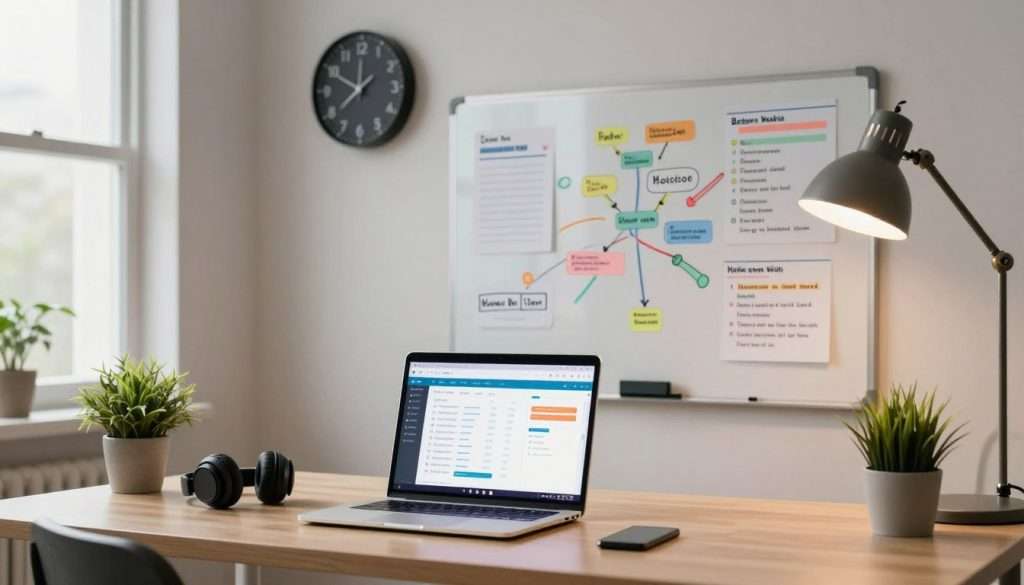
Your smartphone and computer are more than just distractions. They are powerful allies. By using them wisely, you can save hours every week. We aim to turn your digital workspace into a high-performance engine.
Using Productivity Software to Automate Organization
Managing your schedule manually can lead to burnout. Instead, use tools like Notion or Todoist for daily planning. These apps automate tasks and set reminders, so you never miss a deadline.
Centralizing your assignments in one place saves mental energy. You can create templates for your weekly routine. This is one of the most effective productivity hacks for busy students. With an automated system, you spend less time organizing and more time learning.
Curating Digital Resources for Faster Research
Finding reliable information can be challenging. Create a personal library of digital resources to speed up your search. Tools like Zotero or Mendeley help you store and cite sources instantly, saving you from manual bibliography formatting.
Use RSS readers or Google Scholar alerts to stay updated without endless browsing. Filtering your information intake ensures you engage with high-quality content. These productivity hacks make your research focused and efficient.
| Tool Category | Recommended App | Primary Benefit | Ease of Use |
|---|---|---|---|
| Task Management | Todoist | Automated reminders | High |
| Knowledge Base | Notion | Centralized notes | Medium |
| Research/Citations | Zotero | Instant bibliography | High |
| Focus/Timer | Forest | Gamified deep work | High |
The goal is to build a digital ecosystem that works for you. Mastering these tools gives you the freedom to study less while achieving better results. Technology is your best friend when used to your advantage.
The Science of Rest and Cognitive Recovery
Many students overlook the importance of rest in learning. Your brain needs downtime to process what you’ve learned. Adding rest to your study schedule is smart, not lazy.
The Role of Sleep in Memory Consolidation
When you sleep, your brain doesn’t just stop. It goes into a key phase called memory consolidation. This is when it moves new info from short-term to long-term memory.
Skipping sleep means losing the day’s progress. It’s like deleting your work. Sleep is your brain’s save button. Without it, your efforts are forgotten by morning.
Strategic Breaks and the Pomodoro Technique
The Pomodoro Technique helps keep your energy up. It involves focused work followed by short breaks. Stepping away from your desk helps your mind reset and avoid burnout.
Use breaks to stretch, drink water, or look out the window. These micro-recoveries help you stay focused during long study times.
| Rest Strategy | Primary Benefit | Best Time to Use |
|---|---|---|
| Nightly Sleep | Memory Consolidation | Every Night |
| Pomodoro Breaks | Mental Refreshment | During Study Sessions |
| Power Naps | Alertness Boost | Mid-Afternoon |
Managing Your Energy Instead of Your Time
Ever feel like a genius in the morning but a zombie by afternoon? Many students focus on time management, trying to use every second. But the real secret to doing better isn’t just about time; it’s about managing your energy.
Working with your body, not against it, helps you do more in less time. Think of your brain like a battery that needs smart use throughout the day.

Identifying Your Peak Biological Productivity Hours
Everyone has a unique internal clock that tells them when they’re most alert. Some are early birds, tackling tough problems before breakfast. Others are night owls, finding their best work after dark.
To find your peak, track your focus for three days. Note when you’re sharp and when you start to lose focus.
Once you know your peak hours, protect them. Use these times for your toughest academic tasks. Save the easy tasks for when your brain is a bit tired.
Matching Task Difficulty to Energy Levels
Good prioritizing tasks means knowing what your brain can handle at any time. Trying to write a hard essay when you’re tired will be tough and waste time.
Match your hardest tasks to your best hours. Use this guide to organize your day based on your natural energy.
| Energy Level | Best Tasks | Example Activity |
|---|---|---|
| High | Deep Work | Writing essays or solving complex math |
| Medium | Active Review | Self-testing or flashcard practice |
| Low | Administrative | Organizing notes or checking emails |
By focusing on energy, not just time, you’ll get more done faster. Listen to your body, and you’ll see your grades go up without feeling burned out.
Streamlining Note-Taking and Information Synthesis
To master studying smarter, change how you take notes in class. Notes shouldn’t take up your whole evening. By changing your method, you can make raw data clear for exams.
The Cornell Method for Rapid Review
The Cornell Method is a game-changer for organizing your thoughts. It divides your page into three parts: cues, notes, and a summary. This method helps you actively process information, not just write it down.
When reviewing, cover the main notes and use cues to test yourself. This rapid review process saves time. It’s a top way to study smarter and keep your notes useful.
Mind Mapping for Complex Subject Matter
For tough topics, linear notes don’t work. Mind mapping turns complex info into simple diagrams. It makes connections clear at a glance.
This visual method helps you see the big picture. It makes learning feel easy, like telling a story. Using these diagrams makes studying fun and productive.
Building Sustainable Academic Habits
To outperform your peers without burning out, focus on the long game. Many students exhaust themselves with intense, short-term efforts. Instead, aim for a sustainable rhythm that boosts your grades without draining your energy.
Consistency Over Intensity
View your academic journey as a marathon, not a sprint. Consistency is key to achieving great results. Regular, shorter study sessions strengthen your memory more than long, intense ones.
“Success is the sum of small efforts, repeated day in and day out.”
Steady progress helps you avoid burnout. Simple study tips like daily review sessions keep you moving forward. This way, you stay ahead, not behind.
Tracking Progress and Adjusting Your Workflow
Measuring your study sessions is crucial for improvement. A detailed study schedule guides you, showing which methods work best for you.
| Habit Type | Effort Level | Long-term Result |
|---|---|---|
| Sporadic Cramming | High (Stressful) | Low Retention |
| Consistent Review | Low (Steady) | High Mastery |
| Systematic Iteration | Medium (Focused) | Peak Performance |
Reflecting on Weekly Performance
Review your week’s progress. Identify what worked and what didn’t. This honest reflection helps refine your study methods.
Iterating Your Study System
Adjust your study process based on your findings. Maybe change your morning routine or note-taking style. By iterating your study system, you keep it efficient all term.
Conclusion
You now have the tools to boost your performance at work. Success in school isn’t just about being smart or working hard all the time. It’s about making smart, consistent choices.
Think of your brain as a top-notch engine. It works best when you give it rest and focus, not when you push it too hard. By focusing on quality, you free up your evenings and weekends for what’s important to you.
Begin using these strategies today. Soon, you’ll be the go-to person for tips on doing more in less time. Your path to lasting success begins with a small change in your daily routine.
What habit do you want to tackle first? We’re excited to hear about your progress. Keep going and enjoy the benefits of working smarter.