

When you’re tired, match the task to your energy, and sleep if you cannot stay alert. If you keep rereading one line or staring at unopened notes, fatigue is a signal to adjust, not a character flaw.
Mild tiredness may leave room for a small task, but exhaustion calls for rest. We’ll help you tell the difference and make a useful study session feel less like hauling a backpack uphill.
Key Takeaways
- Match your task to the energy you have.
- Choose sleep when you cannot stay alert.
- Start with one small, clear task.
- Try retrieval practice instead of only rereading.
- Take a real break when your focus slips.
- Protect sleep so tomorrow’s study time works better.
A tired brain does not always need a pep talk. Sometimes it needs a smaller task, a change of scene, or a full night of sleep.
A useful study session is one you can finish alert enough to learn from.
How to Study When You´re Tired: Should You Sleep or Study?
You can study when you’re mildly tired, but if you’re nodding off or losing the thread, sleep is the better move. When your attention keeps slipping, stop trying to force a long session.
Sleep deficiency can affect learning, focus, reaction time, decision-making, and memory. The National Heart, Lung, and Blood Institute also notes that brief, involuntary sleep episodes can happen when you are short on sleep.
A 2010 meta-analysis found that short-term sleep loss harmed performance across most cognitive areas. The largest effects appeared in vigilance and attention, two skills that keep a study session on track.
Watch for these signs that your brain needs rest:
- You nod off or cannot keep your eyes open.
- You lose track of a paragraph as you read.
- You repeat the same line without taking it in.
- You make unusually careless mistakes.
Do not drive when you are struggling to stay awake. A brief lapse in attention can put you and others at risk.
If you feel a little slow but can follow a short task, a brief review may still help. Exhaustion is different: you may spend time with your notes without taking in much or checking your work well.
Sleep loss can affect performance even when you are determined to push through. A few minutes of effort cannot always make up for an alert brain.
If you cannot stay awake safely, close the notes and go to bed.
How Can You Make Starting Feel Easier?
A tiny task can be easier to start than a promise to study all night. If you are tired but alert enough for one small session, make the first step low pressure.
Give the task five minutes, then decide whether to continue. A short timer turns “I have to study everything” into a trial run with a clear end.
Start with a five-minute microtask
Set a five-minute timer and pick one action you can finish before it rings. You might make three flashcards or solve two math problems, then check whether your mind feels ready for more.
This is a test, not a trap. When the timer ends, you can stop, take a break, or choose another small task if you still feel alert.
Keep the materials you need within reach before starting. Searching for a worksheet or opening ten tabs can use up the energy you meant to spend on learning.
Choose one low-energy win
Choose a contained task with a visible finish line. Sort a few terms into groups, review one familiar definition, or label the parts of a diagram.
These tasks do not need to be easy forever; they simply make sense when a hard new chapter feels too steep. A finished item gives you a clear result, not just a page you looked at.
If you still feel too tired when the timer ends, stopping is allowed. Your energy is useful information, not a score of your motivation.
Choose the task before you begin, then set a timer that matches its size. Decide in advance what counts as “done” for this first small win.
Which Study Methods Work Best When You’re Tired?
Practice testing and spaced practice are strong choices when you have enough energy for a small review. If rereading makes your eyes glaze over, close the notes and try to produce the answer from memory.
Retrieval practice asks your brain to bring information back before you check it. That effort can show which ideas you know and which ones need another look.
Retrieve before you reread
Use a simple loop: close your notes, explain an idea or answer a question from memory, then check the source. Fix any gaps before moving on.
This approach is also called active recall. It makes a useful difference when you are struggling to study and remember, because it tests what you can retrieve instead of what looks familiar on the page.
| Method | What you do | Retention evidence |
|---|---|---|
| Practice testing | Answer questions from memory | High utility |
| Spaced practice | Review across separate sessions | High utility |
| Highlighting or rereading | Mark or read notes again | Low utility |
A 2013 review rated practice testing and distributed practice as high-utility methods, while highlighting and rereading ranked low. A 2021 meta-analysis of 242 studies and more than 169,000 participants again found practice testing and distributed practice most effective among ten techniques.
Corrective feedback matters, too. Checking an answer lets you repair a wrong guess instead of carrying it into the next session.
Use spacing for material that needs to stick
Spread short reviews across different times instead of cramming them into one block. Spaced practice improves long-term retention compared with cramming, even when total study time is the same.
For example, review a set of terms today, test yourself again later, then return to the hardest ones in another session. The gaps give you a chance to retrieve the material more than once.
A 2023 systematic review of radiology education included eight studies. Five found significant differences between groups on immediate or delayed exams, though those results come from that learning context and do not guarantee the same result for every subject or student.
Turn a large topic into a small question set
When you need to study a lot of information, divide the topic into small questions and revisit them. Questions give a large set of notes a manageable shape.
To remember what you read for exams, close the book and retrieve the key idea before checking it. When attention is low, answer one question before opening the page again.
Write each missed idea as a question for your next review. Correcting one gap is more useful than letting a wrong guess stand.
How Can You Reset With Movement, Light, and a Real Break?
If your attention is slipping, stand up and move for a few minutes instead of rereading the same sentence. A brief reset can help you return with more focus, though it cannot erase sleep loss.
A useful break has a clear end and gives your mind a change from the page. If you want study tips that actually work, pair a quick movement break with a firm return point and active testing.
Move briefly instead of forcing another paragraph
Try an easy walk around the block or a few minutes of gentle movement. In a 2018 study, a ten-minute outdoor walk improved students’ performance on memory, feature-detection, and math tasks.
That finding does not mean movement cures fatigue or replaces sleep. It offers a practical way to step away when the next paragraph is going nowhere.
Use light and an upright study spot
Choose a bright place where you can sit upright, such as a desk near a window. Light and posture can serve as cues for wakefulness, but neither is a substitute for rest.
Keep your bed for sleep when you can. A notebook balanced on your pillow makes it very easy to drift into a nap you did not plan.
Pick a break that actually lets you reset
Phone scrolling can stretch a five-minute pause into a much longer one. Pick something with a natural stopping point instead:
- Take an outdoor walk.
- Stretch your arms and shoulders.
- Stand and look away from the page.
- Drink a glass of water.
- Play one song, then return.
A practical break interval is every 30-50 minutes, but use your attention as a cue. Before you step away, choose the exact question or page you will return to.
A short break works best when it changes what your body is doing, not just what your thumb is doing. Pick a break with a clear end so it refreshes you without swallowing the evening.
Can a Nap Help You Study When Energy Is Low?
A short daytime nap can help alertness, but the minutes right after waking may feel foggy. Sleep inertia is the temporary groggy, slower-to-perform feeling some people have after waking.
Leave time to wake fully before tackling hard work. Nap length and the task waiting afterward both matter, so a nap is a possible aid, not a guaranteed reset.
Keep a short nap short
Short naps of 20 to 30 minutes can improve alertness, concentration, and mood without significant grogginess. They may offer a useful boost when low energy makes a daytime session drag.
In NASA’s 1995 study, pilots who napped for 26 minutes had up to a 54% rise in alertness and a 34% rise in job performance compared with pilots who did not nap. That result came from pilots, so it is not a promise of the same gain for every student.
A caffeine-then-nap routine is not a guarantee that you will wake up instantly sharp. The 20-to-30-minute nap range may help, but your first minutes awake can still feel slow.
Give yourself time to wake fully
A 2025 crossover study of 17 physically active adults found performance markers were impaired during the first 30 minutes after both a 25-minute nap opportunity and a 90-minute opportunity.
Sleep inertia was more pronounced after the 90-minute opportunity for sleepiness, readiness to perform, handgrip strength, and decision-task accuracy. Most performance markers improved 60 to 90 minutes after both nap opportunities.
At least one hour was needed for sleep inertia to fade in that study. Leave a buffer before difficult questions or decisions, especially if your next task needs quick thinking.
Use the time after waking for a gentle transition, such as washing your face or laying out your notes. Avoid scheduling your hardest work for the moment you open your eyes.
Should You Use Caffeine to Stay Alert?
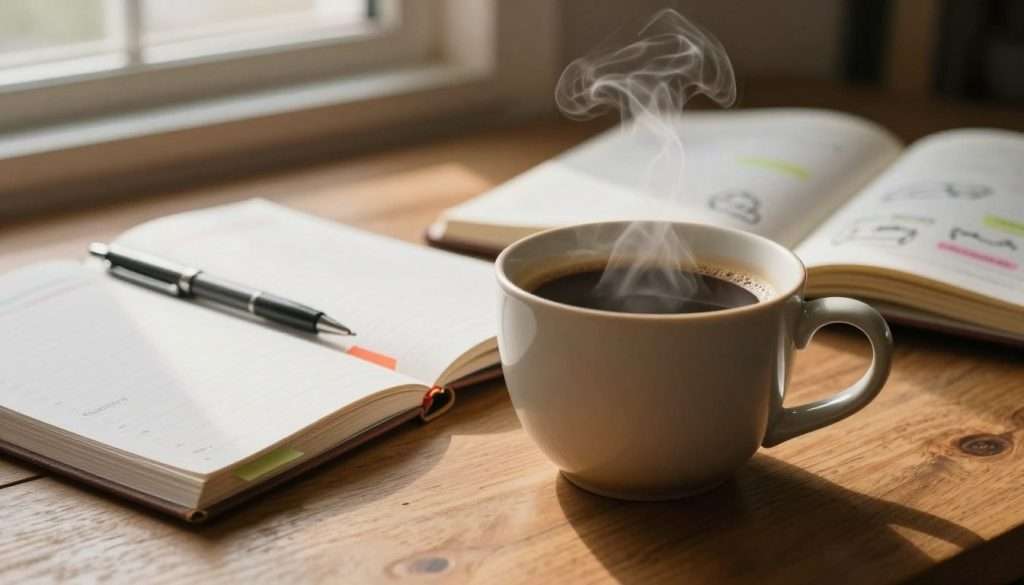
Coffee can make you feel more alert, but it can also borrow from the sleep you need later. The tradeoff depends on when you drink it and how your body responds.
Caffeine may support focus for a while, but it does not replace sleep. Check the serving and bedtime estimates before treating a cup as a harmless late-day fix.
Match caffeine timing to your bedtime
A 2023 meta-analysis of 24 studies found caffeine reduced total sleep time by 45 minutes and sleep efficiency by 7%. It also increased the time needed to fall asleep by nine minutes and waking time after sleep began by 12 minutes.
| Caffeine amount and serving | Sleep-timing estimate | What to keep in mind |
|---|---|---|
| 107 mg coffee serving | At least 8.8 hours before bed | Estimate to avoid less total sleep |
| 217.5 mg pre-workout serving | At least 13.2 hours before bed | Estimate to avoid less total sleep |
| 100 mg in a 2025 trial | Up to 4 hours before bed | Trial concluded this could be consumed |
| 400 mg in a 2025 trial | Within 12 hours of bed | One dose could harm sleep |
The 8.8-hour coffee estimate came from a meta-analysis, while a 2025 randomized trial found 100 mg could be taken up to four hours before bed. The same trial found that one 400 mg dose within 12 hours of bedtime could harm sleep.
Treat a caffeine boost as a tradeoff
Those results are not one universal cutoff. Serving size, timing, and personal sensitivity can change how caffeine affects your sleep and focus.
Coffee is only one source; some energy drinks and pre-workout products contain caffeine, too. Read the serving label so you know what you are choosing, especially when you have more than one drink in a day.
If you notice that an afternoon coffee makes bedtime harder, weigh that cost against the short lift in energy. A calmer evening may help you start tomorrow with a clearer mind.
If caffeine regularly keeps you awake, make the next study plan less dependent on it.
How Can You Protect Sleep and Find a Better Study Time?
The best long-term energy hack is protecting the sleep your next study day depends on. Build a routine that leaves room for enough rest instead of trading sleep for extra study hours.
Adults are generally advised to get 7 to 9 hours of sleep each night to help maintain daytime alertness. Enough rest makes it easier to learn and focus when you sit down to work.
Build your schedule around enough sleep
Cutting sleep to squeeze in more study can backfire. A longer night session may leave you with more time at your desk but less alertness for learning the next day.
Choose a repeatable study time that fits around sleep, classes, meals, and other duties. A realistic plan might set aside one focused session after class instead of leaving every task until late at night.
Being serious with your studies does not mean scolding yourself. Make small commitments you can keep, such as reviewing one topic after lunch on set days.
Use your own alertness pattern as a clue
Alertness often dips between 1 p.m. and 3 p.m. as part of the body’s natural daily rhythm. The dip is common, though your own pattern may not match the clock exactly.
For seven days, log your study start time, prior-night sleep, task, checked answers, and alertness. A simple note such as “biology questions, started at 10 a.m., steady focus” can show useful patterns.
Look for times when your answers are accurate and your attention lasts. Compare them with harder sessions, then shift demanding work when your schedule allows.
One week of honest notes can reveal more than a strict rule copied from someone else. Use your log to move demanding work into a more alert part of your day when your schedule allows.
What Can You Finish in a Short, Focused Study Session?
When time is tight, one checked answer is a better goal than a whole chapter skimmed in a panic. No study method can guarantee you will remember everything in one hour.
Choose one high-value topic, set a clear outcome, and test yourself. One result might be answering five exam questions on the topic or explaining one key process without notes.
If you have one hour, choose one high-value outcome
Use the first part of your study time to decide what matters most. Look at the test outline or class review sheet, then pick a topic that carries real weight.
Keep your goal specific enough to check. “Understand chemistry” is too broad; “answer questions on balancing equations and correct my errors” gives you a finish line.
If you want to know how to study in 1 hour and remember everything, start with a more honest goal: learn and check one important area. A single hour can help, but no one-hour plan can promise total recall.
If the test is tomorrow, retrieve and correct
If you have no time before an exam tomorrow, prioritize practice questions and corrected errors over rereading every page. Fast memorization still needs retrieval and checking, not hurried exposure to more notes.
Try this 35-minute rescue session:
- 2 minutes: Check your alertness and gather what you need.
- 3 minutes: Define one outcome for the session.
- 20 minutes: Retrieve answers or solve practice questions.
- 5 minutes: Check your work and correct errors.
- 5 minutes: Write a restart note for later.
This is a focused way to study for exams when you have no time, not a promise to cover every chapter. Use your mistakes to decide what to review next.
To memorize things fast for a test tomorrow, keep asking yourself questions and checking the answers. A quick glance can feel familiar without helping you recall the idea later.
Leave a restart note with the topic, the next question, and the page you need. That small cue makes it easier to resume the work later.
End by writing the first task for your next rested study session.

Conclusion
Tiredness is a cue to adjust your plan, not proof that you have failed. Use retrieval practice for a short, workable task, and choose sleep when you cannot stay alert.
Pick one small study goal today, then protect the rest your next session needs. Want to go deeper? If this article resonated with you, my free book How to Become the Smartest Student in the Classroom gives you a full system: memory techniques, study routines, and strategies that actually stick. No cost, no catch. Grab your free copy here → https://www.studyingmachine.com/free-books/.
Grab your free copy here → https://www.studyingmachine.com/free-books/.