

You spot a familiar problem on a test, but the page mixes several types. You know the steps from practice, yet you cannot tell which strategy fits. That pause can cost time and shake your confidence.
We can make study sessions better prepare you for those choices. You’ll find practical ways to organize practice, build recall, and shape a study schedule that fits what you’re studying. No method guarantees a perfect score, but thoughtful practice can help you feel more ready when problems arrive in a new order.
Key Takeaways
- Mix related topics that call for different choices.
- Learn the basics before you rotate between problem types.
- Start with two topics and a manageable study session.
- Check your recall again after time has passed.
- Adjust the mix when practice feels confusing.
That moment of uncertainty is something you can practice. First, let’s look at what interleaving means.
What Is Interleaving in Education?
Doing ten similar algebra problems in a row lets you repeat one approach; alternating algebra with related problem types makes you choose. That choice is central to interleaving learning.
Blocked practice means practicing one topic or problem type repeatedly before moving to another. Interleaving means alternating between related topics, tasks, or problem types instead of studying each in a separate block. Both patterns can happen within one lesson or across several lessons.
Useful interleaving alternates related material that calls for different choices, not random subjects.
Interleaving and blocked practice are different study patterns
With blocked practice, you might solve a set of fraction problems, then move to equations. The repeated format makes the next step easy to spot because the whole set points toward one method.
With interleaving, those problem types appear in a mixed order. You need to recognize what each one asks before choosing a method. The difference is not simply a faster or slower study method; it is the kind of decision you practice.
Mix related material, not random subjects
Useful mixes have a clear link. You might compare two ways to solve equations or practice related science concepts that lead to different answers.
Switching from a history chapter to a guitar drill and then to geometry is not automatically interleaving. Those subjects do not help you compare similar ideas. For what is interleaving in education, the key is a planned mix of connected material that asks you to tell concepts apart.
Think of the topics as neighboring paths, not distant destinations. The goal is thoughtful comparison, which helps explain why the method can support recall and problem solving.
Why Can Interleaving Improve Recall and Problem Solving?
Interleaved study can feel less fluent than repeating the same exercise. That extra pause asks you to identify a problem type, recall a method, and tell it apart from nearby concepts.
Interleaving gives you practice choosing what knowledge to use, not only repeating steps you already know. That choice can support long-term retention because you must bring the right idea to mind. Retrieval practice means recalling information without looking at the answer.
Spacing means leaving a gap between learning material and reviewing it. A later recall check can show whether you can still bring the method to mind. Mixing topics and spacing reviews can work together, but effort alone does not prove learning has happened.
| Method | What you practice | What feels easier at first |
|---|---|---|
| Blocked practice | One type at a time | Repeated problems feel smoother |
| Interleaving | Related types alternate | Choosing a method feels harder |
| Blocked practice on an exam | One type within each section | Fewer practice decisions |
| Interleaving on an exam | Mixed types across the test | Practice choosing a method |
In 2011, researchers Robert and Elizabeth Bjork described productive learning challenges as desirable difficulties. The phrase does not mean that every struggle helps. The brain benefits interleaving may offer depend on a useful task, not difficulty for its own sake.
People searching how to use interleaving to improve learning and problem solving brain often want a simple answer: make recall and choice part of practice. A harder-feeling session still needs a sensible structure, so let’s build one.
How to Use Interleaving to Improve Learning and Problem Solving
A learner who knows basic algebra and geometry can begin mixing questions from both. Start small, so the study session stays clear instead of turning into a scramble.
Rotate between two to four related topics, and make sure you know the basics first. A common starting range is 15-30 minutes per block, but treat that as flexible. Adjust it to the material and to how well you can stay focused.
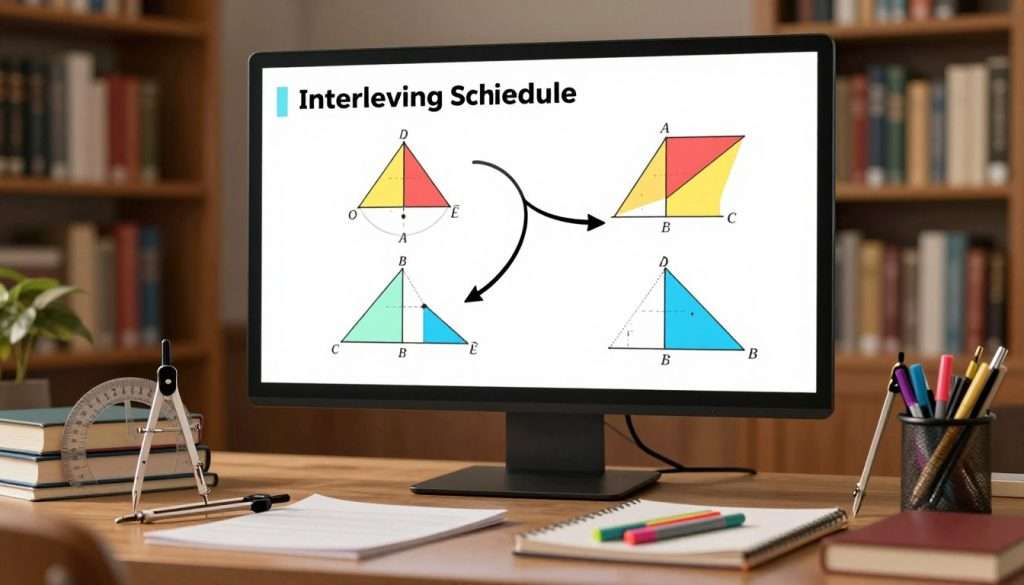
Choose related topics you already partly understand
Pick topics that connect but require different approaches. For example, you could mix solving equations with identifying geometric properties. If you still need help with each basic step, use direct practice first.
A one-slide rotation plan can make the sequence easy to see. A simple ABCABC pattern means you practice topic A, then B, then C, and repeat. For two topics, ABAB may be enough.
Build a simple rotation for each study session
Use this quick plan to set up interleaved practice:
- Choose two to four related topics.
- Make sure you know the basics of each topic.
- Gather mixed questions or tasks before you begin.
- Rotate topics in manageable blocks or after a natural unit of work.
- Check your answers and note what needs another look.
You might use 20 minutes for one topic, then switch after a small group of questions. The ABCABC rotation works well when three kinds of tasks need equal turns. If one topic needs more work, adjust the pattern rather than forcing an even split.
Finish with a quick quiz that asks you to identify which approach fits each problem. You can also make a how to use interleaving to improve learning and problem solving with a quick quiz by mixing the questions instead of naming their topic first.
A how to use interleaving to improve learning and problem solving slide can show the ABCABC pattern at a glance. Try one small rotation first; examples across real subjects can make the choices easier to picture.
What Does Interleaving Look Like in Real Study Sessions?
Imagine a math session with multiplication and division problems mixed together. For each one, you decide which operation fits before working out the answer.
Choose tasks that make you recognize the problem type before you begin the steps. That might mean mixing multiplication and division, or comparing different types of problems that use distinct methods.
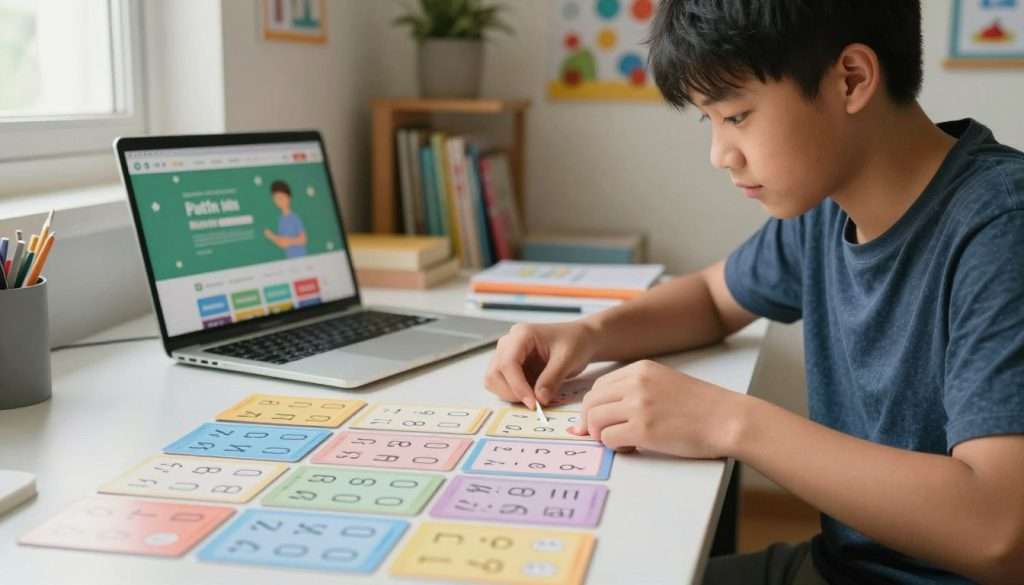
Mix problem types in math and science
In math, combine area questions with perimeter questions, or mix equation problems with fraction problems. Keep the wording clear enough that you can solve each one. Change the order, so the question itself gives you clues rather than a worksheet heading.
In science, mix related applications that call for different ideas. For example, you might sort examples that use different forms of energy, then explain which idea fits each case. A short theory review followed by an application task also makes a meaningful mix.
Alternate skills in languages, music, and movement
For language study, alternate grammar exercises with reading or writing that uses the same grammar in context. You might practice verb forms, then find them in a short passage. That switch asks you to use a concept, not just repeat a rule.
In music, rotate between a scale, a rhythm pattern, and a short piece that uses both. In a sport, practice related skills, such as passing and shooting, in a changing drill. Keep each task connected to a skill you are learning.
A useful example does not need a complicated setup. You can put a rule beside a real task, then ask yourself what changes when the task changes. These examples work best when each switch asks you to make a real distinction. Next, we’ll look at when that challenge helps and when it gets too demanding.
When Should You Use Interleaving, and When Should You Wait?
A beginner who has not learned a formula yet needs to learn it before comparing problems that use it. First build enough knowledge to follow the basic steps.
Interleaving works best when related items are different enough to require a choice. Learn the rules through clear teaching or guided practice, then mix problems that use those rules in different ways.
Start after you understand the basic steps
Blocked practice can help you learn a new skill or repeat a step until it feels familiar. Once you can do the basics, switching between related types gives you a chance to choose the right approach.
The useful middle ground is material that belongs together but is not identical. You can compare two ways to solve a problem, for instance, rather than jump between topics with no link.
Use contrast for concepts, not every memorized pair
Some material offers little to compare. A word and its translation form a simple pair, so mixing them with anatomy terms may not add useful contrast. In a 2014 study, Hausman and Kornell found no benefit from mixing vocabulary and anatomy terms in the tested learning task.
Too many topics, constant switching, or weak background knowledge can turn practice into confusion. Fewer topics may help you focus on the choice that matters. If you cannot explain what makes two approaches different, return to focused practice first.
Use one simple test: does the mix challenge you without confusing you? If the answer is yes, keep practicing; if not, simplify the rotation. Then track whether your choices and recall improve over time.
How Can You Track Progress and Adjust Your Study Schedule?
A learner may feel slower during mixed practice, then choose the right method on a later self-test. That later check can tell you more than a smooth session alone.
Test recall after a gap, because checks days or weeks later can reveal retention better than immediate practice alone. Keep a simple record so you can see which topics still need time.
A slower session does not always mean weaker learning. Check what you can recall and apply later.
Track three things as you study:
- Record which topics and problem types you practiced.
- Check whether you can explain why a method fits a problem.
- Test older material later, then give more time to topics that remain difficult.
Use review results to adjust your schedule
A study session can feel awkward when each question asks you to make a fresh choice. That feeling alone does not show that learning failed. Look at what you can explain and solve without notes, both soon after practice and after time has passed.
If the rotation leaves you confused, reduce the number of topics or return briefly to focused practice. If you can explain your choices but still miss a few questions, spend more review time on those weak spots.
Make one small adjustment after each review, such as giving a hard topic another turn. That keeps your study schedule responsive without turning it into a daily redesign. You can also build wider study habits around retrieval practice and spaced review.
Conclusion
Study can become more flexible one small rotation at a time. Interleaving works best when you know the basics and mix related material that asks you to make meaningful choices.
Choose two related topics and try one short rotation this week. Check what you can recall later, then make one change if the mix feels too easy or too confusing.
Want to go deeper? If this article resonated with you, my free book How to Become the Smartest Student in the Classroom gives you a full system: memory techniques, study routines, and strategies that actually stick. No cost, no catch. Grab your free copy here → https://www.studyingmachine.com/free-books/. Pick your first rotation and give it a try!