
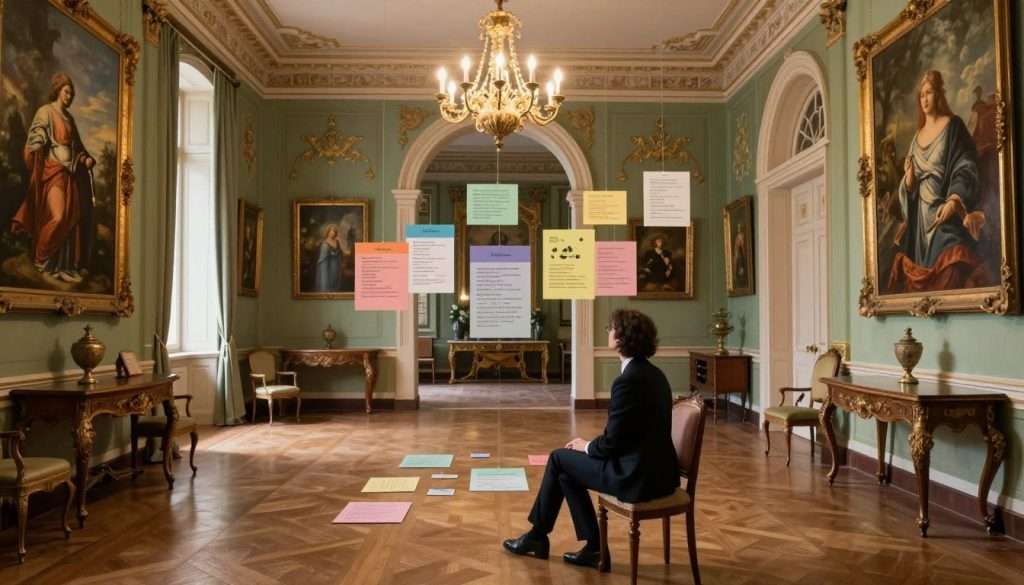
Imagine being able to recall long lists of information easily. This could be for an exam, a presentation, or just for fun. We’ve all had trouble remembering things. But, what if you could use an ancient method to boost your memory?
The Memory Palace technique uses your spatial memory to memorize lists quickly. You link the information you want to remember to specific places. This way, you can recall it with great accuracy.
We’re excited to dive into this technique with you. It’s perfect for students or anyone who loves to learn. You’ll see how easy memorization can be.
Key Takeaways
- Discover the ancient Memory Palace technique for improving memory.
- Learn how to associate information with specific locations for better recall.
- Understand how this technique can be applied to modern learning needs.
- Explore the benefits of using spatial memory for memorization.
- Find out how to make memorization a fun and effective learning experience.
The Ancient Art of Memory: Understanding the Memory Palace Technique
Imagine remembering lists and facts easily, like the ancient Greeks and Romans. They used the Memory Palace technique. This method has helped orators, scholars, and many others improve their memory for centuries.
What Is a Memory Palace and How It Works
A Memory Palace, or method of loci, uses spatial memory to remember things. You imagine a place you know well and link the info you want to remember to spots in it. This makes recalling lists, speeches, or other info much easier.
Historical Origins of the Method of Loci
The method of loci started in ancient Greece and Rome. Orators used it to remember speeches. Roman writers documented it, showing its value in education. Its use has been a key to remembering through history, proving its lasting effectiveness.
Why Spatial Memory Is Your Secret Weapon for Memorization
Spatial memory is great for remembering because it uses our natural ability to recall places. By turning info into mental pictures and linking them to places, you boost your memory. This method works well because it uses many parts of our brain, making info stick better.
| Technique | Description | Effectiveness |
|---|---|---|
| Method of Loci | Uses spatial memory to encode and recall information | High |
| Association | Links new information to something familiar | Medium |
| Repetition | Repeats information to solidify it in memory | Low |
Cicero said, “The memory is enhanced by a proper arrangement of the places and the images.” This quote shows the Memory Palace’s power. Using this technique can greatly improve your memory.
The Science Behind Spatial Memory and Why It Works
Learning how our brains handle spatial memory can help us remember better. Spatial memory is key to our brain’s ability to navigate and remember where things are.
How Your Brain Processes and Prioritizes Spatial Information
The brain uses the hippocampus to process spatial info. This area is vital for making and storing memories. Using spatial memory helps us encode and recall info better.
The Neurological Advantage of Visual-Spatial Associations
Visual-spatial associations give us a neurological advantage. They create clear mental pictures that stick in our minds. This method works because our brains remember pictures and layouts better than words or abstract ideas.
Research and Studies Supporting the Effectiveness of Memory Palaces
Many studies prove the Memory Palace technique works well. People using this method show more brain activity in areas linked to spatial memory and navigation.
| Study | Findings |
|---|---|
| Maguire et al. (2003) | London taxi drivers, known for their exceptional spatial memory, showed increased grey matter in the hippocampus. |
| Kosslyn et al. (1994) | Demonstrated that visual-spatial tasks activate the hippocampus and other areas related to spatial memory. |
By tapping into the science of spatial memory, we can improve our memory and recall.
The Memory Palace Technique: Memorize Lists Instantly Using Spatial Memory
Struggling to remember lists? The Memory Palace technique can help. It uses spatial memory to make remembering lists easy and accurate.
Core Principles That Make This Method So Effective
The Memory Palace technique links items to places in your mind. It works because it uses your brain’s spatial memory. You create vivid images and connect them to places you know well, like your home.
Key elements that make this technique effective:
- Vivid mental imagery
- Association with familiar locations
- Emotional connection to the information
When to Use This Technique in Everyday Life
This technique is useful in many situations. It’s great for remembering shopping lists, studying for exams, or recalling presentations. It’s best for remembering sequences or lists.
You can use it in daily life by:
- Memorizing grocery lists
- Preparing for exams or tests
- Recalling speeches or presentations
Types of Information Best Suited for Memory Palace Memorization
The Memory Palace technique is perfect for lists and sequences. It works well for:
- Shopping lists
- Historical dates and events
- Vocabulary words in a foreign language
- Key points for a presentation or speech
Using the Memory Palace technique can greatly improve your memory. It’s a valuable tool for school and everyday life.
Building Your First Memory Palace: Step-by-Step Guide
Creating your first Memory Palace might seem hard, but it’s easy with a clear guide. Start with a place you know well. Then, turn it into a powerful memory spot.
Step 1: Selecting a Familiar Location as Your Foundation
Choose a place you know well for your Memory Palace. It could be your home, a favorite spot, or a regular route. Pick a place you can easily picture in your mind.
For example, pick your home. Imagine the front door, living room, and kitchen. The more you know the place, the easier it is to remember.
Step 2: Mapping a Logical and Consistent Path Through Your Palace
After picking your location, create a path through it. This path should be clear and consistent. This helps you remember information better.
For instance, walk through your home in a clockwise direction. Start at the front door, then the living room, and the kitchen. Make sure to cover all areas in a logical order.
Step 3: Establishing 5-10 Clear Loci (Memory Stations)
Find specific spots in your path to store information. These spots should be easy to remember. Start with 5-10 spots.
Using your home example, spots could be the front door, the coffee table, and the kitchen sink. Spread these spots out along your path.
| Locus Number | Location Description | Information to Store |
|---|---|---|
| 1 | Front Door | First item on your list |
| 2 | Coffee Table | Second item on your list |
| 3 | Kitchen Sink | Third item on your list |
Step 4: Testing Your Route Before Adding Information
Test your route in your mind before adding information. Walk through your Memory Palace several times. This ensures you can navigate it well and that your spots are clear.
Troubleshooting Your Memory Palace Layout
If your Memory Palace is hard to navigate, don’t worry. You can change your path or spots. The goal is to have a clear, easy-to-follow map.
Common problems include spots that are too similar or a path that’s not logical. Take time to make your Memory Palace easy to navigate.
By following these steps, you’ll have a solid foundation for using the Memory Palace technique. Remember, success comes from the details and regular practice.
Transforming Information into Unforgettable Images
The secret to effective memorization is creating mental associations that are vivid and memorable. When you turn information into images that stick, you improve your recall. This is the core of the Memory Palace method, making it powerful.
Creating Vivid Mental Associations That Stick
To make mental associations stick, make them vivid. Use all your senses to bring images to life. For example, imagine each item on a list in a specific place in your Memory Palace, linked to a smell, sound, or texture.
Using all your senses is key to vivid mental associations. The more sensory details, the more memorable the image. For instance, imagine a giant carton of eggs splattering in your living room, with cracking sounds and egg smells.
Using Exaggeration, Humor, and Absurdity to Your Advantage
Exaggeration, humor, and absurdity are great for memorable images. Ridiculous or humorous associations are distinctive and easy to remember. For example, imagine a comical scenario for a historical date.
Humor is effective because it engages emotions, making memories enjoyable. So, be creative and make your images silly or absurd!
Incorporating Motion and Emotion for Stronger Memory Encoding
Motion and emotion in mental images enhance memorability. Dynamic or emotionally charged images stick better. Imagine a dramatic scene with your list items, adding action and emotion.
By associating emotions with information, you create a deeper brain connection. This makes recall easier. Memories tied to strong emotions last longer.
The SEE Principle: Senses, Emotion, and Exaggeration in Practice
The SEE principle—Senses, Emotion, and Exaggeration—is a tool for memorable encoding. By adding sensory details, emotional resonance, and exaggeration, recall improves. This principle guides creating unforgettable images.
As
“The more you practice using the SEE principle, the more natural it will become to transform information into vivid, memorable images.”
With practice, memorizing lists and information gets much better.
Practical Examples: Memorizing Different Types of Lists
Let’s explore how the Memory Palace technique works for various lists. It’s useful in many real-life situations. This makes remembering information easier.
Example 1: Memorizing a 15-Item Shopping List in Minutes
Imagine you’re about to go grocery shopping. You need to remember 15 items. The Memory Palace technique helps by linking each item to a spot in your memory palace.
You might picture a giant carton of eggs at your door. Then, a bunch of bananas on your couch. This way, you can easily recall your shopping list, even if it’s long.
Example 2: Learning 20 Foreign Language Vocabulary Words
Learning a new language can be tough. But the Memory Palace technique makes it easier. It helps you remember lots of words quickly by linking them to their meanings.
For example, you could picture a word’s meaning at a spot in your memory palace. This makes it simpler to remember during conversations.
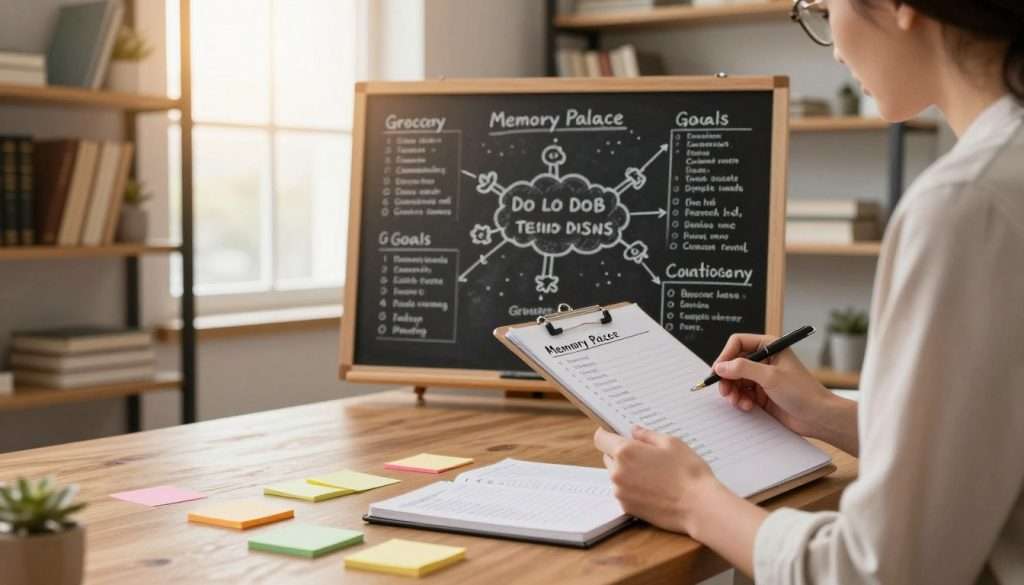
Example 3: Remembering 10 Key Points for a Presentation
Public speaking can be scary, but the Memory Palace technique helps. It lets you organize and recall your ideas easily. You just link each point to a location.
This way, you can confidently give your presentation without notes.
Example 4: Memorizing Historical Dates and Events in Sequence
History lovers and students can also use the Memory Palace technique. It helps you remember dates and events in order. You create a timeline in your memory palace.
This way, you can easily recall dates and events in the right order.
These examples show how the Memory Palace technique is versatile. It works for shopping, learning languages, or preparing presentations. This technique helps you achieve your goals with confidence.
Practicing and Improving Your Memory Palace Skills
Regular practice can greatly improve your memory with the Memory Palace technique. As you get better, your ability to remember things will grow. You’ll notice a big difference in your spatial memory and recalling information.
Daily Exercises to Strengthen Your Spatial Memory
Daily exercises are key to mastering the Memory Palace technique. Here are some exercises to try:
- Every day, take a few minutes to picture a place you know well, like your home or school. Try to remember as many details as you can.
- Practice moving through your Memory Palace in your mind. Imagine going from one spot to the next.
- When you visit new places, focus on their layout and unique features. This helps improve your spatial memory.
Tracking Your Progress: From Beginner to Memory Master
It’s important to track your progress. This shows how far you’ve come and what you need to work on. Keep a journal or log to record your experiences. Note what works and what doesn’t. This will help you improve your technique over time.
Expanding Your Memory Capacity Over Time
As you get better at the Memory Palace technique, you can remember more. You can add more loci or create new Memory Palaces. This lets you memorize longer lists and more complex information.
Tips for expansion include:
- Slowly increase the number of items you try to memorize each day.
- Create new Memory Palaces for different types of information.
- Practice recalling information from multiple Memory Palaces in one session.
Maintaining Long-Term Recall with Spaced Repetition
Spaced repetition is a powerful tool for keeping memories long-term. Reviewing material at longer intervals helps solidify it in your memory. Make spaced repetition a part of your practice to keep your memories sharp and easy to recall.
For example, review a list once a day for a week, then once a week for a month, and once a month to keep it in your long-term memory.
Overcoming Common Challenges and Mistakes
Starting with the Memory Palace technique can bring up some hurdles. But, with the right approach, you can overcome them. Let’s look at some common problems and how to solve them.
When Images Blend Together: Creating Distinct Memory Stations
One big challenge is when images mix up, making it hard to remember things. To fix this, make sure your Memory Palace has clear, separate stations.
- Choose vivid, unique images that stick in your mind.
- Make sure each station is different from the others.
- Regularly walk through your Memory Palace to keep the images strong.
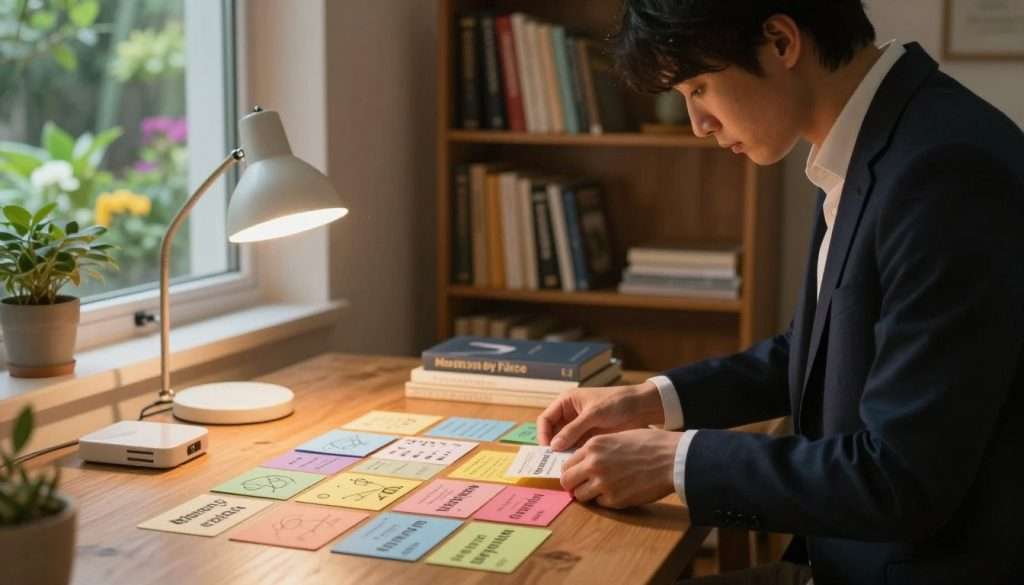
Techniques for Memorizing Abstract Concepts and Ideas
It can be hard to remember abstract ideas. But, there are ways to make it easier. Try linking abstract ideas to things you can touch or see.
For example:
- Think of “freedom” as a bird flying.
- Picture “justice” as a scale or a judge’s gavel.
Refreshing and Maintaining Your Memory Palaces
To keep your Memory Palace working well, refresh and maintain it often. Go back to your stations and update them when needed.
Troubleshooting Memory Retrieval Issues and Forgotten Items
Having trouble getting information from your Memory Palace? Go back to your stations and make the images stronger. Ask yourself:
- Are the images clear and memorable?
- Is the path through the Memory Palace easy to follow?
- Have I practiced recalling the information lately?
By tackling these common problems and using the strategies mentioned, you can beat obstacles. This will help you keep improving your memory skills.
Conclusion: Unlocking Your Mind’s Unlimited Potential
The memory palace method is a powerful tool for memorization. It uses your brain’s ability to process spatial information. This way, you can achieve amazing feats of memory.
Memory champions have used this method to memorize lots of information. They create vivid mental associations and use humor and absurdity. This helps unlock your mind’s full potential.
As you practice and get better at the memory palace method, you’ll see big improvements. You’ll be able to memorize and recall information better. You’ll feel more confident when facing challenges.
We encourage you to keep exploring the memory palace method. With regular practice, you’ll be amazed at what your mind can do. You’ll be unlocking your full potential.