
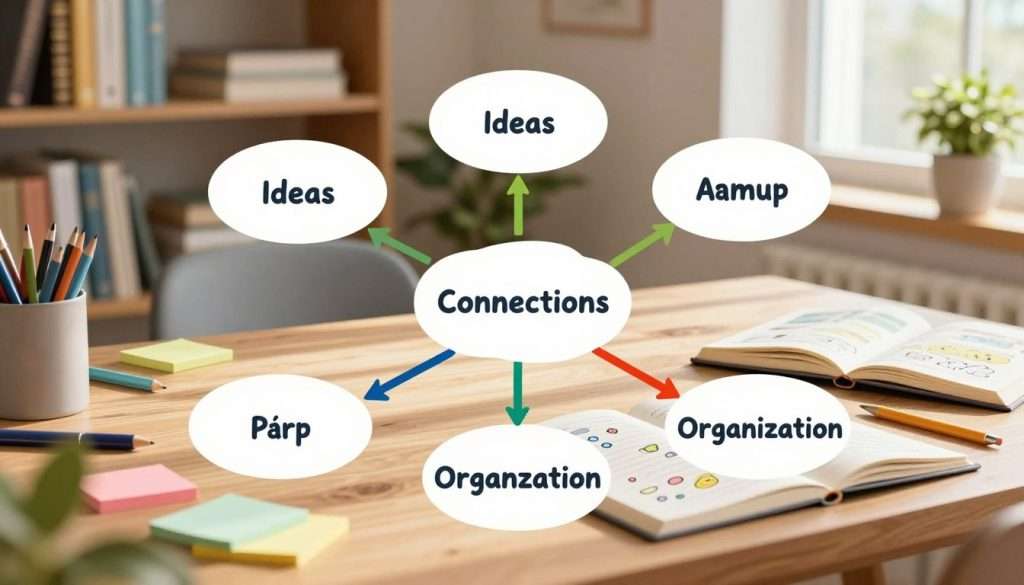
Have you ever stared at your notebook and felt you were reading a foreign language? Many students struggle to turn messy, linear notes into clear ideas. Thankfully, mind mapping for beginners offers a creative way to organize complex ideas without stress.
Instead of endless text, use central themes, colorful branches, and simple sketches to connect concepts. This method makes studying a fun, visual experience instead of a boring task. It is one of our favorite academic success tips because it helps your brain recall information faster during exams.
If this article resonates with you, we have something special to help you improve. Our free book, How to Become the Smartest Student in the Classroom, offers memory techniques and study routines that stick. There is no cost and no catch—just grab your free copy here to start mastering your learning process today!
Key Takeaways
- Mind mapping replaces long, linear notes with clear, visual diagrams.
- Using colors and images helps your brain store information more effectively.
- This method simplifies complex topics by breaking them into manageable branches.
- Visual study tools are essential for improving long-term memory and recall.
- You can transform your study routine by adopting these simple, creative strategies.
Mind Mapping for Beginners: Visualize Your Way to Better Grades
Imagine turning your chaotic class notes into a clear, colorful map of your knowledge. Many students struggle because traditional methods do not match how our brains process information. With mind mapping for beginners, you can change how you study and understand complex topics.
What a Mind Map Is and How It Organizes Information
A mind map is a diagram that displays information visually. You place a central topic in the middle and draw branches for related ideas. As branches move from the center, ideas become more specific, creating a logical hierarchy that is easy to follow.
This method became popular in the 1970s through Tony Buzan, who saw that brains do not think in straight lines. Instead, our minds use associations and connections. When you organize notes this way, you build a structure that mirrors your thought process.
Why Visual Learning Techniques Support Understanding and Recall
Our brains remember images and spatial layouts better than plain text. Using visual learning techniques engages both brain sides and helps you grasp difficult concepts faster. This is not about making notes look pretty; it makes them memorable.
“The mind map is the external mirror of your own radiant thinking facilitated by a powerful graphic process.”
Colors, symbols, and branches create a map your brain can navigate during an exam. My free book How to Become the Smartest Student in the Classroom gives you memory techniques, study routines, and strategies that stick. No cost, no catch. Grab your free copy here.
How Mind Maps Differ From Linear Notes and Outlines
Most students learn to take notes in a linear, top-to-bottom format. Although common, this format often hides relationships between ideas. Linear notes make you read everything to find connections, while a mind map shows the big picture clearly.
- Linear Notes: Fixed sequence, hard to update, hides connections.
- Mind Maps: Radial structure, flexible, highlights relationships.
- Visual Learning Techniques: Boosts retention through spatial awareness.
When you use these visual learning techniques, you stop recording information passively. You become an active architect of your learning. This shift is what mind mapping for beginners aims to achieve, helping you move from rote memorization to true understanding.
The Learning Benefits of Building a Mind Map
Building a mind map gives your brain a roadmap through dense information. Rather than stare at endless text, you create a visual landscape for complex subjects. These visual learning techniques show the big picture while tracking small exam details.
Connecting Big Ideas With Supporting Details
You place the main concept at the center, then branch toward related facts. This layout makes you sort information in a logical way. You can attach definitions, examples, and questions to branches; 80% of sixth-grade science students found it helpful in class.
Using Spatial Relationships to Strengthen Memory
Your brain remembers patterns and physical space. You may picture where a fact sat on the spatial map when you need it later. This is one of the most effective study methods because your mind naturally stores information.
Turning Passive Reading Into Active Study
Reading a textbook cover-to-cover can make you zone out. Building a map makes you select, arrange, and connect what you read. This active process turns a boring task into a challenge: you become an architect, not a spectator, of your knowledge.
Supporting Creative Thinking and Problem Solving
Mind maps are powerful creative thinking tools for difficult problems, brainstorming solutions, and missed connections. Ideas together reveal missed connections; this free book, How to Become the Smartest Student in the Classroom, offers memory techniques, routines, and lasting strategies. No cost, no catch; grab your free copy here.
| Feature | Linear Notes | Mind Maps |
|---|---|---|
| Structure | Sequential/List | Radiant/Branching |
| Engagement | Passive | Active |
| Memory Aid | Low | High |
| Flexibility | Rigid | Dynamic |
Essential Elements of an Effective Student Mind Map
To stop staring at blank pages, learn how to build a clear mind map. A good map needs more than attractive design; it needs a logical structure your brain can follow. This approach supports memory improvement techniques and turns study time into active learning.
The Central Topic and Clear Branch Structure
Every strong map starts with one clear idea in the page’s center. This central topic anchors everything you add. From there, draw primary branches that show your subject’s main themes.
Think of these branches as the skeleton of your knowledge. Distinct branches help your brain sort information before you explore details. This structure makes relationships between concepts easier to see.
Short Keywords Instead of Overloaded Sentences
Many students write long, clunky sentences on their branches. Instead, use short keywords or brief phrases. This helps you reduce complex ideas to their most important parts.
Fewer words give your brain more space to process meaning. Your map also becomes faster to scan during a quick review. The goal is to trigger memory, not rewrite the entire textbook.
Colors, Symbols, Images, and Visual Cues
Your brain loves visuals, so colors and symbols are powerful memory improvement techniques. Give each main branch a different color to group related information naturally. Add simple icons or sketches for abstract concepts.
These cues act as mental hooks. A color or small drawing can help your brain recall related facts. This mix of words and images creates a multi-sensory experience that helps information stay much longer than plain text.
Hierarchy, Spacing, and Consistent Organization
A cluttered map can confuse you. Use hierarchy by placing key ideas near the center and supporting details farther out. This layout matches how your brain naturally organizes information.
Leave plenty of white space so your ideas do not feel crowded. A clean map is easier to review when you feel stressed or rushed.
If this article helps, my free book How to Become the Smartest Student in the Classroom offers a full system. It includes memory techniques, study routines, and strategies that actually stick. It costs nothing, has no catch, and you can grab your free copy here.
How to Create Your First Mind Map From Class Notes
Turning raw information into a clear visual format is one of the most effective study methods available. You do not need to be an artist to turn scribbled lecture notes into a clear map. With a simple, repeatable process, you can make study sessions more productive.
Choose One Focused Topic or Learning Objective
Before drawing, identify your study session’s specific goal. Mapping an entire textbook chapter can often cause confusion. Instead, choose one core concept or lecture topic to keep your map focused and manageable.
Place the Main Concept at the Center
Write your main topic in the middle of a blank page. Use a landscape layout to give your ideas more room to grow. This central anchor is the heart of your map, so every detail connects to the big picture.
Add Major Ideas as Primary Branches
Think of your notes’ main themes or sub-topics as a tree’s thick branches. Draw lines that radiate from the central concept. Keep labels short and punchy so your brain can process the hierarchy quickly.
Expand Each Branch With Facts, Examples, and Questions
Now add details that make these effective study methods work. Attach smaller twigs to primary branches for specific facts, supporting examples, or lingering questions. This detail moves you beyond rote memorization toward deeper understanding.
Review and Refine the Map After Finishing
When your map is complete, step back and study its connections. You may need to move branches or add a color-coded symbol for key terms. Refining your work makes the map useful for future review, not just a one-time doodle.
If this article resonated with you, my free book How to Become the Smartest Student in the Classroom gives you a full system. It includes memory techniques, study routines, and strategies that actually stick. There is no cost and no catch. Grab your free copy here.
Mind Mapping Strategies for Different Subjects
Let’s explore ways to shape visual notes around each subject’s unique structure. With various creative thinking tools, you can change how you process complex information in every classroom.
Using Mind Maps to Study Biology and Other Sciences
Science focuses on systems and processes. In biology, try a flow-chart structure to map life cycles or chemical reactions.
This helps you see each sequence clearly. A logical path makes it easier to remember how one stage leads to the next.
Mapping Themes, Characters, and Evidence in English Literature
Literature connects abstract ideas to concrete text. Use a central theme as your core, with branches reaching to characters and supporting evidence.
This method keeps essays organized and protects your main argument. It turns messy notes into a clear, persuasive map.
Organizing Formulas and Problem-Solving Methods in Mathematics
Math can feel overwhelming, but a brace map breaks formulas into their parts. Group different problem-solving methods under one main concept.
This lets you see how a formula connects with the steps needed to solve a problem. It is one of the most effective creative thinking tools for mastering tricky equations.
Connecting Events, Causes, and Consequences in History
History is a giant web of cause and effect. Use a timeline-style map to link major events with their causes and long-term consequences.
Seeing the big picture helps you understand the “why” behind the dates. It makes the past feel like a living story, not a list of facts.
Structuring Vocabulary, Grammar, and Conversations in Language Classes
Learning a new language is easier when you group words by category or context. Create branches for verb conjugations, common phrases, and thematic vocabulary lists.
This visual organization helps you recall words faster during conversations.
If this article resonated with you, my free book How to Become the Smartest Student in the Classroom is free. It includes memory techniques, study routines, and strategies that actually stick. There is no cost or catch. Grab your free copy here → https://www.studyingmachine.com/free-books/.
Using Mind Maps to Prepare for Tests and Assignments
Turn massive textbook chapters into simple, one-page maps to improve your grades. Instead of reading endless pages, reduce core concepts to one visual snapshot. These effective study methods show the big picture without minor details.

Condensing a Chapter Into a One-Page Review Map
Focus on meaningful connections instead of copying every sentence. Place the main chapter theme in the center of your page. Draw branches for primary topics, then add essential keywords or dates.
Finding Knowledge Gaps Before an Exam
If you stare at a branch and struggle to remember details, you found a knowledge gap. That struggle reveals a clear next step. Spot these weak areas early, then review them; this is one of the best academic success tips.
Practicing Retrieval With Blank or Partially Completed Maps
Create a map with only the main branches filled in. Leave supporting details blank, then fill them from memory. This active recall method works better than rereading notes, making it one of the most reliable study habits for students.
Planning Essays, Presentations, and Long-Term Projects
Mind maps help with more than exams; they organize thoughts for major projects. Use one to outline your essay, so arguments flow logically from one point to the next. This visual approach shows the entire scope of your work before you write one paragraph.
| Feature | Traditional Notes | Mind Mapping |
|---|---|---|
| Review Speed | Slow and linear | Fast and visual |
| Memory Recall | Passive reading | Active retrieval |
| Organization | List-based | Hierarchical |
| Focus | Detail-heavy | Concept-driven |
My free book How to Become the Smartest Student in the Classroom gives you a complete system. It covers memory techniques, study routines, and strategies that stick. It has no cost or catch; grab your free copy here → https://www.studyingmachine.com/free-books/.
Cognitive Mapping Strategies for Stronger Memory
Building a rock-solid memory is not about working harder; it requires smarter cognitive mapping strategies. Visualizing information gives your brain a map to follow, making facts easier to retrieve later.
Linking New Material to Prior Knowledge
Your brain connects new ideas to things you already know. When you start a topic, link the new concept to something familiar. This anchoring process makes information feel familiar and easier to understand.
Adding Personal Examples and Memorable Associations
Abstract facts can be hard to remember, but personal stories stay with you. Attach a funny memory or real-life example to your map’s branches. These memory improvement techniques make dry data meaningful to you.
Combining Mind Maps With Spaced Repetition
Do not draw your map once and forget it. Review your maps at increasing intervals to fight natural forgetting. This pattern keeps information fresh without hours of cramming before a test.
Using Active Recall Instead of Simply Rereading
Rereading notes feels useful, but it rarely works well. Instead, study your central topic and redraw its branches from memory. If you get stuck, that is a great sign—it shows where your knowledge gaps are.
Reviewing Maps at Strategic Study Intervals
Consistency helps with long-term retention. Check your maps at these times to strengthen what you learned:
- Immediately after finishing the initial map.
- One day later to reinforce the core connections.
- One week later to ensure the information has moved into long-term storage.
If this article resonated with you, my free book How to Become the Smartest Student in the Classroom offers a full system. It includes memory techniques, study routines, and strategies that stick. There is no cost or catch. Grab your free copy here.
Paper or Digital Mind Mapping Software: Choosing the Right Method
Choosing the right method can change how you process information. You may prefer paper’s hands-on feel or the sleek efficiency of mind mapping software. Both methods can improve grades, but each suits different study goals.

When Hand-Drawn Maps Improve Focus and Recall
There is something magical about putting pen to paper. Drawing by hand engages your brain physically and helps cement ideas in memory. It also blocks notifications and web browsing, creating deep, uninterrupted focus.
“The act of writing by hand is a powerful tool for cognitive retention, forcing the brain to slow down and synthesize information more effectively.”
When Digital Tools Make Editing and Collaboration Easier
Your notes may need to grow and change. With mind mapping software, you can move branches, add links, and attach files without redrawing the page. It helps group projects because you can share ideas with classmates in real-time.
Useful Features to Look For in Mind Mapping Software
If you choose digital tools, look for a clean interface and simple controls. Useful features include drag-and-drop branches, cloud syncing across devices, and image or PDF exports. These tools can make study sessions much smoother.
Examples of Digital Tools Such as MindMeister, Coggle, and XMind
Several useful options can help you get started. MindMeister supports cloud-based collaboration, while Coggle has a simple, colorful interface that is easy to learn. For complex projects, XMind offers advanced features and handles large maps with ease.
Keeping Technology From Becoming a Study Distraction
It is easy to get distracted by the features in your mind mapping software. Remember, the goal is learning, not choosing the perfect font or icon. Focus on your content, and use technology to support thinking instead of procrastination.
If this article helped, my free book How to Become the Smartest Student in the Classroom gives you a full system. It covers memory techniques, study routines, and strategies that actually stick. It costs nothing and has no catch. Grab your free copy here.
Common Mind Mapping Mistakes and How to Fix Them
Mind mapping is powerful, but it is easy to weaken your own work. When you use visual learning techniques, you may want to place every detail on the page. Yet the goal is clarity, not empty space.
Writing Complete Paragraphs on Every Branch
Writing full sentences or paragraphs on branches is a common trap. This makes your brain read instead of visualize. Use short keywords or phrases; explain the idea aloud instead of writing it all.
Adding Too Many Colors, Fonts, or Decorations
Using every highlighter and sticker can be fun, but too much flair creates visual noise. When your map looks like a rainbow explosion, your brain struggles to find the core information. Use color sparingly to group related ideas, not merely to decorate.
Creating Maps That Are Too Broad to Review
Trying to fit an entire semester of history on one sheet creates stress. A broad map can hide the connections between specific facts. Use these visual learning techniques to break topics into smaller maps, each focused on one learning goal.
Copying Notes Without Making Meaningful Connections
Copying lecture notes into a map wastes time. You must process information actively to remember it. Ask how branches relate, then use connecting lines to show those relationships clearly.
Failing to Update Maps as Understanding Improves
Your first draft is rarely your best work. As you study, you may find new details or move ideas into better categories. Always revisit your maps and refine them; this repeated process strengthens your understanding.
| Common Mistake | The Better Approach | Why It Works |
|---|---|---|
| Writing full paragraphs | Use single keywords | Boosts active recall |
| Over-decorating | Use color-coding | Improves visual hierarchy |
| Copying raw notes | Synthesize concepts | Deepens understanding |
| Static, finished maps | Iterative updates | Refines mental models |
If this resonated, my free book How to Become the Smartest Student in the Classroom gives you a full system. It covers visual learning techniques, memory techniques, study routines, and strategies that stick. It is free, with no catch; grab your free copy here → https://www.studyingmachine.com/free-books/.
Building Mind Mapping Into Better Study Habits
Let’s turn mind mapping from a one-time trick into a powerful, lasting habit. By using these effective study methods, you can see studying as a creative process instead of a chore.
Using Maps During a Weekly Study Routine
Set aside a specific time each week to review your notes and build a summary map. This consistent practice helps you consolidate information before it fades from your memory.
Think of your weekly map as a snapshot of your progress. It keeps your study habits for students focused and prevents last-minute panic before a big exam.
Combining Mind Maps With Flashcards, Practice Tests, and Summaries
You do not have to use mind maps alone. They work best with other active learning tools to create a complete system.
- Use your map to identify key concepts, then create flashcards for those specific terms.
- Take a practice test, then use your map to fill in the gaps where you struggled.
- Write a short summary after finishing a map to solidify your understanding in your own words.
Adjusting the Method to Personal Learning Preferences
Your study style is unique, so adjust the process as needed. If you are a visual learner, add more icons and colors to your branches.
If you prefer logic, focus on the hierarchical structure and clear, numbered lists. Make the map work for you instead of following rigid rules.
Measuring Study Skills Improvement Through Recall and Performance
How do you know if your hard work is paying off? Track your study skills improvement by noting how much you recall without your notes.
If you can explain complex topics to friends easily, your methods are working. Performance on quizzes and assignments will follow as your understanding deepens.
Want to Go Deeper With a Complete Student Success System?
Explain that the free book How to Become the Smartest Student in the Classroom includes memory techniques, study routines, and strategies that actually stick.
If this article resonated with you, my free book How to Become the Smartest Student in the Classroom gives you a complete system. It covers memory techniques, study routines, and strategies that actually stick. There is no cost and no catch.
Invite readers to get the free copy with the call to action: “Grab your free copy here → https://www.studyingmachine.com/free-books/”
Grab your free copy here → https://www.studyingmachine.com/free-books/
Conclusion
You now have the tools to turn complex information into clear visual maps. Focus on a central idea, use short keywords, and add bright visual cues. Studying then feels less like a chore and more like a creative project. These habits drive real study skills improvement by keeping your brain engaged and active.
Remember that your maps are living documents. Start with one topic, build meaningful connections, and refine your work as understanding grows. Consistent practice with these academic success tips will help you retain information longer and recall it easily during high-pressure exams.
If this approach resonates, my free book How to Become the Smartest Student in the Classroom offers a full system. It includes memory techniques, study routines, and strategies that actually stick.
There is no cost and no catch. Grab your free copy here → https://www.studyingmachine.com/free-books/.
Your path to better grades starts with the very next page you map out. Take control of your learning today, and watch your confidence soar.